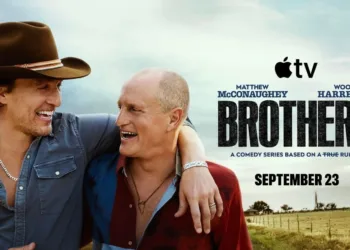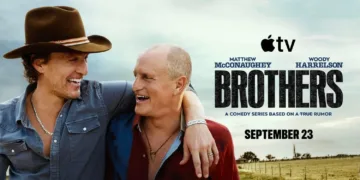




















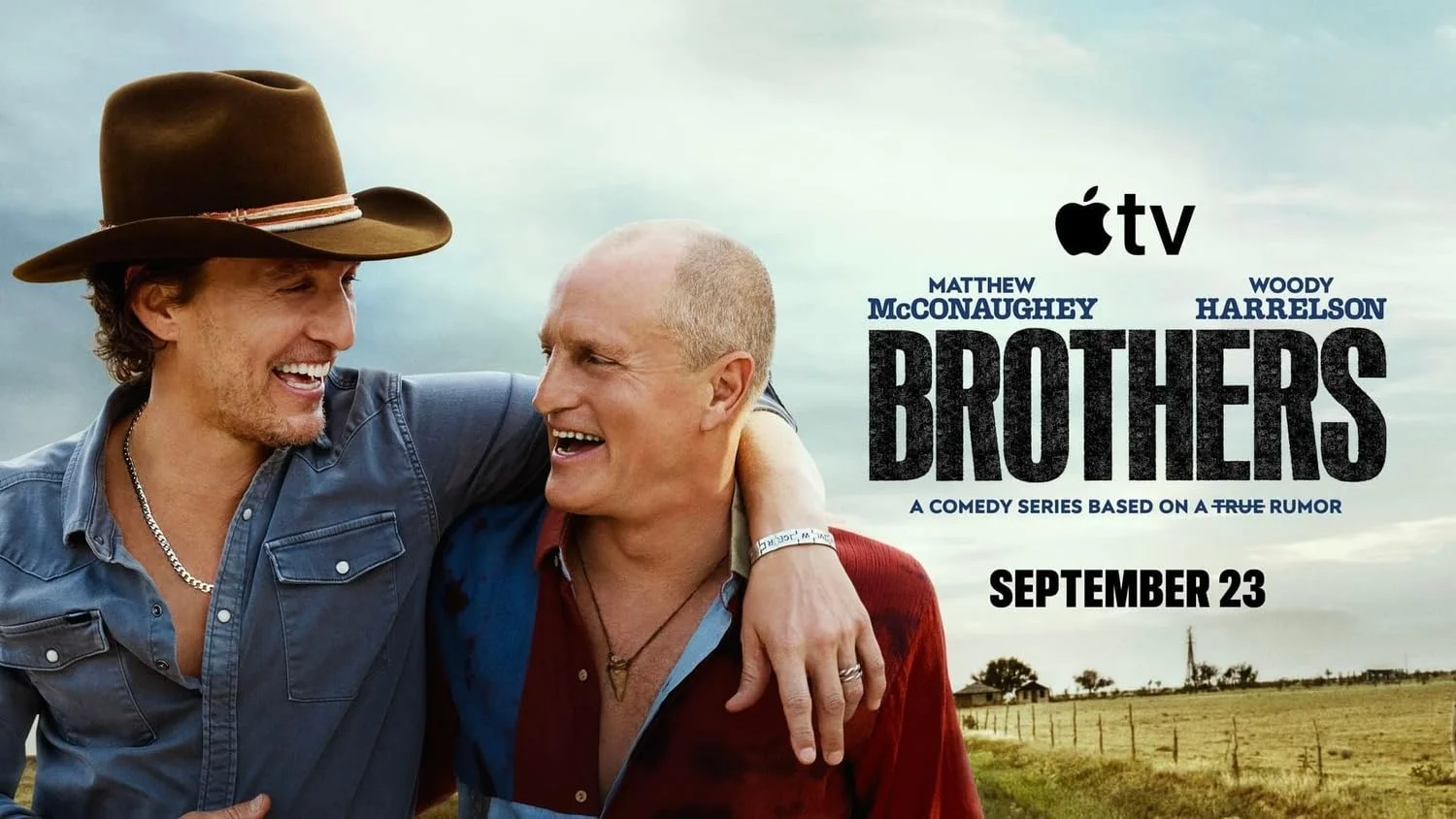

A show about Woody Harrelson discovering that Matthew McConaughey might be his half-brother should not have trouble deciding what its story is. That premise comes preloaded with friendship, family history, celebrity mythology, and a question capable of disturbing everything the two men think they know about each other. Brothers has all of that sitting in its lap. Then it spends much of its eight-episode season finding other things to do.
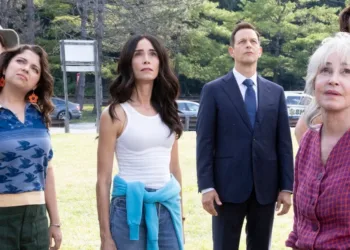
Woody arrives at Matthew’s Texas ranch with his wife Joy and daughters Olive and Kai after Olive’s engagement collapses. Matthew has his own problem, struggling to write a speech honoring his late father, Big Mac. Then Ma Mac, played by Holland Taylor with the dangerous cheerfulness of someone who has held onto a secret long enough to find it funny, tells Woody that she once knew his father rather well.
Suddenly Matthew’s parentage is uncertain. Woody keeps the revelation from him and quietly starts looking for answers. It is an excellent sitcom complication because it converts an already famous friendship into a structural problem. Every disagreement between the men can now carry a second meaning. Every memory of Big Mac can become unstable. Yet that question keeps slipping behind the furniture.
The season gives its attention to Matthew deciding to run for governor of Texas, Olive recovering from her failed engagement, two families learning to tolerate each other, and assorted domestic plots built around the reliable sitcom principle that grown men can ruin a perfectly normal week through avoidable stupidity. Matthew and Woody forget Valentine’s Day gifts. They chaperone a school dance.
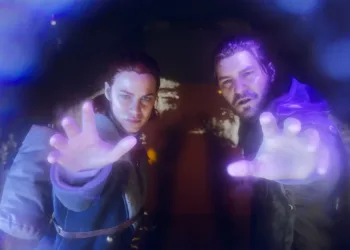
Matthew rides a bull. Woody brings home a dog. The pair disguise themselves as musicians to test their talent without celebrity getting in the way. None of these premises is automatically fatal. Sitcoms have survived for decades on considerably less. The problem is accumulation. These episodes rarely place new pressure on the larger story, so conflict repeatedly rises, resolves, and returns everyone to roughly the same position.
That rhythm becomes especially noticeable because the show already possesses several stronger sources of escalation. Matthew’s gubernatorial campaign could have turned his friendship with Woody into a weekly stress test. One man wants public legitimacy while the other proudly identifies as an anarchist.
Lisa Gilroy’s campaign manager sees the comic potential immediately, treating Matthew’s folksy celebrity persona as an asset that needs professional supervision. The campaign also exposes how insulated both stars are from ordinary life. Yet the political storyline often sits beside the family comedy instead of reorganizing it. The show keeps adding engines when one of them needs to take control.
The character design has a similar problem. Early episodes establish a clean comic arrangement: Matthew is the comparatively orderly Texan host and Woody is the roaming hippie agent of chaos who arrives uninvited in a psychedelic bus. Their public images do much of the setup, allowing Harrelson to turn his flaky beliefs and loose social boundaries into actual comic behavior.
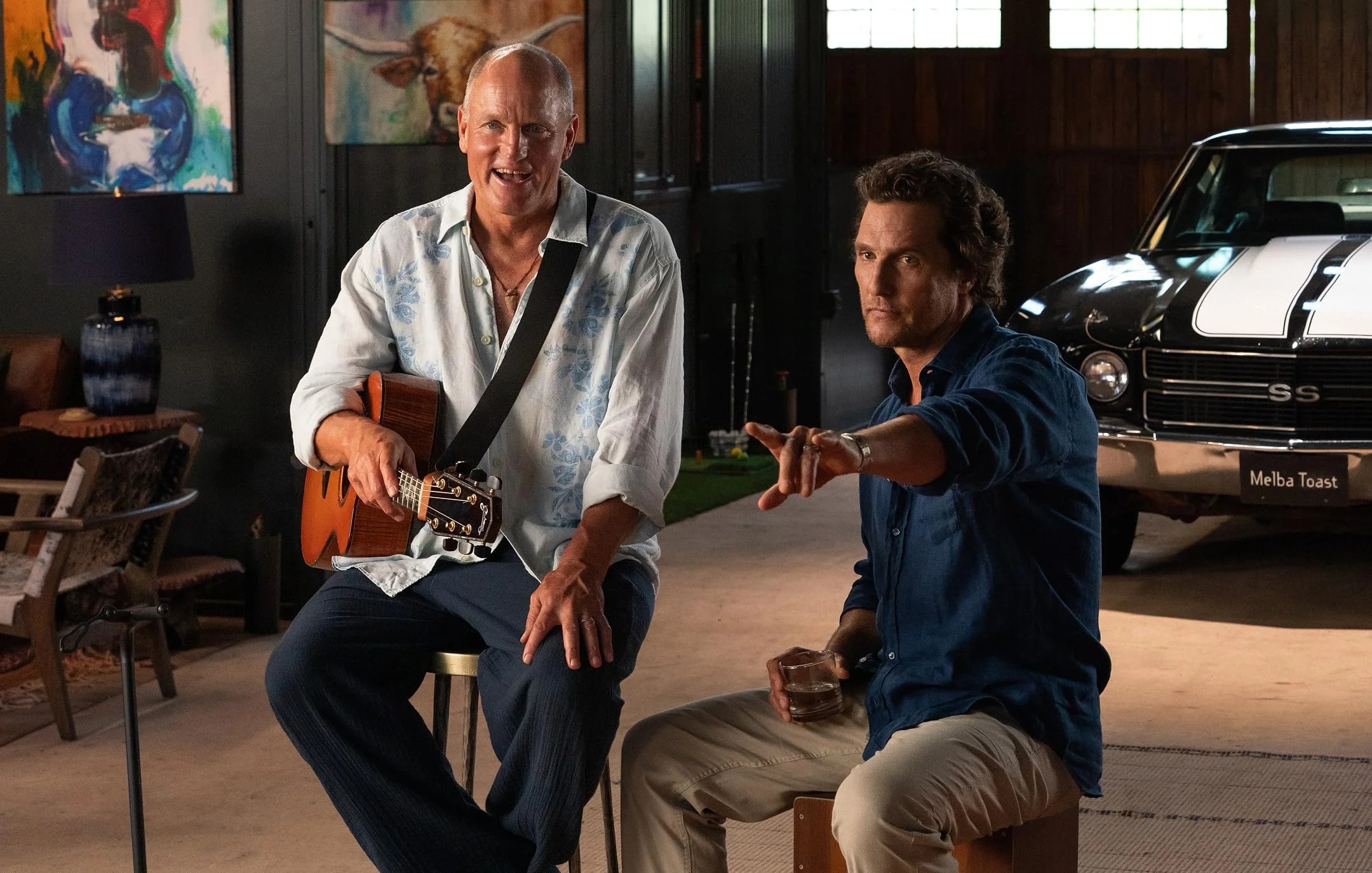
McConaughey plays the straighter role and gives the friendship some resistance. Then the season gradually shifts until both men are variations on the same clueless celebrity. That opens space for jokes about fame, but it weakens the contrast that initially makes the pairing function.
Harrelson benefits most from the looseness. He throws himself into fictional Woody’s terrible instincts, environmental convictions, casual selfishness, and inability to detect when everyone else would like him to stop talking. There are flashes of the effortless sitcom performer who spent years making Woody Boyd funny before movies trained audiences to expect danger or eccentricity from him. McConaughey has a quieter assignment.
His best material comes when Matthew’s reverence for his late father collides with the uncertainty Woody is hiding from him. Those scenes briefly suggest the version of Brothers that might have fused comedy and character instead of scheduling them in alternating blocks.
Their chemistry still carries plenty of individual scenes. A crowded rideshare with young fans works because both stars lose control of the room. The coffeehouse disguise plot becomes funnier once the absurdity of two famous actors trying to prove their artistic legitimacy overtakes the thin setup.
Their friendship is visible even when the writing is running on fumes, and both men are willing to make their screen personas look ridiculous. The limitation is that self-mockery rarely develops into sharper characterization. References to their movies, books, politics, and public reputations frequently remind us who these men are outside the series without teaching us much about who these fictional versions are becoming inside it.
The supporting cast often fares better because its members have cleaner functions. Taylor’s Ma Mac can turn a family secret into a punchline without draining it of consequence. Gilroy’s campaign manager works because she is allowed to tell Matthew and Woody what the series itself sometimes hesitates to admit: their fame has distorted their understanding of normal behavior.
Highdee Kuan gives Olive enough hurt beneath the broken-engagement plot to create one of Woody’s few sustained emotional responsibilities. His attempts to repair their relationship carry weight because the story asks him to remain accountable after the joke has finished.
The frustrating part is how professionally assembled all of this is. The Texas locations give the series warmth and space, the photography avoids the muddy visual anonymity that drags down plenty of streaming comedy, and the production has experienced sitcom hands behind it. That experience surfaces in small places: a quick exchange between Woody and two men collecting an old debt from his father, or a visual gag built around Matthew’s absurd grooming routine. The craft rarely looks uncertain even when the storytelling does.
That distinction explains why Brothers remains easy to watch while struggling to build momentum. Its strongest question could have reshaped the friendship, the campaign, Matthew’s relationship with his father, and Woody’s uneasy inheritance from his own. Instead, the season protects most of its pieces from lasting damage. The families quarrel, the friends collide, lessons are learned, and the machinery resets. By the time the paternity story asks for emotional weight, the series has spent too long treating consequence as something to clean up before the next episode.
Brothers premiered globally on Apple TV+ on September 23, 2026. The comedy series chronicles a fictionalized version of Matthew McConaughey and Woody Harrelson, whose strong friendship is tested when their combined families attempt to live together on a Texas ranch.
Where to Watch Brothers Online


Full Credits
Title: Brothers
Distributor: Apple TV+
Release date: September 23, 2026
Rating: TV-MA
Running time: 28–33 minutes per episode
Director: Trent O’Donnell, Jason Winer, Erin O’Malley
Writers: Matthew McConaughey, Woody Harrelson, David West Read, Lee Eisenberg, Mike Jones, Nick Sherman, Brett Baer, David Finkel, Danya Jimenez, Hannah McMechan, Alex Cuthbertson, Matt Fusfeld
Producers and Executive Producers: David West Read, Matthew McConaughey, Woody Harrelson, Lee Eisenberg, Natalie Sandy, Trish Hofmann, Bill Bost, David Finkel, Brett Baer, Jason Winer
Cast: Matthew McConaughey, Woody Harrelson, Holland Taylor, Natalie Martinez, Brittany Ishibashi, Highdee Kuan, Oona Yaffe, Nolan Almeida
The Review
Brothers
Brothers has the right stars, a strong central complication, and enough sitcom craft to remain pleasant company. Its problem is structural. The possible half-brother revelation should organize the season, yet it repeatedly gives way to campaign detours and disposable domestic plots that reset before they can change anyone. Woody Harrelson gets the better comic material, Matthew McConaughey handles the quieter dramatic beats well, and Holland Taylor and Lisa Gilroy sharpen nearly every scene they enter. There is a better series hiding inside this one. The season simply keeps wandering past it.
PROS
- Harrelson and McConaughey retain easy chemistry
- Harrelson finds strong comic rhythms
- Taylor and Gilroy consistently enliven the ensemble
- Warm, polished Texas production
- Several effective character-driven scenes
CONS
- The strongest premise remains underused
- Too many competing story engines
- Familiar sitcom plots rarely build lasting consequences
- Matthew and Woody’s comic contrast weakens
- Celebrity references sometimes substitute for characterization