














Heart of the Beast spends a surprising amount of time making sure we are not too frightened by it. The opening gives Odin a kind of narrative insurance policy before the real ordeal has begun, and an early encounter with J.K. Simmons’ Watkins exists partly to verbalize things the wilderness will soon make impossible to explain. For a survival film, this is curious behavior. David Ayer wants danger, but he also wants to hold the audience’s hand through it. My first instinct was to hold that against the movie. Then the plane went down.
James Belmont, a retired Special Forces veteran played by Brad Pitt, has disappeared into Alaska with Odin, the military dog who survived combat beside him. Their retreat resembles peace from a distance. Look closer and it starts to resemble avoidance. Odin has a prosthetic leg, titanium teeth, and nightmares. James’ damage is less spectacular, which may be why he has constructed a life where almost nobody can see it.
The symmetry could have become embarrassingly tidy: wounded soldier, wounded dog, healing each other under photogenic skies. Instead, the film makes their dependence increasingly uneven and therefore interesting. James looks like the caretaker at first. After he suffers a heart attack while flying and crashes their plane, that hierarchy becomes harder to maintain. They are nearly 60 miles from a road, his body is failing, and the supposedly dependent animal keeps becoming the thing that allows him to continue.
There is a word for the way movies like this usually operate, some variation on emotional blackmail. Put the dog in danger, wait for the audience to surrender. Ayer certainly knows the mathematics. What complicates the accusation is how much effort he puts into the physical reality between those obvious beats.
The crash itself is allowed to develop without frantic cutting doing all the work. Later, James returns to the submerged wreckage for supplies, struggles through injuries, checks his map and compass, tends to Odin, and keeps moving because stopping is not really an available option. The movie becomes absorbed in small acts of persistence. Survival here is less heroic than administrative. One problem is solved, another immediately takes its place.
That patience matters when the larger dangers arrive. There is a grizzly, a pack of wolves, violent water, precarious crossings and enough accumulated bodily punishment to make the distance ahead feel cruel. Some of the digital animal work weakens the illusion. A computer-generated predator can be beautifully rendered and still arrive carrying the faint smell of software. The stranger achievement is that these episodes rarely erase the smaller bodily details surrounding them.
Mauro Fiore’s images create another contradiction. The landscape is enormous and beautiful, sometimes so beautiful that it softens the threat it is meant to represent. Alaska, played here by New Zealand, keeps offering postcard grandeur while James is falling apart inside the frame. Nature does not become a villain. It mostly remains indifferent. That distinction is important, because the film is less interested in conquering wilderness than in testing a relationship.
Pitt is useful precisely because he initially seems almost too useful. Movie stars bring accumulated mythology with them, and Pitt carries the assumption that this man will somehow remain intact. James does not. His physical decline chips away at that screen invulnerability until the casting starts working against itself.
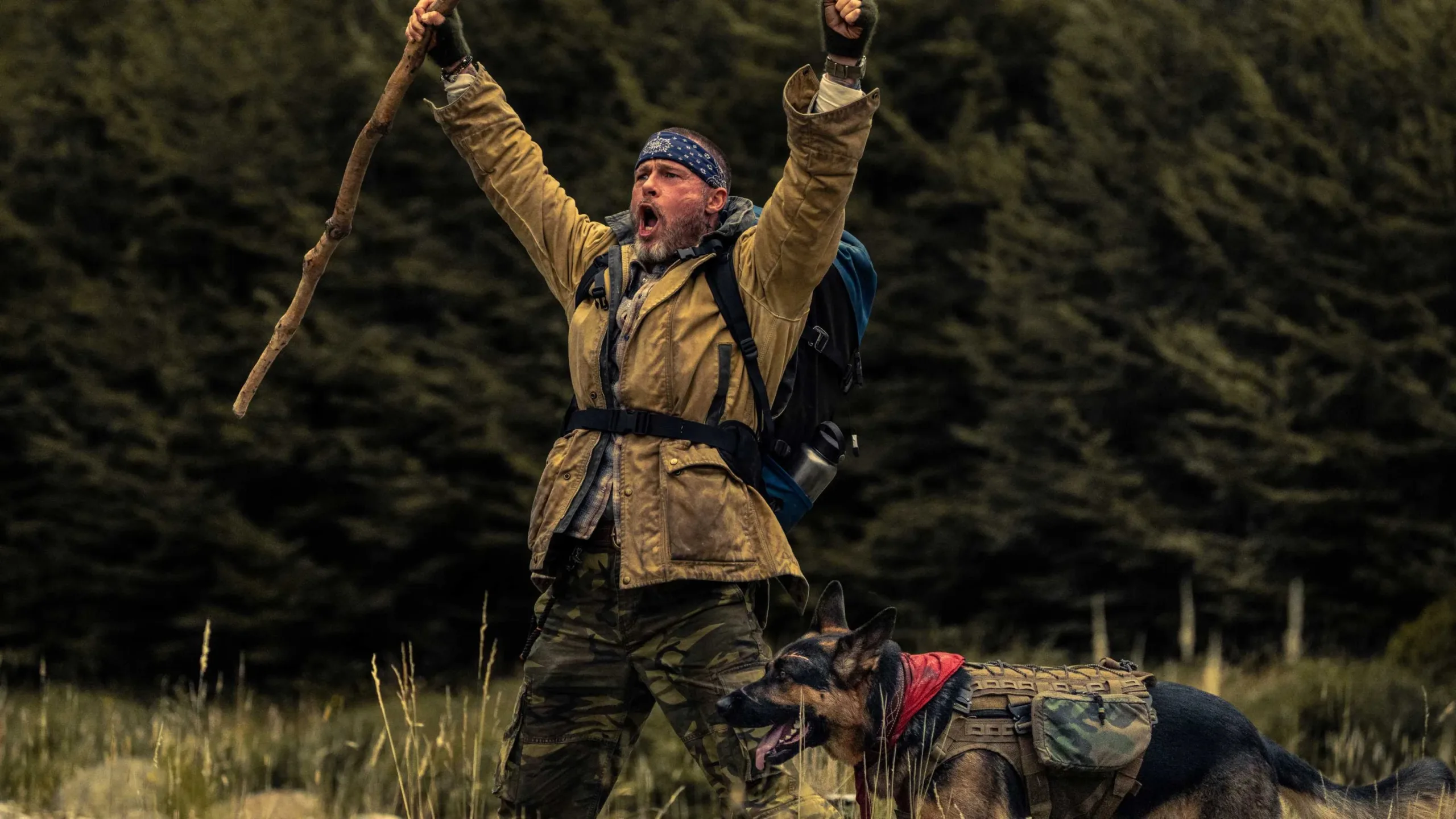
His strongest moments are not speeches. Much of the film leaves him talking to Odin, muttering to himself, or saying nothing. A quiet scene in which he removes Odin’s artificial leg and massages the injured stump says more about their bond than any declaration could. Care becomes a physical routine, almost a language.
Odin, primarily played by a German shepherd named Uber with three other dogs doubling him, never feels like an emotional prop that occasionally barks on cue. Some combination of training, editing and Pitt’s responses gives the animal genuine presence. The eyes do a considerable amount of acting. I realize how dangerously close that sentence comes to becoming one of those “the dog deserves an Oscar” reviews, so I will stop there. The harder material sits underneath all this tenderness.
James and Odin survived war together. War injured them both, yet it also supplied the discipline, skills and ideas of loyalty that now keep them alive. Heart of the Beast appears aware of this contradiction without really examining it. The film wants to honor service, and by the closing stretch that impulse grows increasingly explicit. Military fraternity, sacrifice and endurance move from background texture toward something closer to doctrine. I kept wondering what the film believes James is recovering from. Combat? Isolation? Civilian life? The inability to imagine himself outside the identity that damaged him?
The combat flashbacks do not offer enough material to answer that. They sketch trauma rather than investigate it. James’ history remains deliberately thin, which works when we are watching him survive and becomes limiting when the movie begins making larger gestures toward military sacrifice. The individual man is complicated. The institution surrounding him is treated with considerably less curiosity. Perhaps expecting that curiosity is asking Heart of the Beast to become a different movie. I am not entirely convinced it is.
Its simplicity is partly responsible for its power. James loves Odin. Odin trusts James. Both are damaged. Both keep choosing the other when self-preservation would be easier. Ayer strips the relationship down until loyalty becomes almost embarrassingly literal, then places enough pain around it that the sentiment survives.
Which returns me to the movie’s peculiar need to reassure us. We are told too early that certain fears can be put aside, and several emotional turns can be spotted long before they arrive. The mechanism is visible almost the entire time. And yet visibility is not the same thing as falseness.
Heart of the Beast knows where it wants the audience to cry and knows roughly how it intends to get us there. What saves it is the stubborn physical detail between those calculations: James checking a map, tending Odin’s leg, dragging himself toward a road. The movie keeps announcing its sentiment, but the bodies have already made the case.
Heart of the Beast hits theaters on September 25, 2026, courtesy of Paramount Pictures. The survival thriller follows a former Special Forces officer and his retired combat dog as they navigate a brutal fight for survival after a plane crash in the remote Alaskan wilderness.
Where to Watch Heart of the Beast (2026) Online
Full Credits
Title: Heart of the Beast
Distributor: Paramount Pictures
Release date: September 25, 2026
Rating: PG-13
Running time: 1 hour 41 minutes (101 minutes)
Director: David Ayer
Writers: Cameron Alexander
Producers and Executive Producers: Olivia Hamilton, Marty Bowen, David Ayer, Brad Pitt, Damien Chazelle, Scott Lumpkin, Cameron Alexander, Chris Long, Pete Chiappetta, Anthony Tittanegro, Andrew Lary, Sophie Cassidy, Zack Conroy
Cast: Brad Pitt, J.K. Simmons, Anna Lambe
Composer: Jared Michael Fry
The Review
Heart of the Beast
Heart of the Beast makes its machinery visible early, then spends the rest of its runtime proving that obvious emotional design and genuine feeling can coexist. David Ayer occasionally reassures the audience when greater uncertainty would have helped, and the military framing grows simpler as the film widens its ideas. Still, the physical specificity of James and Odin’s ordeal, Brad Pitt’s steadily eroding invulnerability, and the tenderness embedded in their routines give the sentiment real weight. You can see the tears coming. They arrive anyway.
PROS
- Pitt turns movie-star toughness into vulnerability
- James and Odin’s bond feels physically lived-in
- Patient survival sequences give the ordeal weight
- Strong use of landscape and bodily detail
CONS
- The opening reduces too much uncertainty
- Some digital animal work weakens the danger
- Combat flashbacks remain thin
- The military themes become overly simple