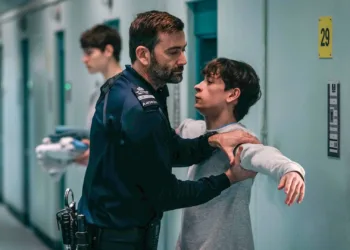






























A school can call almost anything discipline if the people enforcing it are allowed to define strength for everyone else. That is the tension Minerva Academy keeps circling, sometimes clumsily, sometimes with surprising force. Its military high school promises structure, purpose, and belonging to teenagers who are still figuring out who they are. It also regulates how they dress, how they behave, whom they can date, and how much humiliation they are expected to absorb in the name of becoming tougher.
For a teen drama, that is fertile territory. Adolescence is already a period of testing rules and trying on identities. Minerva answers that instability with uniforms, hierarchy, early drills, inspections, punishments, and a three-day initiation in which new cadets risk elimination after accumulating red marks. Senior students are given authority over juniors through the Smallsword mentorship tradition, while hazing lurks beneath the language of resilience and tradition. Even Camilla’s repeated punishment for not knowing the national anthem becomes part of the school’s wider insistence that belonging must first be performed correctly.
The series is strongest when it understands that this contradiction is richer than a simple battle between rebellious teenagers and cruel adults. Minerva can offer community, routine, and a sense of purpose. It can also teach young people that obedience is maturity and vulnerability is failure. That distinction matters because the show rarely needs to declare that every rule is wrong. Its sharper question is what happens when an institution becomes so invested in preserving itself that tradition starts outranking the people supposedly benefiting from it.
The difficulty is that Minerva Academy initially packages these ideas inside some very recognizable streaming-teen-drama furniture. Salvo arrives looking for answers about Francesco, the older friend from his group home who disappeared after entering Minerva. Camilla enters as the wealthy rebellious girl sent away by her father to be straightened out. Vincenzo actually wants to be there, following the path of his military father while dealing with that father’s worsening cancer. Romance, rivalries, forbidden relationships, fencing, competitions, secrets, and rule-breaking crowd the season around them.
Early on, the ensemble can feel less like a community than a casting spreadsheet wearing matching uniforms. The premiere has to introduce recruits, senior cadets, teachers, commanders, initiation rituals, and the disappearance mystery at once. The male cadets are especially difficult to distinguish at first, while several supporting characters barely register before the story moves on.
The season improves once those familiar types stop functioning as shortcuts and begin revealing the histories underneath them. Camilla’s rebellion gains context. Vincenzo’s ambition becomes tangled with family expectation and grief. Salvo’s investigation grows less interesting as a mystery mechanism than as a way of exposing what the institution hides from its younger members. The second half gives the characters enough time to complicate the labels the first few episodes place on them.
That progression matters because Minerva Academy sells serious social material through familiar YA convention. Romance gets you through the door. A mystery keeps the autoplay countdown relevant. Then, somewhere between the uniforms and forbidden relationships, the series begins talking about institutional power, masculinity, class, family authority, abuse, and the limits placed on adolescent self-determination. The formula is obvious. The fact that the show occasionally makes something thoughtful out of it is less obvious, and far more interesting.
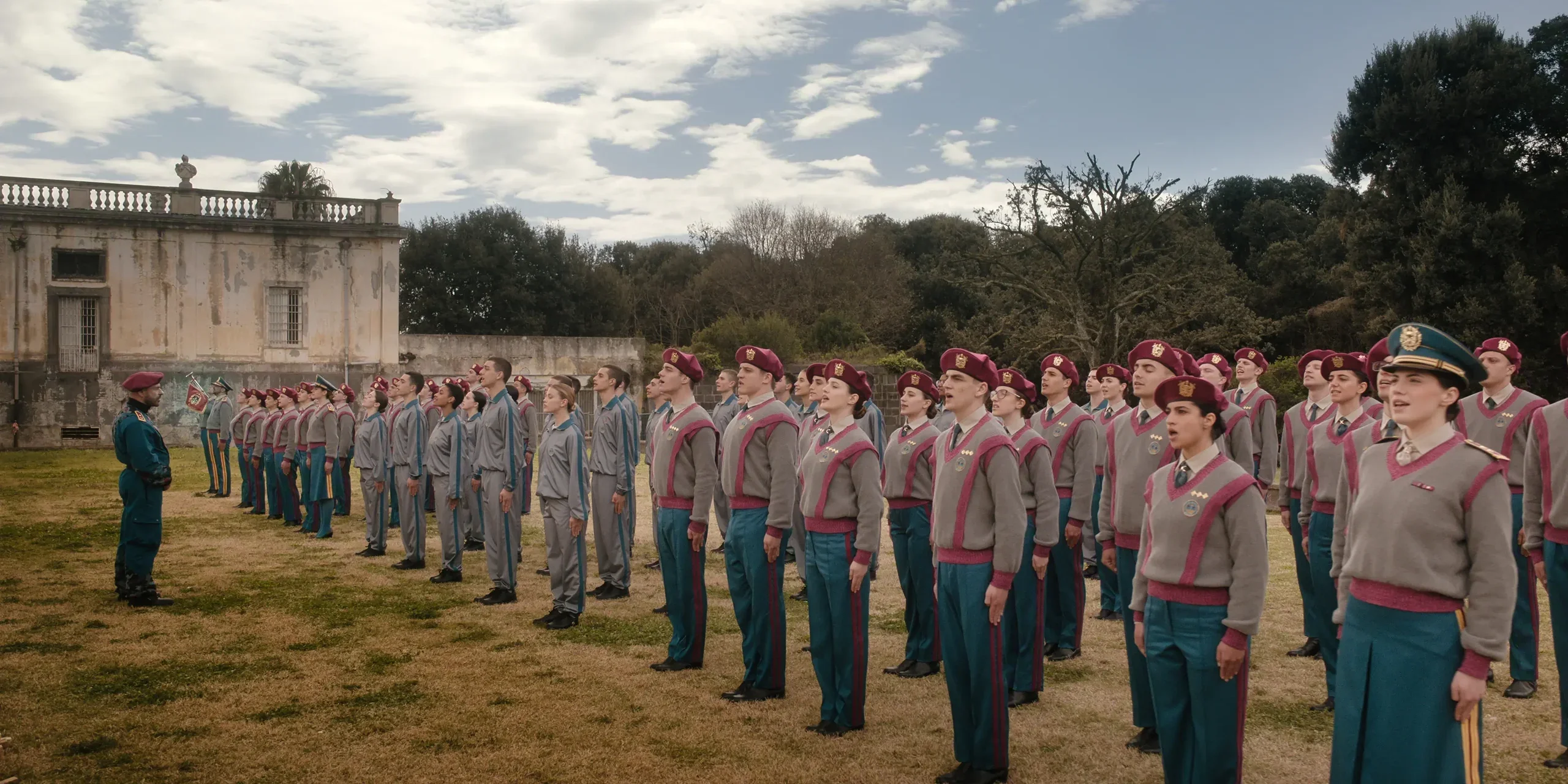
Laura Canali helps sharpen that argument. As a civilian History and Philosophy teacher, she is almost deliberately mismatched with Minerva’s culture. She listens to students, challenges decisions, and refuses to treat longevity as proof that a tradition deserves to survive. Major Teresa Bonaiuto represents a different form of resistance. She believes in the institution, yet wants to discard practices that leave it trapped in its own past.
Their presence keeps the series from pretending change comes only from teenage rebellion. Canali questions Minerva from outside its military logic. Bonaiuto pushes from within it. The distinction gives the show a more mature view of reform than the standard outsider-arrives-and-fixes-everything model. Institutions rarely change because one enlightened person explains morality to everyone in the room, tempting as television finds that fantasy.
The richest example of Minerva’s ideology is Commander Achille Giordano, because he carries it home. Giordano believes deeply in discipline and toughness, yet he is also a father raising Diego and Paola after their mother left. His years of military service took him away during part of their childhood. With Diego especially, his faith in toughness becomes painfully personal. He wants his son protected from weakness, disappointment, and whatever else the world might do to him. Diego, meanwhile, wants his father’s approval while still carrying the damage of abandonment and emotional distance.
Massimiliano Gallo and Simone Secce give that relationship the season’s strongest emotional weight. Giordano never needs to become a monster for the dynamic to hurt. He loves Diego. The problem is that he has absorbed an institutional definition of care in which preparing someone for pain can look dangerously similar to causing it first.
That is where Minerva Academy stops being another series about attractive teenagers breaking rules in attractive uniforms. The school’s ideology does not stay inside drill yards or disciplinary hearings. It enters families. It shapes romance. It decides what emotional behavior is considered acceptable. It gives older students permission to reproduce the same hierarchy imposed on them.
The Francesco mystery keeps the season moving, and its connection to Diego gives Salvo a reason to keep digging. Yet the relationships, especially Giordano and Diego, prove stronger than the disappearance plot itself. The mystery supplies momentum. The institution supplies meaning.
By the end, the harder question is no longer what Minerva is hiding. It is what Minerva teaches its students to hide in themselves. A school built to produce stronger young adults can offer discipline, solidarity, and direction. It can also confuse conformity with growth. Minerva Academy becomes worth watching when it recognizes that those two outcomes can come from the same system, sometimes in the same person.
Minerva Academy premiered on Netflix on September 22, 2026. Set inside a harsh Italian military high school, the teen drama series follows a new cadet secretly investigating the mysterious disappearance of his best friend.
Where to Watch Minerva Academy Online


Full Credits
Title: Minerva Academy
Distributor: Netflix
Release date: September 22, 2026
Rating: TV-MA
Running time: 50 minutes per episode
Director: Ivan Silvestrini
Cast: Ciro Minopoli, Nicole Malaj, Gaia Garavaglia, Biagio Venditti, Margherita Buoncristiani, Michele Rosiello, Cristiana Capotondi, Massimiliano Gallo
The Review
Minerva Academy
Minerva Academy works best when its military school stops functioning as a dramatic backdrop and starts revealing what institutions can teach young people about obedience, strength, and belonging. The early episodes lean heavily on familiar YA types, and the Francesco mystery never becomes the season’s richest material. Giordano and Diego provide the emotional center, turning the academy’s ideology into something painfully intimate. The series grows sharper as its characters complicate the roles first assigned to them.
PROS
- Strong Giordano and Diego relationship
- Thoughtful critique of institutional discipline
- Familiar characters gain depth
- Effective second-half development
CONS
- Crowded early ensemble
- Mystery is less interesting than the relationships
- Some YA conventions feel overly familiar