


























• Latest
  • Trending
Monowave Review

Monowave Review: Emotion Becomes the Language of Play

Maya & Samar Review

Maya & Samar Review: Passion Burns Brighter Than Its Politics

Cocoon: One Summer of Girlhood Review

Cocoon: One Summer of Girlhood Review: War Reaches the Classroom First

Brailled It Review

Brailled It Review: The Braille Challenge Through Its Competitors’ Eyes

Dark Hollow Review

Dark Hollow Review: Coal Country Horror Finds the Wrong Target

Bucks County, USA Review

Bucks County, USA Review: Five Hours Inside America’s School Board Wars

Silent Hill: Townfall Review

Silent Hill: Townfall Review: The Fog Has Rules Now

Ghost in the Cell Review

Ghost in the Cell Review: Anger Management Has Never Been This Bloody

American Summer Review

American Summer Review: Nostalgia Without the Memories to Match

La Bola Negra

“La Bola Negra” Wins Toronto’s People’s Choice Award, Handing Netflix an Oscar Front-Runner

4 hours ago
Yesim Ustaoglu

Yeşim Ustaoğlu Returns to San Sebastian With “What Remains,” a Road Movie About a Poet Who Walks Away

4 hours ago
The Dark gets In

Blue Finch Films Boards Sean Hogan’s Supernatural Thriller “The Dark Gets In” Ahead of Beyond Fest

4 hours ago
In My Father’s Room

Novelist Maha Harada, 64, Brings Her Directing Debut “In My Father’s Room” to San Sebastian

4 hours ago
  • Home
  • Privacy Policy
  • Terms and Conditions
  • Gazettely Review Guidelines
Monday, September 21, 2026
GAZETTELY
  • Home
  • Movie and TV News
    La Bola Negra

    “La Bola Negra” Wins Toronto’s People’s Choice Award, Handing Netflix an Oscar Front-Runner

    Yesim Ustaoglu

    Yeşim Ustaoğlu Returns to San Sebastian With “What Remains,” a Road Movie About a Poet Who Walks Away

    The Dark gets In

    Blue Finch Films Boards Sean Hogan’s Supernatural Thriller “The Dark Gets In” Ahead of Beyond Fest

    In My Father’s Room

    Novelist Maha Harada, 64, Brings Her Directing Debut “In My Father’s Room” to San Sebastian

    Ben Affleck Jennifer Garner

    Ben Affleck Nearly Cast Ex-Wife Jennifer Garner as His Wife in “Animals”

    Aaron Sorkin

    David Fincher Was Aaron Sorkin’s First Pick for “The Social Reckoning,” but Netflix Deal Stood in the Way

    Ke Huy Quan

    Ke Huy Quan Recalls Near-$100,000 “Temple of Doom” Check That Stunned His Family

    Paramount

    Paramount Settlement Talks Pause as Some State AGs Demand Tougher Terms

    Youth Sharon Horgan

    Sharon Horgan Explains the “Youth” Premiere’s Emotional Twist: “It Was Always Going to End Like That”

  • Movie and TV Reviews
    Maya & Samar Review

    Maya & Samar Review: Passion Burns Brighter Than Its Politics

    Cocoon: One Summer of Girlhood Review

    Cocoon: One Summer of Girlhood Review: War Reaches the Classroom First

    Brailled It Review

    Brailled It Review: The Braille Challenge Through Its Competitors’ Eyes

    Dark Hollow Review

    Dark Hollow Review: Coal Country Horror Finds the Wrong Target

    Bucks County, USA Review

    Bucks County, USA Review: Five Hours Inside America’s School Board Wars

    Ghost in the Cell Review

    Ghost in the Cell Review: Anger Management Has Never Been This Bloody

    American Summer Review

    American Summer Review: Nostalgia Without the Memories to Match

    Influence Review

    Influence Review: The Most Dangerous Person in the Room Thinks She’s the Director

    Come With Me Review

    Come With Me Review: Parasocial Faith Meets a Very Real Reckoning

  • Game Reviews
    Monowave Review

    Monowave Review: Emotion Becomes the Language of Play

    Silent Hill: Townfall Review

    Silent Hill: Townfall Review: The Fog Has Rules Now

    Graveyard Keeper 2 Review

    Graveyard Keeper 2 Review: Fixing the Grind Without Fixing Every Mystery

    BLACKWOOD Review

    BLACKWOOD Review: Stylish Takedowns, Shaky Foundations

    Sniper Dan Review

    Sniper Dan Review: The Real Skill Is Knowing Where to Look

    The Walking Dead: Streets of Survival Review

    The Walking Dead: Streets of Survival Review: Rick and Company Enter the Arcade

    Woodo Review

    Woodo Review: Finding Wonder Beyond the Screen

    Train Sim World 7 Review

    Train Sim World 7 Review: Three Railways, Three Different Rhythms

    Aniimo Review

    Aniimo Review: Great Creatures Trapped Behind Too Many Menus

  • The Bests
No Result
View All Result
  • Home
  • Movie and TV News
    La Bola Negra

    “La Bola Negra” Wins Toronto’s People’s Choice Award, Handing Netflix an Oscar Front-Runner

    Yesim Ustaoglu

    Yeşim Ustaoğlu Returns to San Sebastian With “What Remains,” a Road Movie About a Poet Who Walks Away

    The Dark gets In

    Blue Finch Films Boards Sean Hogan’s Supernatural Thriller “The Dark Gets In” Ahead of Beyond Fest

    In My Father’s Room

    Novelist Maha Harada, 64, Brings Her Directing Debut “In My Father’s Room” to San Sebastian

    Ben Affleck Jennifer Garner

    Ben Affleck Nearly Cast Ex-Wife Jennifer Garner as His Wife in “Animals”

    Aaron Sorkin

    David Fincher Was Aaron Sorkin’s First Pick for “The Social Reckoning,” but Netflix Deal Stood in the Way

    Ke Huy Quan

    Ke Huy Quan Recalls Near-$100,000 “Temple of Doom” Check That Stunned His Family

    Paramount

    Paramount Settlement Talks Pause as Some State AGs Demand Tougher Terms

    Youth Sharon Horgan

    Sharon Horgan Explains the “Youth” Premiere’s Emotional Twist: “It Was Always Going to End Like That”

  • Movie and TV Reviews
    Maya & Samar Review

    Maya & Samar Review: Passion Burns Brighter Than Its Politics

    Cocoon: One Summer of Girlhood Review

    Cocoon: One Summer of Girlhood Review: War Reaches the Classroom First

    Brailled It Review

    Brailled It Review: The Braille Challenge Through Its Competitors’ Eyes

    Dark Hollow Review

    Dark Hollow Review: Coal Country Horror Finds the Wrong Target

    Bucks County, USA Review

    Bucks County, USA Review: Five Hours Inside America’s School Board Wars

    Ghost in the Cell Review

    Ghost in the Cell Review: Anger Management Has Never Been This Bloody

    American Summer Review

    American Summer Review: Nostalgia Without the Memories to Match

    Influence Review

    Influence Review: The Most Dangerous Person in the Room Thinks She’s the Director

    Come With Me Review

    Come With Me Review: Parasocial Faith Meets a Very Real Reckoning

  • Game Reviews
    Monowave Review

    Monowave Review: Emotion Becomes the Language of Play

    Silent Hill: Townfall Review

    Silent Hill: Townfall Review: The Fog Has Rules Now

    Graveyard Keeper 2 Review

    Graveyard Keeper 2 Review: Fixing the Grind Without Fixing Every Mystery

    BLACKWOOD Review

    BLACKWOOD Review: Stylish Takedowns, Shaky Foundations

    Sniper Dan Review

    Sniper Dan Review: The Real Skill Is Knowing Where to Look

    The Walking Dead: Streets of Survival Review

    The Walking Dead: Streets of Survival Review: Rick and Company Enter the Arcade

    Woodo Review

    Woodo Review: Finding Wonder Beyond the Screen

    Train Sim World 7 Review

    Train Sim World 7 Review: Three Railways, Three Different Rhythms

    Aniimo Review

    Aniimo Review: Great Creatures Trapped Behind Too Many Menus

  • The Bests
No Result
View All Result
GAZETTELY
No Result
View All Result
Monowave Review

Cocoon: One Summer of Girlhood Review: War Reaches the Classroom First

Maya & Samar Review: Passion Burns Brighter Than Its Politics

Home Games Reviews Games

Monowave Review: Emotion Becomes the Language of Play

Enzo Barese by Enzo Barese
11 minutes ago
in Games, Nintendo, PC Games, Reviews Games
Reading Time: 5 mins read
A A
0
Share on FacebookShare on TwitterShare on PinterestShare on WhatsAppShare on TelegramSummarize with ChatGPTSummarize with Perplexity

Studio BBB has built a game about emotion that rarely asks the player to read much about emotion. Happiness sends Mono higher. Anger lets him scale walls. Sorrow changes how he moves through water and narrow spaces. Anxiety protects him from danger. Then those same feelings can be sung into the creatures sharing each level, changing what they do and, with it, the geography of the stage. The idea is simple enough to understand within minutes. Its consequences take nearly the entire game to unfold.

That clarity suits a debut made in Seoul and released into a genre whose visual grammar is already international. Monowave does not lean heavily on Korean iconography or a regional storytelling tradition that the game itself does not establish. Its language is movement, colour, reaction, and cause. Studio BBB takes the familiar structure of a platformer and makes emotional behaviour the part that needs no translation.

Mono is a newborn Guardian tasked with recovering the scattered fragments associated with the Prism Tree. That premise provides enough direction, though the plot remains deliberately light. What gives the game personality is the way each emotional state changes both Mono and the creatures around him.

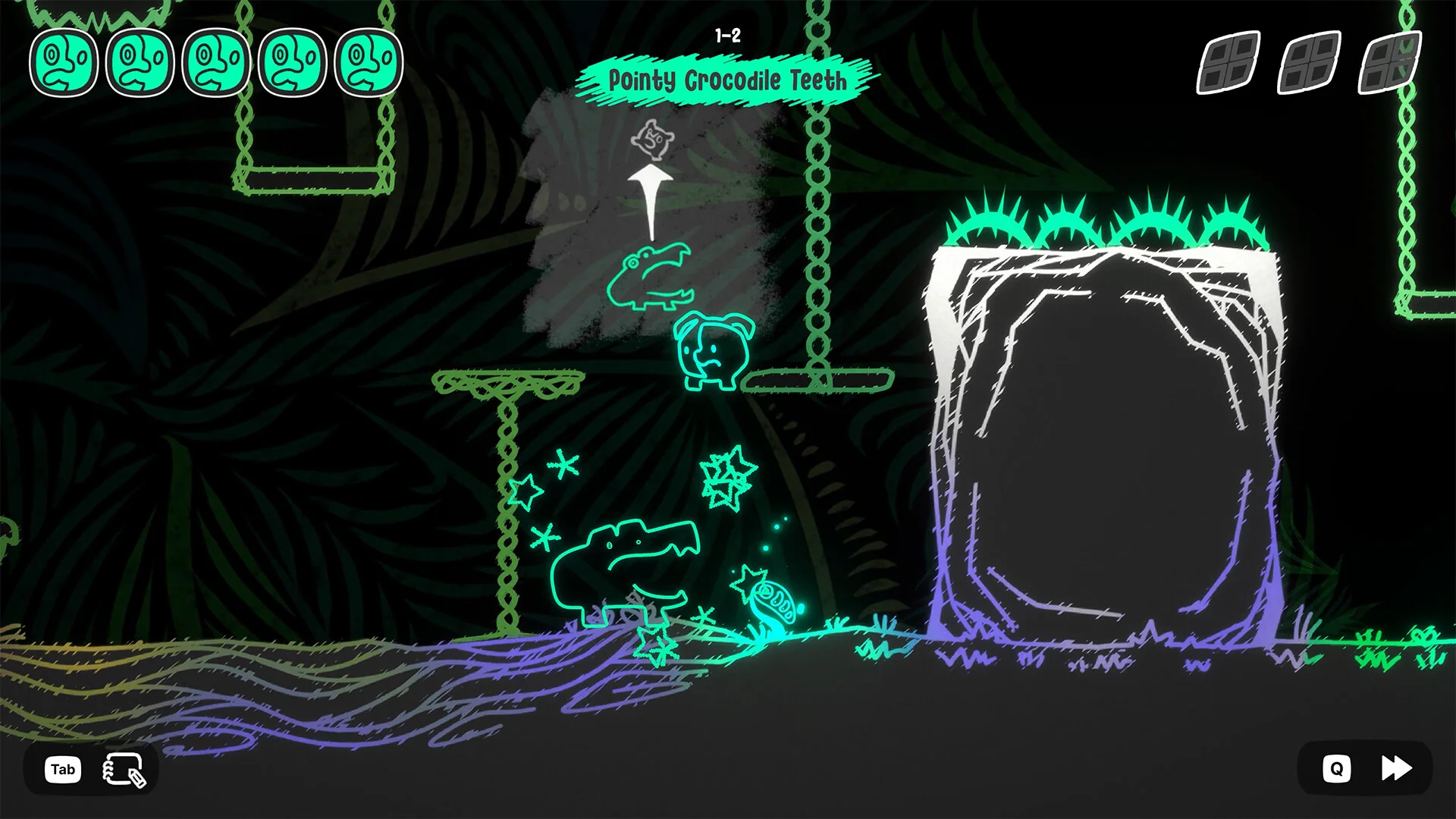
A joyful gorilla can launch him across a gap. Anger can turn that same creature into a way of destroying an obstruction. Anxiety changes its behaviour again. Elsewhere, a sorrowful whale sinks while a happy one produces a useful water spout. Crocodiles, lizards, and other animals become small systems with several possible functions rather than fixed environmental props.

The distinction matters. Plenty of puzzle games assign four colours to four locks and call it a mechanic. Monowave asks the player to learn behaviour. A new creature initially presents a small mystery: what does anger make this thing do, and can that reaction solve the problem in front of me?

The game becomes increasingly confident about combining those answers. Later stages may require carrying the correct emotion through part of the level, transferring it to an animal, using the resulting behaviour to reach another section, then relying on Mono’s own movement abilities to finish the sequence.

Those abilities grow with him. Dashes, double jumps, and other upgrades gradually turn what begins as modest platforming into a broader movement set. Studio BBB is careful about giving each new tool time to settle before combining it with existing ones, and the relatively compact stages help.

Nearly fifty levels are arranged across four regions, with hidden exits, secret stages, boss encounters, and three optional collectibles per stage. The structure belongs to decades of familiar platform-game design. Here, that familiarity works as scaffolding. The stranger idea, emotions functioning as transferable states, always has a recognizable frame around it.

The strongest puzzles are conversations between convention and invention. You know what a wall jump is. You know what a moving platform does. Monowave’s question is what happens when a creature’s mood determines which piece of level architecture it effectively becomes.
Monowave Review

The game is unusually thoughtful about helping the player answer that question. You can move the camera around to inspect a stage before committing to a route. Menus record information about creatures, hazards, and environmental objects after you encounter them, so progress includes learning the world’s rules rather than memorizing everything perfectly. Most useful is the hint system.

Remain stuck long enough and a meter fills, allowing the game to reveal a limited part of the solution. It then withdraws and begins recharging instead of tracing the entire puzzle for you. Monowave wants assistance to restore momentum, not replace understanding, and its best puzzles still belong to the player after the hint has appeared.

The unevenness arrives when the game asks for precision rather than interpretation. Some later platforming sequences introduce difficulty spikes that feel harsher than the puzzle logic surrounding them. Movement can occasionally feel floaty, hazard hitboxes are not always as forgiving as the otherwise approachable design suggests, and one boss encounter stands out as a sharper obstacle than much of what precedes it. Longer late-game sequences can also demand enough backtracking or execution that the relaxed rhythm tightens considerably.

These problems expose an interesting split. Monowave communicates its invented systems with confidence, yet some of its most ordinary platforming demands are where friction appears. The unfamiliar material is often easier to read than the familiar material is to execute.

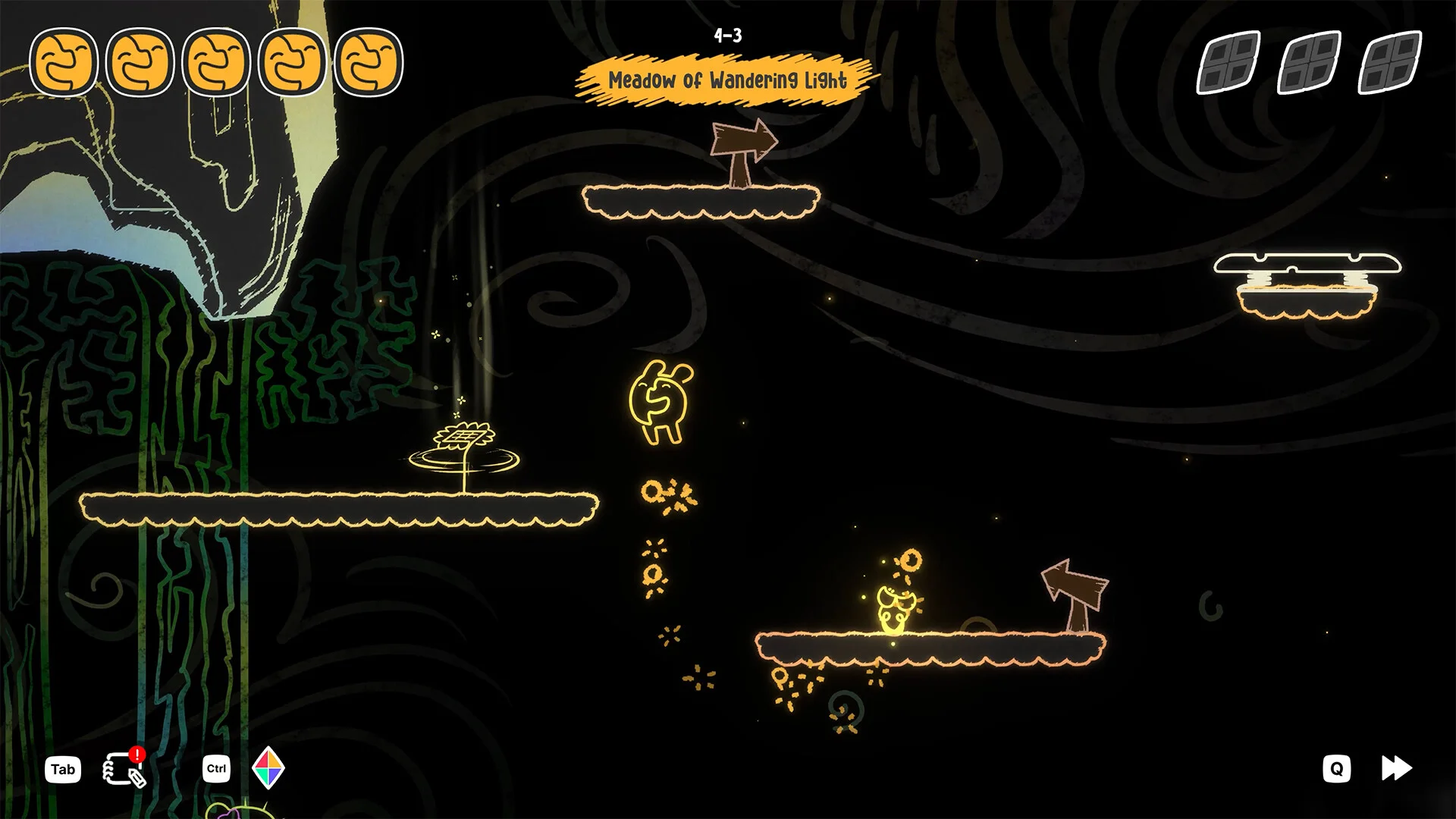
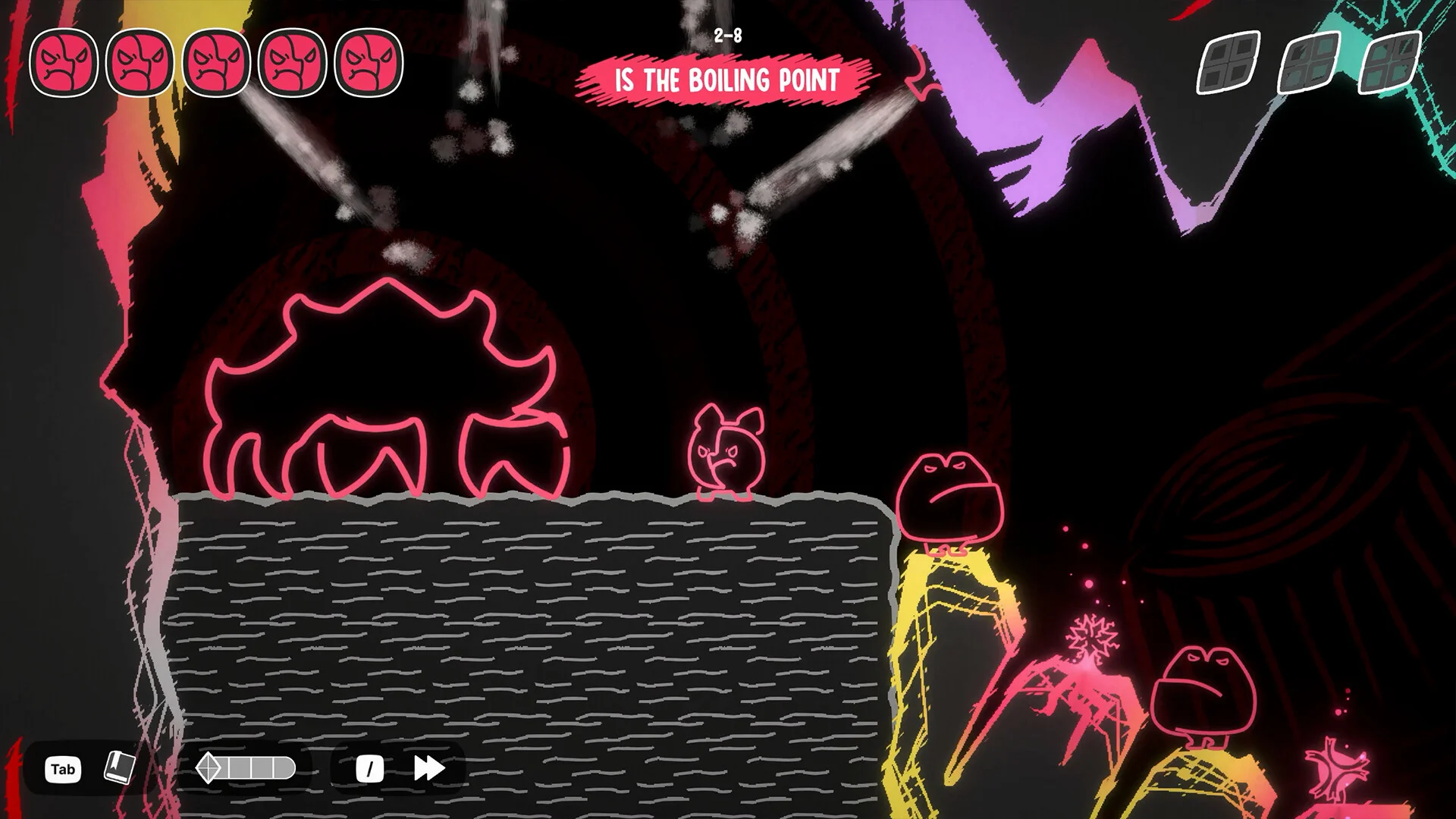
Its visual design helps enormously. Characters and environments are drawn in bright, glowing lines against deep black backgrounds, evoking chalkboards and children’s scratch-art books without looking like either one copied literally. Emotional states are immediately legible because colour is doing mechanical work. Mono changes. Creatures change. A puzzle can be understood partly by looking at the screen before consulting a menu.

The soundtrack follows the same principle by giving each region an emotional identity. The volcanic area, associated with anger, leans into a military drumbeat, while other regions receive music matched to their dominant mood. One missed opportunity is that the score appears tied more strongly to location than to whichever emotion Mono currently carries. Considering how responsive the animation and creature behaviour are, music could have joined that network of reactions.

This relationship between image, sound, movement, and emotion gives Monowave much of its cross-cultural readability. Clear state changes, readable animation, and movement carry information before exposition needs to. Studio BBB’s variation is to make feeling itself part of that control language.
Monowave Review

That is also why the sparse story works better as a framework than as the main attraction. Brief dialogue-free cutscenes connect the regions, while additional explanations sit in menus for players who want them. Some may find Mono’s adventure touching, and there is warmth in the little Guardian restoring a world thrown out of emotional balance. The richer idea is expressed through play.

Anger is useful. Anxiety is useful. Sorrow is useful. Happiness is useful. None of them exists as the correct permanent state. Every time the player deliberately gives a supposedly unpleasant feeling to a creature because the situation requires it, the game’s argument about emotional balance becomes mechanical rather than rhetorical.

Local co-op is less convincing. A second player controls Prism, the floating companion normally associated with hints, and can assist with interactions and point out elements in the environment. The arrangement makes sense for a parent helping a younger player, yet Prism has far less agency than Mono and removes access to the usual solo hint function. It feels adjacent to the central design rather than deeply integrated with it.

Monowave is much stronger when a single player is learning its emotional vocabulary directly, watching the same creature become obstacle, tool, threat, or ally depending on the state passed into it. Studio BBB has taken a form built from familiar platforming traditions and found a portable idea inside it. The game may come from Seoul, but its most successful act of translation happens without subtitles: colour changes, behaviour follows, and the player learns what a feeling can do.

The Review

Monowave

8 Score

Monowave gives a familiar puzzle-platformer structure a distinctive identity by making emotion part of movement, creature behaviour, colour, and problem-solving. Studio BBB's strongest achievement is how easily that system communicates across language and culture, while still leaving room for experimentation. Some late precision sections, uneven hitboxes, and a limited co-op role create friction, yet the central mechanic remains inventive and consistently rewarding.

PROS

  • Excellent emotion-based puzzle system
  • Strong visual communication
  • Inventive creature interactions
  • Smart, restrained hint design
  • Distinctive scratch-art presentation

CONS

  • Late difficulty spikes
  • Occasional floaty movement
  • Some unreliable hazard hitboxes
  • Co-op feels underdeveloped

Review Breakdown

  • Overall 0
Tags: Action gameAdventureCasual gameFeaturedIndie gameMonowavePhoenixx Inc.Studio BBB Inc.
Previous Post

Cocoon: One Summer of Girlhood Review: War Reaches the Classroom First

Next Post

Maya & Samar Review: Passion Burns Brighter Than Its Politics

0 0 votes
Article Rating
Subscribe
Connect with
Login
I allow to create an account
When you login first time using a Social Login button, we collect your account public profile information shared by Social Login provider, based on your privacy settings. We also get your email address to automatically create an account for you in our website. Once your account is created, you'll be logged-in to this account.
DisagreeAgree
Notify of
guest
Connect with
I allow to create an account
When you login first time using a Social Login button, we collect your account public profile information shared by Social Login provider, based on your privacy settings. We also get your email address to automatically create an account for you in our website. Once your account is created, you'll be logged-in to this account.
DisagreeAgree
guest
0 Comments
Oldest
Newest Most Voted

This Week's Top Reads

  • Is This Seat Taken? Review

    Is This Seat Taken? Review: A Satisfying Mental Workout

    1287 shares
    Share 0 Tweet 0
  • Agatha Christie’s Tommy & Tuppence Review: Two Great Detectives Need Sharper Mysteries

    0 shares
    Share 0 Tweet 0
  • Tom Pelphrey Wins First Emmy, Dedicates It to Pregnant Kaley Cuoco

    0 shares
    Share 0 Tweet 0
  • Fauda Season 5 Review: Revenge Crosses the Mediterranean

    1 shares
    Share 0 Tweet 0
  • Trust Review: Squandered Potential and an Incoherent Plot

    6 shares
    Share 0 Tweet 0
  • Youth Review: Growing Up Does Not End at 50

    1 shares
    Share 0 Tweet 0
  • The Perfect Lie Review: The Dinner Club Knows How to Keep a Secret

    0 shares
    Share 0 Tweet 0

Must Read Articles

Silent Hill: Townfall Review
Reviews Games

Silent Hill: Townfall Review: The Fog Has Rules Now

2 hours ago
Ghost in the Cell Review
Movies

Ghost in the Cell Review: Anger Management Has Never Been This Bloody

3 hours ago
Gandhari Review
Movies

Gandhari Review: A Rich Mythology Trapped Inside a Familiar Thriller

22 hours ago
Lovesick Review
TV Shows

Lovesick Review: Revolution Outside, Restriction at Home

1 day ago
Daniel and the Fiery Furnace Review
Movies

Daniel and the Fiery Furnace Review: Its Quietest Moments Burn Brightest

1 day ago
Loading poll ...
Coming Soon
Which of Alfred Hitchcock's 1960s thrillers is your all-time favorite?

Gazettely is your go-to destination for all things gaming, movies, and TV. With fresh reviews, trending articles, and editor picks, we help you stay informed and entertained.

© 2021-2026 All Rights Reserved for Gazettely

What’s Inside

  • Movie & TV Reviews
  • Game Reviews
  • Featured Articles
  • Latest News
  • Editorial Picks

Quick Links

  • Home
  • About US
  • Contact Us
  • Advertise with Us
  • Review Guidelines

Follow Us

Facebook X-twitter Youtube Instagram
No Result
View All Result
  • Gazettely | Movie, TV & Game Reviews, News, and Rankings
  • Movies
  • Entertainment News
  • Movie and TV Reviews
  • TV Shows
  • Game News
  • Game Reviews
  • Contact Us

© 2024 All Rights Reserved for Gazettely

wpDiscuz
0
0
Would love your thoughts, please comment.x