





























The people making the decisions in Patrick Bresnan’s First They Came for My College usually appear at a greater distance. In 2023, Florida Governor Ron DeSantis appointed a conservative majority to New College of Florida’s board of trustees. President Patricia Okker was removed, and Richard Corcoran took her place.
New trustee Christopher Rufo appears in board meeting footage, at times attending virtually. Bresnan’s movement between those meetings and student spaces gives the political language a physical destination. A vote or appointment reaches a classroom, a student organization, a faculty member deciding how long she can continue her work.
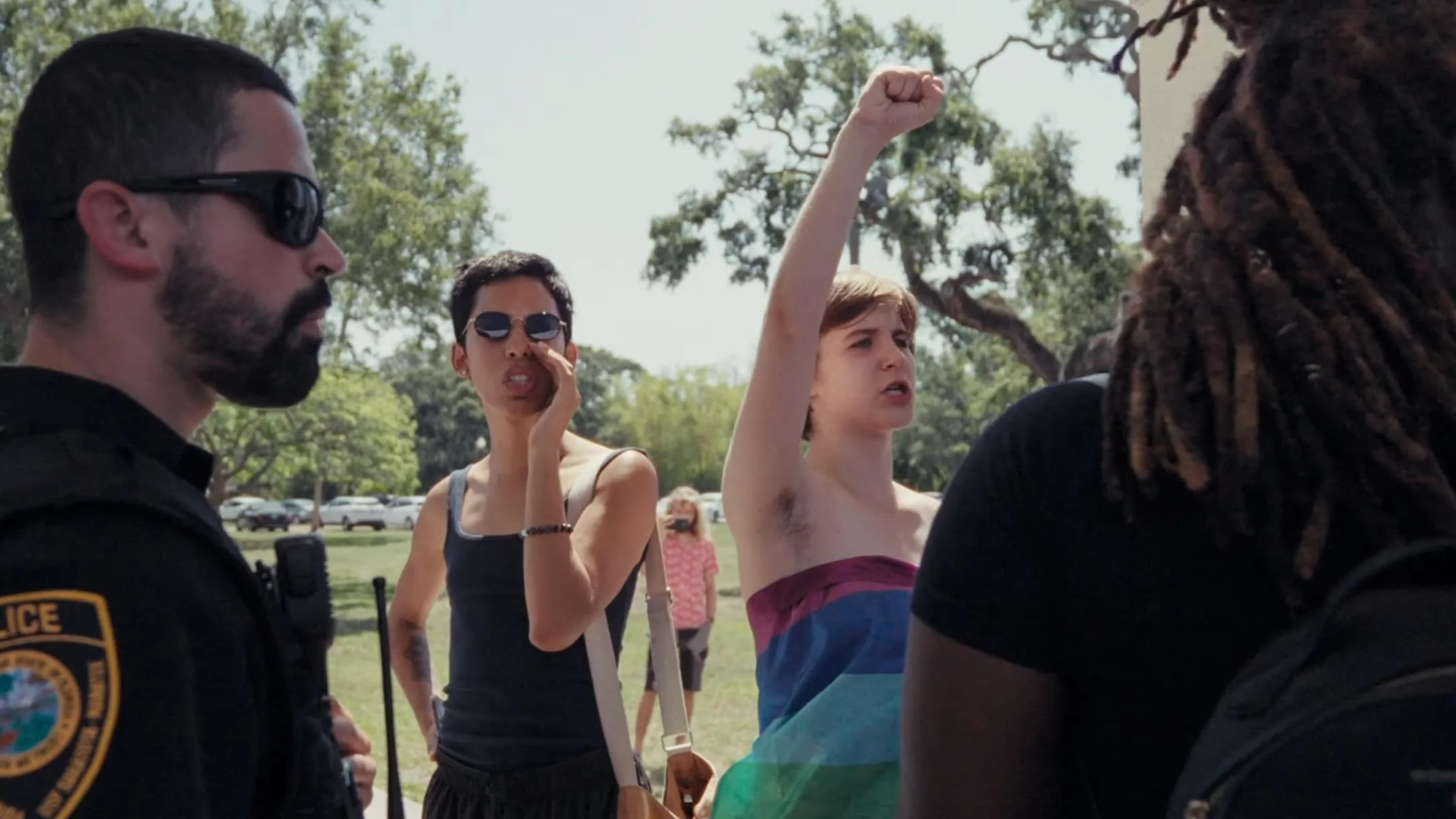
The conversations inside The Catalyst newsroom carry a peculiar burden. Students are discussing events that will determine the future of their education, while their newspaper becomes one of the places those events are recorded. Footage taken by students extends the same idea beyond the newsroom: the people affected by the takeover can hold a camera, too. Bresnan is most alert when he stays near that exchange between living through a change and trying to describe it. Control of a college is exercised in ordinary places, and its students can document what happens there.
New College had offered an unusually open liberal arts environment. Under its new leadership, diversity and gender studies provision became targets, while LGBTQ+ students faced reported harassment on campus. Amy Reid, director of the Gender Studies program, steps into a faculty board vacancy and advocates for the institution’s existing commitments.
Her position makes the stakes plain without requiring the film to treat academic freedom as an abstraction. A course of study depends on people being able to teach it, students being able to pursue it, and a college willing to make room for both. Change any of those conditions and the promise made to an enrolled student changes with them.
Catherine “Libby” Harrity’s story gives that broken promise a personal scale. The student senate president leaves for Hampshire College after Rufo alleges that she spat at him. The film does not need her transfer to stand for every student’s experience. It is enough to see that continuing an education elsewhere means surrendering the one she chose, along with the community she helped represent. Bresnan’s attention to students prevents their resistance from becoming an inspiring image detached from its costs.
That attention also allows Josh, one of the incoming conservative students, to become a person rather than a symbol of the new administration. Among artistically minded peers, he begins to belong in ways his initial political position could hardly predict; by the film’s later stages, he is drawing again. His change is one of the documentary’s loveliest developments.
It also complicates the assumption that students arriving under the new leadership share full responsibility for what the trustees are doing. Libby’s description of incoming athletes as pawns reaches toward a similar distinction, although the film gives those students far less room to emerge as individuals. Bresnan is generous enough to recognize what a campus community might offer someone recruited into a campaign against its culture.
Josh’s story creates a harder question for the film itself. His growing ease among other students gives the documentary a welcome release from the language of opposing sides, yet that release occupies space in a story whose institutional conflict continues. Several prominent student accounts lead toward transfer or graduation.
Those who remain to contest the college’s direction receive less sustained attention. The imbalance matters because a person can find a new home while the conditions that displaced others remain in place. Bresnan finds genuine hope in Josh’s experience; his editing gives less shape to the work of carrying on at New College after such moments of hope.
The observational material shows what that work might mean for the film’s form. In The Catalyst newsroom, discussion unfolds among students with a stake in what they are saying. The board meeting footage supplies necessary information, though its formal proceedings can leave the film dependent on the officials whose power it is examining.
At other points, explanation crowds the less orderly texture of campus life. Bresnan’s coverage of a Rocky Horror Picture Show shadow-cast performance restores some of that texture. The sequence draws its emotion from students making a shared occasion together. Its pleasure sits beside the knowledge that the spaces supporting such occasions have become contested.
First They Came for My College is a forceful account of an institution being changed around the people who trusted it. Its student footage and moments of collective life make that change felt with greater precision than a recital of political positions could.
The film’s tenderness toward those who leave, and toward Josh as he discovers a place among his peers, is earned. Yet its gaze follows those trajectories further than it follows the people still working inside the college. Once the shadow cast has finished and the students have gone home, the trustees’ decisions are still there for the next day’s classes.
First They Came for My College expanded to commercial theaters on September 17, 2026, following its premiere at SXSW. The documentary chronicles the intense fallout after Florida state officials stage an administrative takeover of New College, turning the campus into a frontline for academic freedom.
Full Credits
Title: First They Came for My College
Distributor: Independent Theatrical Release
Release date: March 2026 (SXSW) / September 17, 2026 (Theatrical)
Running time: 1 hour 45 minutes (105 minutes)
Director: Patrick Bresnan
Producers and Executive Producers: Harry William Hanbury
Cast: Documentary Subjects / Real-life Figures
Director of Photography (Cinematographer): Patrick Bresnan
The Review
First They Came for My College
Patrick Bresnan gives New College’s students room to document a takeover that changes their education around them. The newsroom scenes and student footage make institutional power feel immediate, while Josh’s changing sense of belonging adds welcome complexity. The film is less attentive to those who remain at the college and continue resisting. Its hope is earned, though its view of the unfinished struggle is narrower than its subject deserves.
PROS
- Student footage gives affected students a voice.
- Josh’s story complicates political divisions.
- The shadow-cast performance captures campus community.
CONS
- Remaining students receive limited attention.
- Board meetings sometimes crowd out campus life.
- Incoming athletes remain thinly drawn.