


















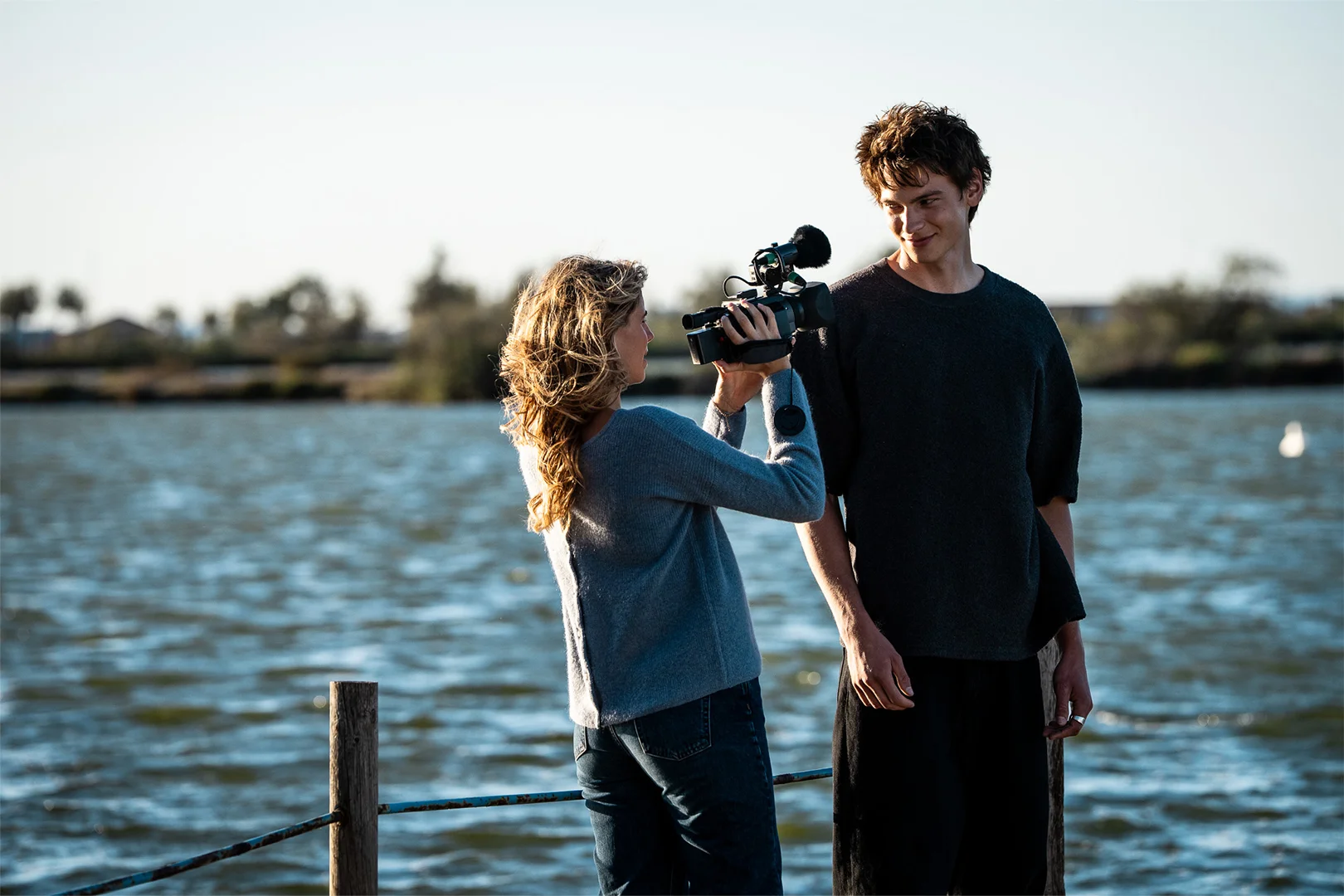
I wanted to see what Alma would make of her film assignment. Watching her develop ideas, work on her laptop, and respond to the practical demands of a student production gives her ambition a texture that a declaration of artistic dreams could never supply alone. The classroom instructions and feedback make the task feel achievable, with enough difficulty to invite curiosity. For a while, You+Me – Against the World offers the pleasure of watching someone discover an activity she wants to take seriously.
The assignment puts Alma alongside Vadim, a withdrawn classmate whose reputation makes her wary. Working together gives their attraction somewhere to grow: ideas can reveal temperament, disagreements can expose priorities, and the finished project requires some degree of trust. Yet their contributions are unevenly developed. Alma supplies much of the creative thinking and writing; Vadim offers suggestions and performs in the short. We get a clearer sense of her investment in filmmaking than his. The collaboration brings them into contact without doing enough to establish what they recognize in each other.
Alma’s enthusiasm matters because her family has already arranged a different future. Her father expects her to study law and eventually enter his Paris firm, while she secretly pursues film studies and gives herself a year to try the life she wants. Vittoria di Savoia makes her uncertainty sympathetic.
Alma’s reserved manner carries the discomfort of someone accustomed to meeting expectations, and her involvement in the project gives that hesitation something to push against. Her financial security does little to answer the personal question of how she wants to spend her days. Making the student film is an early, concrete answer.
Vadim arrives with much less security. Having grown up without his parents and moved between homes, he has obtained a university scholarship after trouble in his teenage years. Rumors about drugs and the company he keeps complicate Alma’s first impression.
There is a workable emotional invitation here: someone attempting a fresh start is still being read through his past. Lucas Barski’s guarded performance preserves the uncertainty, though it offers few rewards as that uncertainty fades. His reserve keeps asking us to look beneath the surface while the characterization gives us limited access to what is there.
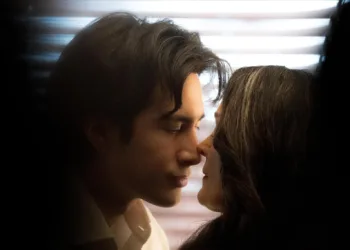
The romance has moments of attraction, and the intimate scenes have an appealing polish. I can accept that Alma and Vadim want to be close. My investment weakens around the kiss, when anticipation gives way to a relationship that needs a different source of momentum. Learning how two people behave together can be as absorbing as waiting for them to admit their feelings. Here, further closeness brings too little emotional discovery. The relationship progresses visibly, yet our understanding of the couple struggles to keep pace.
That makes the repeated intimate encounters feel increasingly insistent. They establish desire again when the relationship would benefit from a clearer sense of trust, vulnerability, or conflicting needs. The filmmaking assignment has already provided a useful setting for those discoveries, with Alma’s ideas and Vadim’s participation giving them something to respond to beyond physical attraction.
As the romance takes priority, that shared activity loses some of its dramatic value. Di Savoia’s anxious, tentative Alma remains easier to care about because her creative ambition gives her a recognizable desire outside the relationship. Vadim’s troubled history supplies reasons for his guardedness without supplying the same immediacy.
Manon Gaurin’s film, adapted from Emma Green’s fiction, uses a familiar progression from distrust to attraction. Familiarity itself causes little difficulty. The pleasure of this kind of romance often lies in discovering the particular people occupying an expected situation. The slow stretches here come from how little changes emotionally between the major developments.
The thriller strand tries to restore uncertainty through Oscar and Félix, whose connection to Vadim brings his past back into the present. Their intermittent threats should turn curiosity about him into concern for his future. Instead, danger keeps returning without gathering enough force between appearances.
It registers as another complication for the couple, then recedes before apprehension can settle. The romance and suspense depend on the same missing development: a sufficiently personal understanding of Vadim to make his exposure feel frightening. His history tells us that stability has been difficult to obtain; the film gives too little attention to what that stability means to him now.
The later complications leave Alma’s own future receiving less attention too. Her family’s expectations initially make filmmaking feel like a meaningful act of self-direction. Once romantic obstacles and Vadim’s troubles occupy the foreground, the question of what she can create becomes harder to follow. The student project had allowed her to make decisions with visible substance, from developing ideas to writing them into a film. As its importance diminishes, so does our access to the future she was trying to choose.
You+Me – Against the World premiered on Amazon Prime Video on September 18, 2026. The French romantic drama follows a wealthy young woman secretly pursuing filmmaking who falls for a rebellious campus peer while hiding dangerous family secrets.
Where to Watch You+Me – Against the World (2026) Online


Full Credits
Title: You+Me – Against the World
Distributor: Amazon Prime Video
Release date: September 18, 2026
Rating: R
Running time: 1 hour 34 minutes (94 minutes)
Director: Manon Gaurin
Writers: Manon Gaurin, Eliane Vigneron, Alix Letribot
Cast: Vittoria Di Savoia, Lucas Barski, Zoé Garcia, Léo Legrand, Jean-Yves Berteloot, Suliane Brahim, Aymeric Fougeron, Gabrielle Taittinger
Director of Photography (Cinematographer): Sylvestre Dedise
The Review
You+Me - Against the World
Alma’s filmmaking ambition gives You+Me - Against the World someone worth caring about, helped by Vittoria di Savoia’s sympathetic performance. The romance struggles to turn attraction into emotional understanding, while intermittent threats generate little sustained concern. I stayed interested in the future Alma wanted to create, even as the film gave that future less attention.
PROS
- Sympathetic performance from Vittoria di Savoia.
- Engaging student-filmmaking material.
- Attractive intimate scenes.
CONS
- Limited emotional development within the romance.
- Vadim’s guarded characterization offers few discoveries.
- Repeated encounters slow the relationship’s progression.
- Intermittent threats fail to sustain suspense.
- Alma’s creative ambition loses dramatic attention.