






























The oil billionaire takes over the White House meeting called to address a catastrophe his own drilling has set in motion. Digger Rockwell, played by Tom Cruise beneath prosthetics and a thinning hairline, has an explanation ready: the president supplied the permissions and subsidies that made his operations possible.
His accusation is accurate enough to be useful. In Alejandro González Iñárritu’s Digger, complicity gives the industrialist leverage over the government that should be holding him accountable. President Compson, played by John Goodman, must confront a man who knows exactly how much responsibility they share.
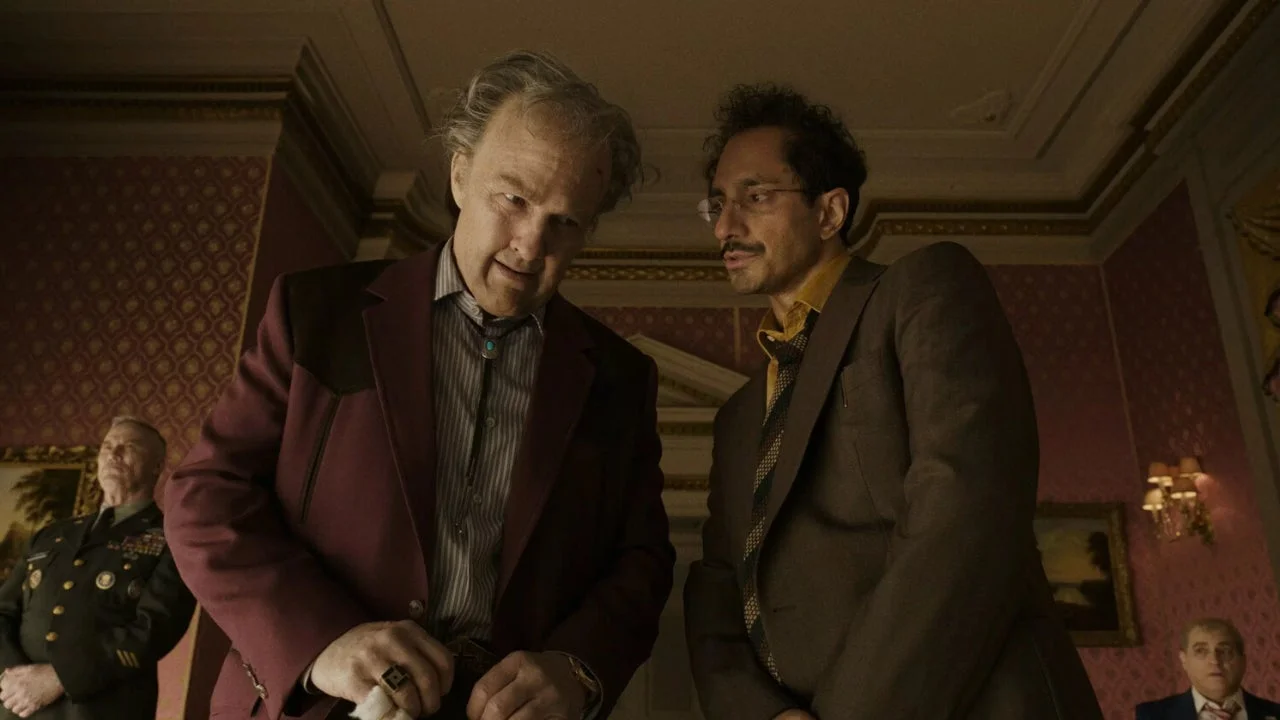
Dr. Ganesh has considerably less room to maneuver. Riz Ahmed’s scientist warned Digger about the dangers before the Greenland operation triggered an ice-shelf collapse threatening northern Europe. His knowledge neither prevented the disaster nor secured him authority afterward.
Ahmed’s mounting agitation gives this imbalance a human cost: he has to keep persuading people whose power includes the freedom to disregard him. When Digger proposes bombing icebergs, the familiar relationship between expertise and decision-making becomes grotesque. The man who ignored the warning still has the means to make his next idea everyone else’s problem.
Digger’s address to an assembly of European leaders extends that struggle into public persuasion. He attacks their dependence on petroleum, turning the comforts of consumer life into evidence against their objections. Cruise gives the speech an abrasive momentum, his drawl and physical swagger making accusation feel like command.
There is a legitimate contradiction in societies consuming the products of an industry they condemn. Digger exploits it to blur the difference between using those products and controlling their manufacture. His dismissal of renewable energy and nuclear power receives little resistance, allowing his claim to realism to occupy space that an actual argument should fill.
The administration’s prayer circles offer a sharper comic account of political bad faith. Religious devotion is welcomed for its public usefulness and discarded once the faithful have served their purpose. Here, the joke describes an arrangement rather than announcing that the powerful are fools.
Digger’s attachment to Maggie, his ancient, incontinent cat, supplies a different scale of concern. He can lavish attention on a creature within his household while refusing the obligations attached to his industrial reach. The contrast makes his affection credible without making it exculpatory; tenderness has a very small jurisdiction in his life.
Then the film changes the status of everything being watched. The disaster story is an elaborate theatrical production, and Cruise also plays Curtis Markson, the anxious actor portraying Digger. The revelation redirects attention toward the people manufacturing this account of political failure.
Curtis and his director, played by Sophie Wilde, dispute the purpose of their undertaking, while Kenny, a financial backer played by Jesse Plemons, enters their discussion. The question of authority survives the change of setting. A production devoted to exposing the misuse of power has its own negotiations among artistic intention, performance, and money.
Cruise makes that transition worth watching. Digger’s certainty is an aggressively assembled thing: the prosthetic face, Western clothes, satin pajamas, cowboy boots, and expansive behavior turn privilege into a costume that seems to license every demand. Curtis’s anxiety unsettles that construction.
The actor can reproduce the confidence of a man who expects obedience while struggling to establish what the reproduction accomplishes. This is the film’s most productive use of Cruise’s commanding presence. His ability to monopolize attention becomes part of the subject, and the quieter exchanges with the director complicate the pleasure of watching him dominate a room.
The production design prepares for the theatrical frame through details that refuse naturalism. Maggie is a puppet, at once pitiable and repellent; miniature backdrops make the manufactured world conspicuous. Dennis Gassner’s elaborate settings offer the pleasure of inspecting an illusion whose construction remains visible.
That visibility matters because Digger’s political authority is itself sustained by presentation. Yet the reveal cannot settle every objection to the earlier broadness. Once the disaster becomes a performance within a performance, its consequences acquire distance. The ingenuity of the construction can command attention that the catastrophe’s human meaning struggles to retain.
Emmanuel Lubezki’s desaturated imagery brings that difficulty into the assembly sequence. The predominantly gray gathering provides a stylized field against which Digger’s gestures seize the eye. It is an effective image of political attention being captured, but the surrounding figures become visually interchangeable.
Their objections matter chiefly as resistance for Cruise to overwhelm. The staging exposes domination while granting the dominant figure the scene’s expressive vitality. This makes the sequence exciting and politically uneasy: the film’s strongest performer supplies much of the pleasure attached to the power being attacked.
The backstage disputes could deepen that unease by examining what political art can accomplish under the conditions that finance it. Kenny’s intervention gives this inquiry a concrete foothold. The discussion becomes less searching when the difficulty of making meaningful art threatens to take precedence over the conditions being represented.
Curtis’s uncertainty deserves dramatic attention, but it does not confer insight by itself. The production’s argument about purpose needs consequences beyond the distress of its participants. Otherwise, the environmental emergency risks becoming an imposing setting for artistic self-examination, with the scale of the catastrophe underwriting the seriousness of the performers’ concerns.
A related limitation appears in the recourse to a wealthy figure’s resources and technology as a means of addressing the disaster. Changing the character of the benefactor leaves the concentration of agency largely intact. Wealth retains the capacity to create damage and the privilege of supplying relief, while those outside the governing rooms remain dependent on decisions made within them.
The theatrical frame makes this persistence especially uncomfortable. Curtis and his director can debate the value of their work, but Kenny’s presence establishes a material condition of that debate: the person financing the representation can enter it and speak.
Digger arrives in theaters in the United States and the United Kingdom on October 2, 2026, following a premiere in London. The satirical comedy-drama follows a wealthy tycoon racing against time to prove he is humanity’s savior after unleashing a potential world-ending disaster.
Where to Watch Digger (2026) Online
Full Credits
Title: Digger
Distributor: Warner Bros. Pictures
Release date: October 2, 2026 (United States and United Kingdom)
Rating: 15
Running time: 2 hours 8 minutes (128 minutes)
Director: Alejandro G. Iñárritu
Writers: Alejandro G. Iñárritu, Nicolás Giacobone, Alexander Dinelaris, Sabina Berman
Producers and Executive Producers: Tom Cruise, Alejandro G. Iñárritu, Mary Parent
Cast: Tom Cruise, Riz Ahmed, John Goodman, Sandra Hüller, Michael Stuhlbarg, Jesse Plemons
Composer: Cosmo Sheldrake
The Review
Digger
Digger gives corporate culpability a commanding face in Tom Cruise, whose swagger makes political domination disturbingly entertaining. Its elaborate artificial world opens a serious argument about who controls the telling of catastrophe. Yet the theatrical frame distances human consequences, and the proposed rescue preserves wealth’s authority. The film exposes the privileges of power with greater precision than it imagines their removal.
PROS
- Cruise’s forceful performance and revealing shifts into Curtis.
- Sharp depiction of corporate and government complicity.
- Elaborate design that makes fabrication part of the argument.
- Prayer-circle satire grounded in political behavior.
CONS
- The theatrical frame weakens the catastrophe’s human immediacy.
- Artistic anxiety threatens to displace political inquiry.
- Wealth retains control over both destruction and relief.
- Gray assembly staging makes opposing figures interchangeable.