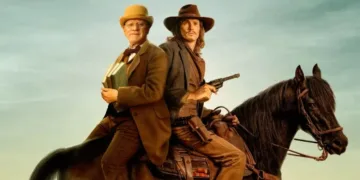



























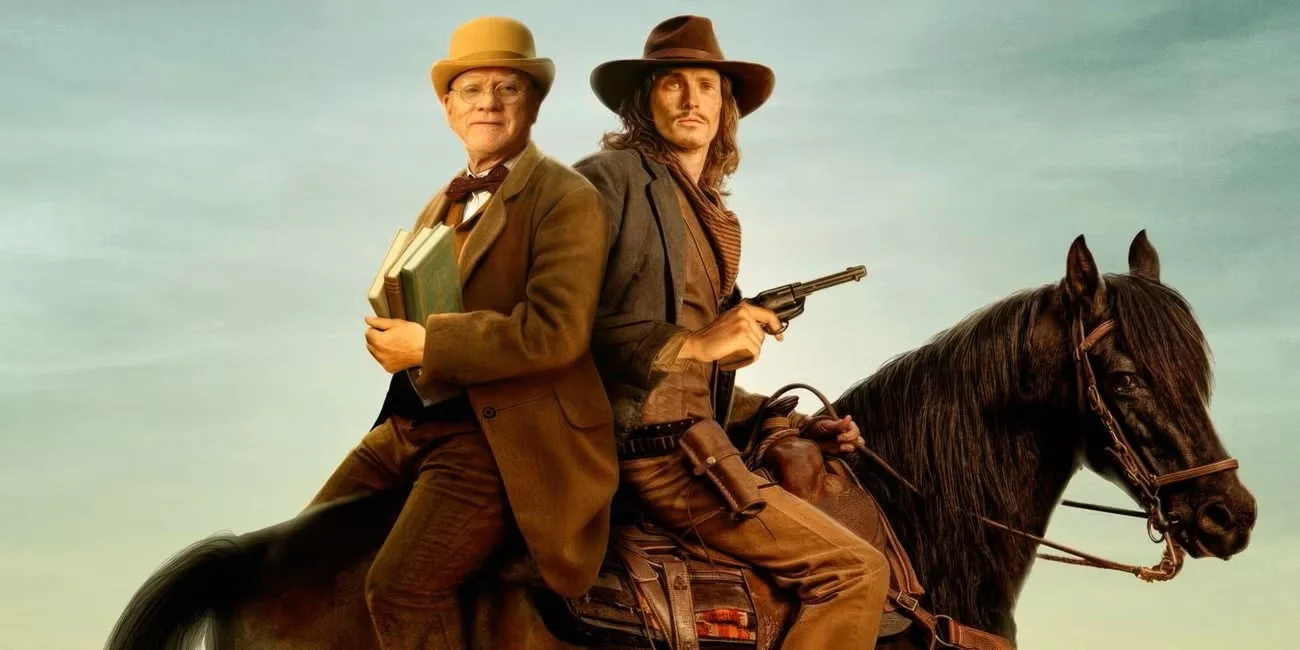

Cecil Peachtree responds to being robbed by offering his robber a job. Stranded at a frontier railway station, the English schoolteacher promises Jedidiah Dooley his first month’s salary if the outlaw gets him to Fortune before classes begin on Monday.
It is a useful opening bargain for Last Train to Fortune: Cecil can negotiate, Dooley needs money, and neither has much reason to trust the other. Malcolm McDowell’s elaborate politeness makes the proposal funny, but the writing gives it practical sense. Cecil has identified something worth bargaining with after his possessions have proved a disappointing haul.
Their arrangement becomes less comfortable when Dooley loses Cecil’s pocket watch in a poker game. The watch was a gift from Cecil’s father, so its disappearance carries a cost that the promised salary cannot cover. Transporting the teacher is one obligation; respecting what matters to him is another.
That distinction gives this modest Western comedy its most productive dramatic material. The friendship develops through the gap between what Dooley has agreed to do and what Cecil gradually needs from him, with the outlaw’s carelessness becoming harder to dismiss once another person bears the consequences.
Director Adam Rifkin, working from Michele Rifkin’s screenplay, gives the partnership an effective comic rhythm early on. At their first campfire, Cecil delivers an earnest account of the pleasures of teaching while Dooley falls asleep. McDowell supplies the conviction that makes the interruption work.
Cecil believes his listener should be grateful for the opportunity, and his persistence leaves him slow to recognize the audience’s departure. Paxton’s contribution is economical here: Dooley’s exhaustion answers the speech without requiring a competing routine. The scene establishes incompatible priorities while allowing both men to remain understandable.
McDowell is particularly good at keeping Cecil’s dignity intact through humiliations that ought to dismantle it. In Lobo, his cheerful greeting to a passing stranger receives a hostile response, yet his courtesy remains his preferred means of dealing with people. The performance makes that persistence entertaining without rendering the teacher entirely helpless.
His bargaining at the station has already demonstrated an ability to read a situation. His professional history complicates him further: an altercation with a British headmaster and rejection elsewhere have left Fortune as his remaining opportunity. There is temperament beneath the cultivated delivery, and McDowell makes room for it.
Dooley’s characterization develops less successfully through withheld information. Paxton makes the outlaw’s tough presentation visibly insecure, which helps the comic exchanges but weakens the later disclosure that he has never killed anyone. The screenplay schedules a revelation that the performance has already delivered.
This is a problem of emphasis rather than a fatal weakness in the pairing. Dooley remains an agreeable companion, and his growing willingness to protect Cecil gives him a credible direction. The film gains more from watching him accept responsibility than from asking us to reassess how dangerous he might have been.
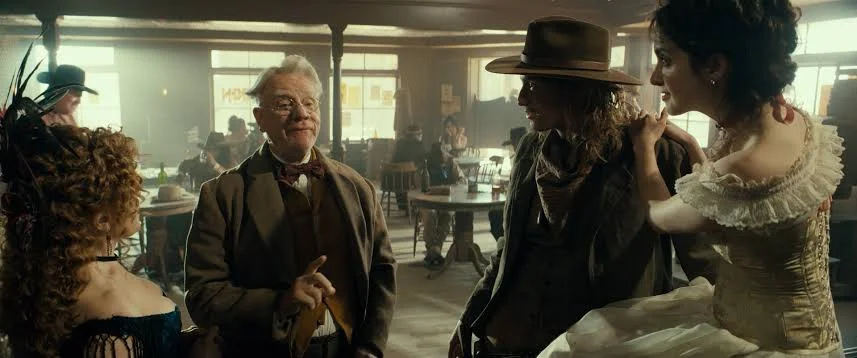
The middle stretch is uneven because its adventures do different amounts of work. Lobo supplies gambling, saloon distractions, intoxication, and trouble with the law. Dooley’s loss of the watch deepens an existing conflict, while Cecil’s disastrous introduction to whiskey shifts the comedy toward physical indignity.
McDowell commits to the latter, including the vomiting, but the gag offers less interaction between the leads than the campfire exchange. For a while, Cecil becomes someone to whom embarrassing things happen. Imprisonment and escape restore movement, yet the Monday deadline recedes behind the succession of familiar Western incidents.
An episodic route is perfectly suitable for this story. The difficulty is making each stop alter the partnership enough to justify the interruption. The encounters with Snake and Charlie bring that issue into sharper focus because their aggression introduces a severity the saloon comedy has scarcely prepared us for.
Burning Cecil’s suitcase library is an attack on something the film has taken care to establish as precious. It gives the danger personal meaning, but the brutality sits awkwardly beside the easygoing mischief. The escalation has dramatic purpose; the transition into it is less convincing.
The expansive widescreen landscapes give the trip a scale that the small cast and intimate premise might otherwise lack. Against those stretches of country, getting a teacher to a classroom can seem a substantial undertaking. The framing supports the contrast between Cecil’s narrow professional destination and the unfamiliar world he must cross to reach it. Yet scenery cannot provide progression on its own. The film is most engaging when the distance between the men changes, and less so when another obstacle simply lengthens the route.
Its argument for education benefits from moments that challenge Cecil’s authority. His surprise at meeting a well-read Indigenous man exposes the limits of his assumptions about where learning belongs. Dooley’s practical knowledge likewise makes the teacher dependent on abilities his books cannot supply.
These encounters prevent the relationship from becoming entirely one-directional. Cecil has something valuable to offer an illiterate man who has built his identity around outlaw bravado, but he also needs help, protection, and correction. The speeches about reading become easier to accept when the story permits its advocate to be taught something.
At Fortune, Cecil’s disheveled, partly bloodied arrival in the schoolroom earns a comic reaction from Mary Steenburgen as the teacher covering his absence. The interruption briefly keeps the ending in the register of a genial farce before Dooley’s presence in the classroom asks for a quieter response.
That final choice is persuasive as an expression of trust: accepting Cecil as a teacher means abandoning some of the defensive posture that shaped their first encounter. The resolution simplifies the work of changing a life, but the relationship has supplied a reason for Dooley to attempt it. Sitting down to learn is a credible decision for him; the lessons themselves still lie ahead.
Last Train to Fortune received a theatrical release in the United States on September 18, 2026, following its initial festival premiere. The Western comedy-drama follows an uptight British schoolteacher who misses his transport and forms an unlikely bond with a rugged outlaw tasked with getting him to his destination.
Where to Watch Last Train to Fortune (2026) Online

Full Credits
Title: Last Train to Fortune
Distributor: TriCoast Worldwide, Vitagraph Films
Release date: November 8, 2025 (Ojai Film Festival) / September 18, 2026 (United States)
Rating: PG-13
Running time: 1 hour 34 minutes (94 minutes)
Director: Adam Rifkin
Writers: Michele Rifkin
Producers and Executive Producers: Michael P.J. Gerstein, James Paxton, Matt Williams, Adam Rifkin, Brad Wyman
Cast: Malcolm McDowell, James Paxton, Mary Steenburgen, Bernadette Peters, Laura Marano, Lee Arenberg, Marshall Bell, M.C. Gainey
Director of Photography (Cinematographer): Chase Bowman
Editors: Daniel Flesher
Composer: Jack Ryan Sullivan
The Review
Last Train to Fortune
Last Train to Fortune builds an appealing friendship from a practical bargain, with Malcolm McDowell giving Cecil’s courtesy both comic persistence and useful intelligence. Its strongest scenes change the men’s obligations to each other. The episodic middle is less disciplined: broad gags interrupt their interplay, harsher violence unsettles the tone, and Dooley’s supposed revelation arrives late. Still, his decision to enter the classroom gives the friendship a credible destination.
PROS
- McDowell’s resourceful, dignified comic performance
- Effective early exchanges between the leads
- Friendship developed through growing responsibility
- A credible emotional payoff in the classroom
CONS
- Detours weaken the deadline’s urgency
- Dooley’s vulnerability is revealed too early
- Intoxication gags reduce the leads’ interaction
- Brutality clashes with the genial comedy