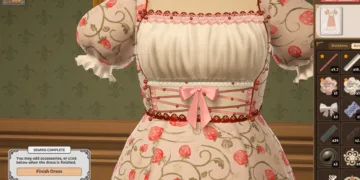


























Players coming from Style Savvy or Fashion Dreamer will recognize the kind of request Rose brings to Dressmaker’s newly opened shop in Twillford. A librarian needs something professional, and the player must translate her preferences into clothing. Her first commission specifies a Professional score of 40, a quality score of 60, and a budget of 200 gold. The familiar task of finding a suitable outfit now includes deciding on its components, purchasing the material, and sewing it together.
Black or brown wool pinstripe fabric offers a Professional score of 50 at 10 gold per metre, giving that initial brief a straightforward starting point. From there, the choices become less automatic. Bodices, necklines, sleeves, skirts, and accessories all contribute to the finished garment’s suitability. A ribbon that looks appealing can pull the design away from the customer’s requirements. Visible scores make those consequences readable, but they leave room for different answers. Rose needs a dress that meets her brief; she hasn’t handed over a picture for the player to duplicate.
That distinction gives Cozy Lives’ fashion simulation its strongest reason to exist alongside its peers. Selecting clothing and constructing clothing involve different kinds of ownership. Here, a fabric choice follows you from the sketchbook to the cutting table and onto the mannequin. Taking bust, waist, and hip measurements, then adjusting the dress form, establishes a particular person as the intended wearer. The process keeps bringing the player back to the practical demands of a commission, even when an elaborate design starts looking tempting.
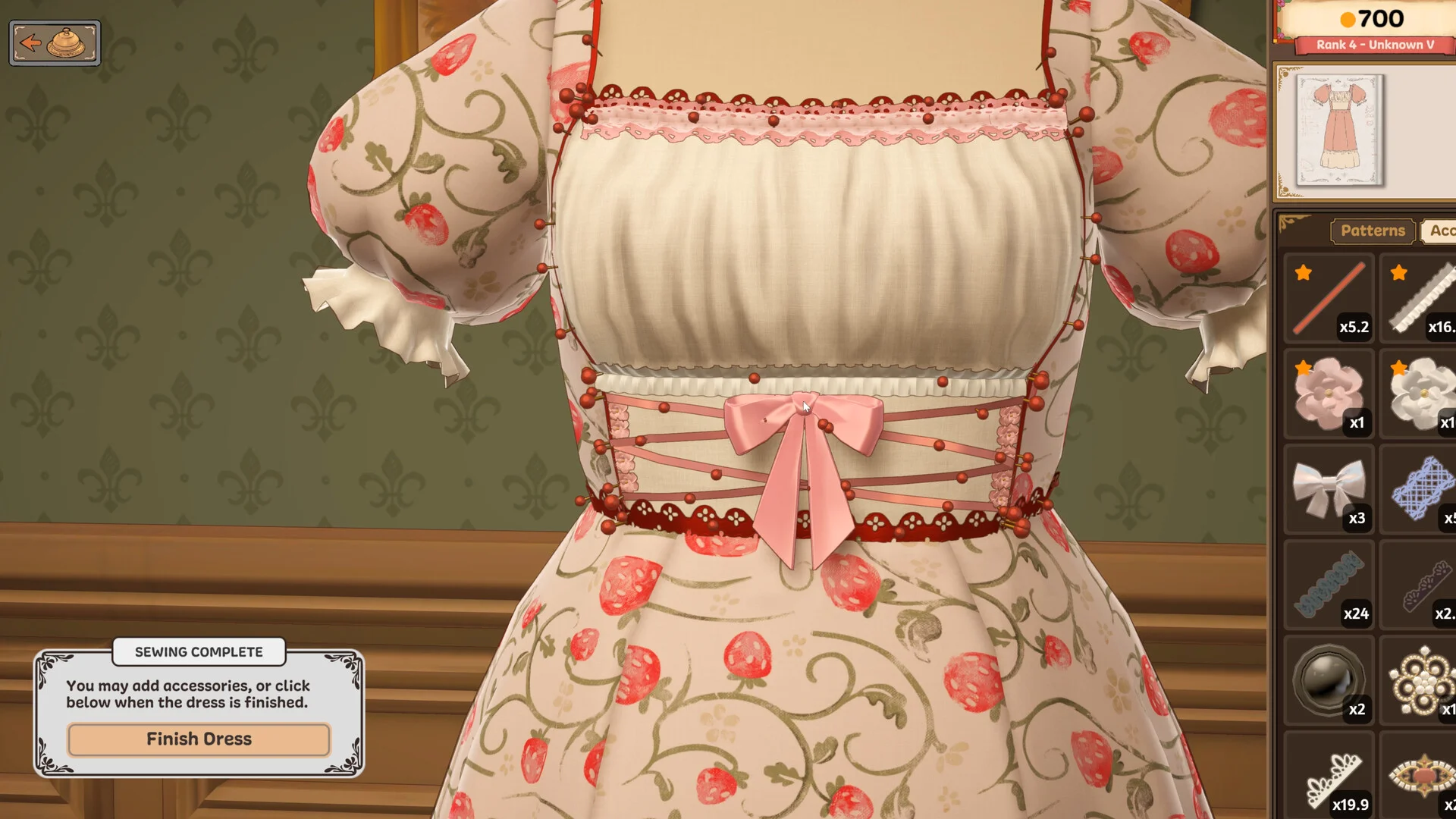
Pattern placement is especially effective at making construction matter. Pieces need to follow the appropriate grain or bias direction, while their arrangement determines how efficiently the material gets used. It introduces a spatial problem beneath the styling decisions: the beautiful fabric still has to accommodate the required pieces. Cutting itself happens automatically once the layout is ready, which keeps attention on planning. Pinning the pieces onto the mannequin then provides a useful inspection stage. An unsatisfying combination can be revised before the player commits to finishing it.
Sewing introduces a different kind of concentration. Guiding fabric along the seam and controlling the machine’s speed makes quality depend partly on execution. The sound gives this stage a convincing physical presence, from the machine’s rhythm to the scissors cutting and landing on the table. Fabric unrolling and pins entering the dress form make the quieter steps register too. Those small sounds help distinguish this from a clothing editor in which a click immediately produces the desired result. Each garment acquires a history of handling.
The realism is deliberately forgiving. A seam ripper lets the player undo stitching, recycling restores cut material, and commissions impose no timers. Sewing assist handles rotation while leaving the player involved in running the machine.
These accommodations preserve the construction process without making every mistake expensive. They also reveal the limit of the game’s appeal for someone who mainly wants to style outfits. Assistance reduces the coordination required; it doesn’t remove the time spent sewing successive pieces. After several commissions, a stage that initially establishes craftsmanship can become the familiar task standing between a new idea and its completion.
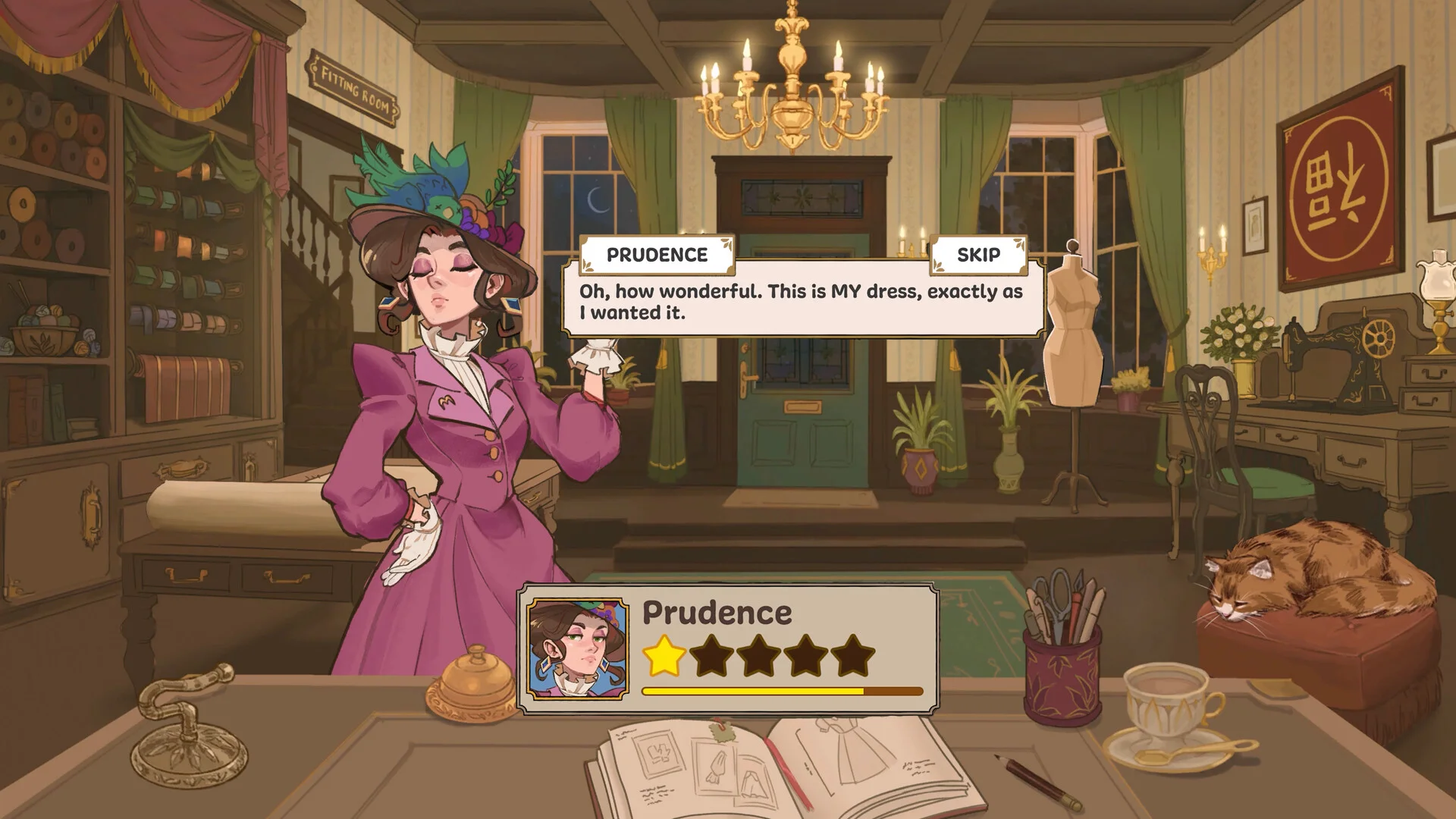
Returning customers give that repeated work a reason beyond earning money. Prudence’s interest in marrying the Duke connects with his sister Priya’s efforts to find him a spouse, while Priya also has artistic interests of her own. Their visits gradually make separate requests feel like parts of the same town.
Dorothy, who arrives with three pigeons and may leave one after a successful commission, brings a stranger sort of reward. Customers also refer to dresses made for friends or describe the confidence their new clothes have given them. The garments circulate through conversation, allowing the player’s work to acquire a social presence.
Progression supports that continuity by expanding the available designs. Simple early dresses give way to layered gowns, additional fabrics, and increasingly elaborate accessories. The useful progression is the widening range of things the player can attempt. A new pattern changes the shape of the next project; a new fabric invites a different combination. The presentation reinforces the division between meeting people and making their clothes. Illustrated patrons occupy the shop’s 2D scenes, while the 3D workspace allows the garment to become the object of close inspection.
Independent designs receive a thinner response. Off-the-rack dresses allow unrestricted experimentation between commissions, and selling them produces coins. That is welcome freedom after working within somebody else’s taste, but the sale offers little interaction.
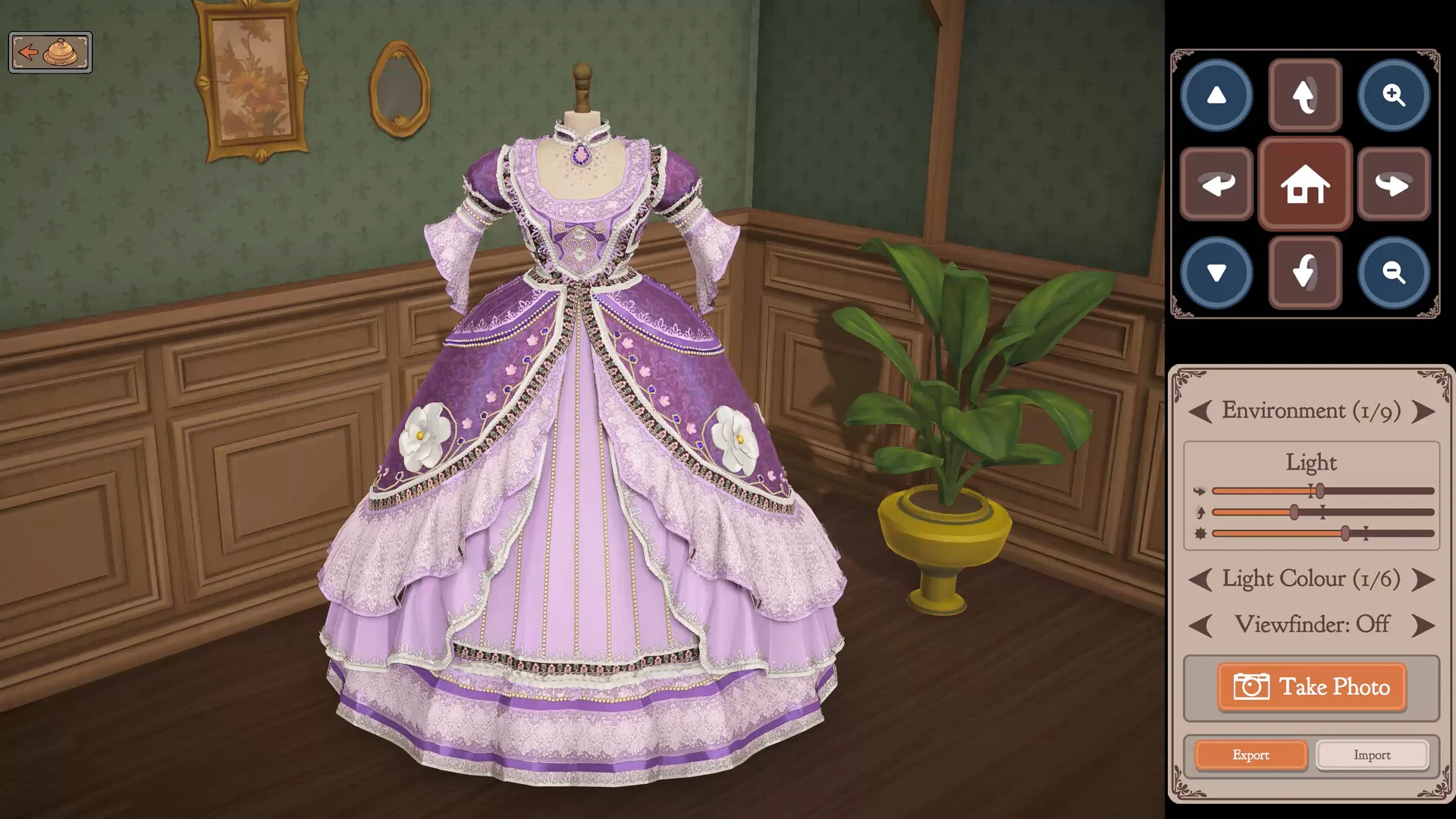
A commissioned dress might be mentioned by another patron; a personal creation disappears into a transaction. The photo tools provide backgrounds, lighting, and poses, with PNG export preserving the finished design. Yet there is no enduring display in the shop. For a game that asks players to invest in making individual garments, the limited opportunity to keep living with them is a noticeable omission.
Some of that investment is also made harder by the interface. Fabric and accessory filters need to be applied separately, adding repeated setup to a process built around checking compatible materials. Finicky accessory placement and zooming are particularly irritating near the end of a project, when the remaining work should be about getting details right. Small text can hinder handheld play. The gentle instrumental music fits the relaxed setting, though its limited selection becomes conspicuous during long sessions, especially when construction keeps the player at the same task.
Reported audio stuttering when switching away from the game interrupts that relaxed pace, while crashes involving lost progress raise a heavier concern. Their frequency cannot be established across every setup, but lost work matters here because completion involves several distinct stages. Dressmaker gives the player permission to take time over a fabric layout, reconsider a combination, or patiently sew a difficult seam. A crash can turn that care into work that has to be repeated, making a player reluctant to begin the elaborate dress the expanding catalogue has encouraged them to attempt.
The Review
Dressmaker
Dressmaker gives fashion-game players a satisfying shift from choosing outfits to constructing them. Customer briefs leave room for personal taste, while pattern placement and sewing make each garment feel earned. Returning patrons give the work a social purpose, though independent designs receive little lasting recognition. Repeated sewing and awkward controls can interrupt experimentation, and reported crashes threaten the time invested. It suits players who want to enjoy the making as much as the finished outfit.
PROS
- Flexible commissions reward thoughtful design.
- Tactile construction with forgiving correction tools.
- Connected customers give garments social significance.
- Unlocks expand creative possibilities.
CONS
- Sewing can become repetitive.
- Independent designs receive limited recognition.
- Finicky placement, zooming, and separate filters.
- Reported crashes can erase progress.