

















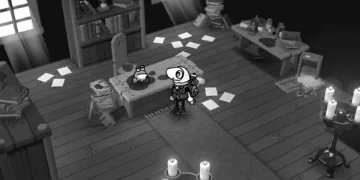





Connie sees the chair’s legs moving beneath a closed door. The narrow strip of shadow gives her too little to understand and enough to fear: something familiar has acquired an intention. Bahman Ghobadi lets the threat remain on the other side, where an ordinary piece of furniture can still shelter an unknown life.
Elsewhere, the chair appears beside a tree, a fleeting proximity that could suggest recognition, dependence, even longing. I cannot settle on an emotion for it. That uncertainty gives the image its sadness. Something seems to have survived without being able to explain what survival means.
The sounds of felled trees carry a related disturbance. Cutting becomes screaming, and wood ceases to feel like mute material. Trees Are Watching draws on a Kurdish belief that the dead return as trees and can continue their existence in the objects made from them. Within that belief, a chair might contain a person condemned to endure each alteration of its body. Ghobadi’s sound makes this possibility briefly unbearable: death offers no release, and the familiar things arranged around a room may have histories of pain their owners cannot hear.
Eva Green plays Darya, a writer returning to Mardin, Turkey, to research her work, accompanied by her Deaf daughter Connie and their dog. The house where they stay connects her to childhood friends Nihal and Spin; two large trees stand outside.
Connie hears unsettling disturbances through her hearing aid, while the dog directs its aggression toward an ornately carved chair. Neva Kuş gives Connie a lively presence within this oppressive setting. Her alertness helps the strange events register as experiences happening to someone, before they become information in a mystery Darya must solve.
The most persuasive fear belongs to the childhood passages. Nihal has absorbed the belief that people become trees, but a plumber’s story about spirits inhabiting toilets turns that distant possibility into an immediate terror. She becomes afraid to use the bathroom alone.
Ghobadi finds something deeply troubling in this small disruption of daily life: a child must inhabit a world whose simplest necessities have been made dangerous by adult speech. The young actresses playing Nihal and Spin give their circumstances a felt weight. Their fear persists through the familiarity of living together, under the same authority, in the same rooms.
Nihal’s drawings, which anticipate a dark fate for her mother, provoke the mother’s anger. Here the film approaches a painful exchange between an adult’s power and a child’s private imagination, then allows the mother to harden into a source of cruelty.
The domestic conflict needs a fuller human presence behind that threat. The sisters can carry terror through their performances, but the writing gives them too little psychological room around it. Their mother’s reduced characterization also weakens the suggested connection with Darya’s own troubled parenting. Cruelty, distress, and inherited fear gather in the same story without becoming distinct experiences.
The flashbacks create another distance. Many belong to Nihal and Spin, extending beyond Darya’s direct experience, yet the present-day drama asks us to feel them pressing upon her. Memory seems capable of moving between people as spirits move between bodies and wood, a possibility the film never quite develops.
Green lends conviction to Darya’s attempts to understand what has returned, especially when adult Spin appears with demands for revenge. In their encounters, framing that conceals mouths behind the tops of other characters’ heads unsettles the dialogue itself. Voices arrive from bodies we cannot fully read. For a while, the photographic form supplies the estrangement missing from the psychological writing.
That form loses coherence in the generative AI passages. Folklore anecdotes and some connecting views, including overhead images of Darya’s car, acquire synthetic textures that sit uneasily beside the faces and physical spaces around them.
The interruption matters particularly in a film asking us to sense life inside matter. The photographed children make fear seem to arise from a body’s dependence on its surroundings; the generated imagery gives the surrounding world an unconvincing material presence. An unconvincing log-crash sequence produces a similar loss of physical consequence through its effects. These passages leave less for the actors to inhabit, even as the film asks their performances to hold its suffering together.
The ecological idea suffers with them. Roadside logging connects the supernatural premise to visible destruction, and the association between cutting and screaming makes each fallen tree a potential death repeated. Yet the film keeps decorating and explaining this connection until its disturbing simplicity recedes.
The score’s recurring high-pitched strings exert a comparable pressure. They insist upon alarm, crowding the quieter uncertainty around Connie’s hearing and the chair’s unexplained movements. Ghobadi has found an unsettling relationship between human pain and damaged timber, then surrounds it with signals that tell us how frightened to be.
Once the chair drags openly across rooms, is taken to the police station, and eventually flies at Darya in an empty swimming pool, the film demands a different kind of belief. There is nothing inherently impossible about frightening an audience with furniture. The earlier shadow proves that. But the airborne attack directs attention toward the chair’s mechanics, while the tone continues to ask for tragic dread. The object has become so insistently active that the possible person within it is harder to feel. Its movement invites laughter the surrounding drama has little capacity to absorb.
Darya’s pleas to officer Vedad about her sanity and stopping her medication move the film toward a psychological account of what we have seen. Green sustains the distress, but the screenplay has not developed Darya’s inner life sufficiently to make this shift deepen our understanding of her. At approximately 106 minutes, the extended flashbacks and successive epilogues spend considerable time clarifying events already legible enough.
The additional explanations also change the status of the earlier encounters. Spin’s demands, Connie’s discoveries, and Darya’s fear become material to be sorted into an account of what happened. The film grants Darya an explanation without making clear how she can live with experiences that felt so physically real.
Trees Are Watching world-premiered at the Toronto International Film Festival in September 2026. The psychological thriller follows a writer who returns to her hometown with her daughter, only to be haunted by childhood memories and the mysterious environment surrounding her.
Where to Watch Trees Are Watching (2026) Online
Full Credits
Title: Trees Are Watching
Distributor: Mij Film Productions
Release date: September 2026 (Toronto International Film Festival)
Running time: 1 hour 46 minutes (106 minutes)
Director: Bahman Ghobadi
Writers: Bahman Ghobadi
Producers and Executive Producers: Martin Scorsese, Lucas Akoskin, Bahman Ghobadi
Cast: Eva Green, Murat Yıldırım, Zeynep Çamcı, Lucas Akoskin
Director of Photography (Cinematographer): Touraj Aslani
Editors: Farbod Khoshtinat
Composer: Bamdad Afshar
The Review
Trees Are Watching
Trees Are Watching briefly makes survival after death feel like imprisonment, with human pain lingering inside timber. Its childhood passages, committed performances, and partially concealed haunting give that idea weight. Synthetic imagery, thin psychological writing, and an awkward escalation into flying furniture erode the dread. The repeated explanations leave Darya’s suffering easier to identify than to feel.
PROS
- Affecting child performances and Eva Green’s commitment.
- Unsettling early staging around the chair.
- Tree-cutting sounds give ecological destruction a human presence.
CONS
- Synthetic imagery and weak effects disrupt physical credibility.
- Underdeveloped psychology limits Darya and the sisters’ mother.
- Chair attacks clash with the tragic tone.
- Repeated explanations stretch the mystery.