

























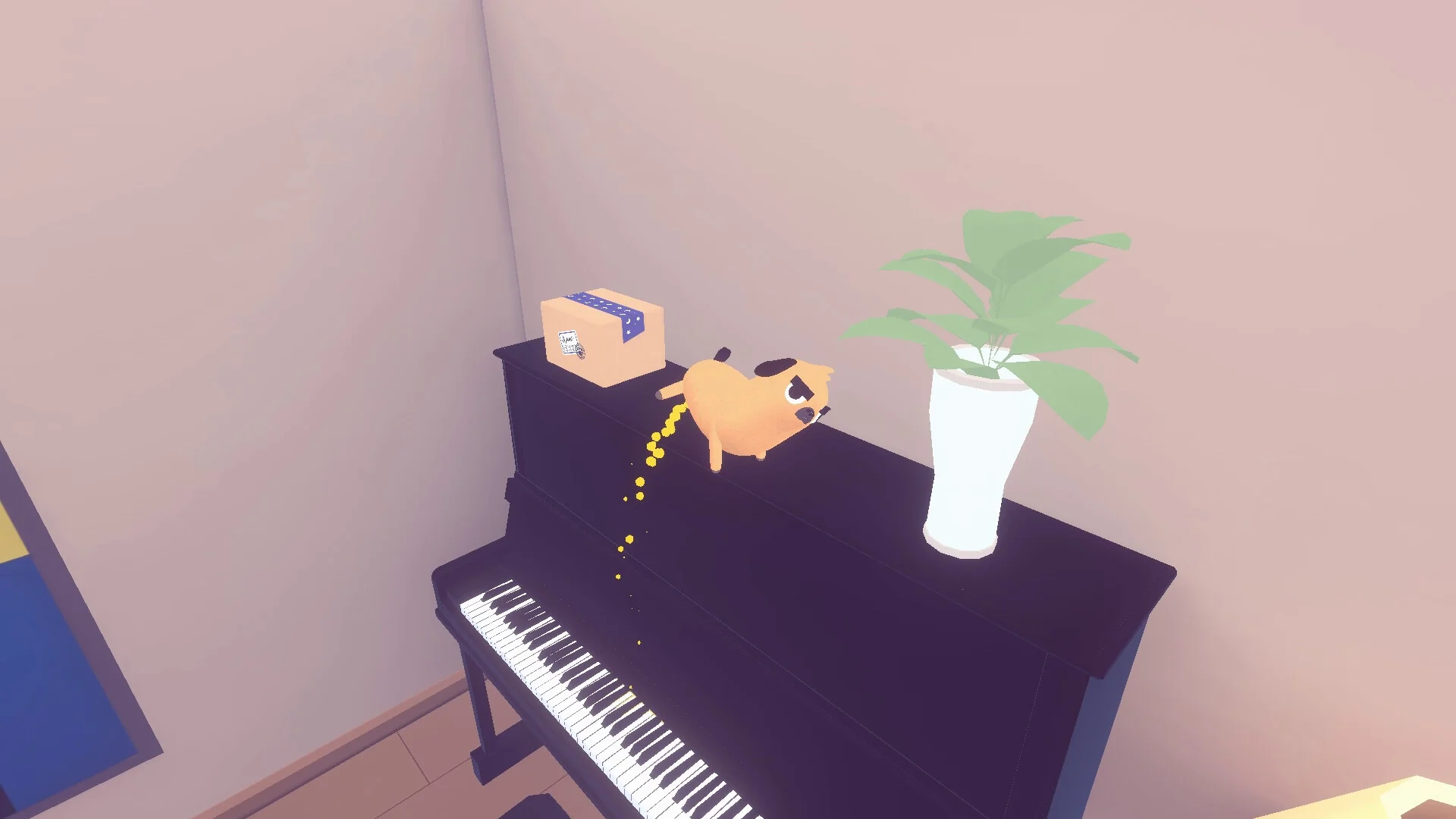

I wanted to keep Charlie moving before I cared much about his badges. His little legs work furiously beneath a rounded body, while his eyebrows suggest that the entire household has somehow disappointed him. Left alone after his owner departs, the pug has a house and garden full of things to investigate, carry, and ruin. Doggy Don’t Care gets considerable mileage from that physical presence. Running and jumping are enjoyable partly because Charlie looks so determined doing them. Affection arrives through movement, giving the subsequent destruction a willing accomplice in the player.
The house makes misbehavior easy to understand. A toilet can overflow. An oven can catch fire. Toilet paper can become something to unravel across a room. These are familiar objects with familiar uses, which gives their misuse an immediate comic payoff.
Picking things up with Charlie’s mouth, jumping onto furniture, and deploying his apparently inexhaustible bladder provide a small vocabulary for experimentation. There is pleasure in discovering how far those actions reach, especially when something ordinarily treated with care becomes available to an animal with no apparent interest in keeping it intact.
That freedom soon acquires a gentle sense of purpose. The opening house asks you to find ten hidden treats before working through a collection of badges, each awarded for a particular activity. Finding a remote and turning on the television sits alongside feeding toast to a pigeon and causing domestic disasters.
The quieter tasks matter. They make Charlie’s world feel available for play beyond the immediate pleasure of smashing something. Badge pictures offer clues to the required actions, while Rocko, a cockatoo, provides hints if a missing objective leaves you wandering. The satisfaction comes from recognizing a possibility in the surroundings and making it happen.
There is a useful tension between that discovery and the requirement to finish the badge set before moving on. At first, a badge gives an amusing experiment a little acknowledgment. Later, the remaining pictures can redirect your attention toward something specific you have overlooked.
Doggy Don’t Care keeps that search approachable: the clues and hints allow curiosity to survive a moment of confusion. Its puzzles rarely demand a strenuous leap of logic, but interpreting an image and identifying the relevant object still gives you something to contribute. The ease works because the game leaves room for the small pleasure of figuring things out.
Across its four locations, the scale of that pleasure grows. Home gives way to a farm, an office, and a museum, with the farm expanding the space available for Charlie’s interference. Activating a combine harvester and putting tools into its shredder takes the domestic joke into a setting where the equipment can accommodate much larger trouble.
The museum’s linked badge activities offer a different kind of escalation, asking you to connect actions across a multi-step solution. This is where the game’s curiosity feels most productive. Familiar controls can still produce a fresh response when the surroundings ask you to think about their relationship differently.
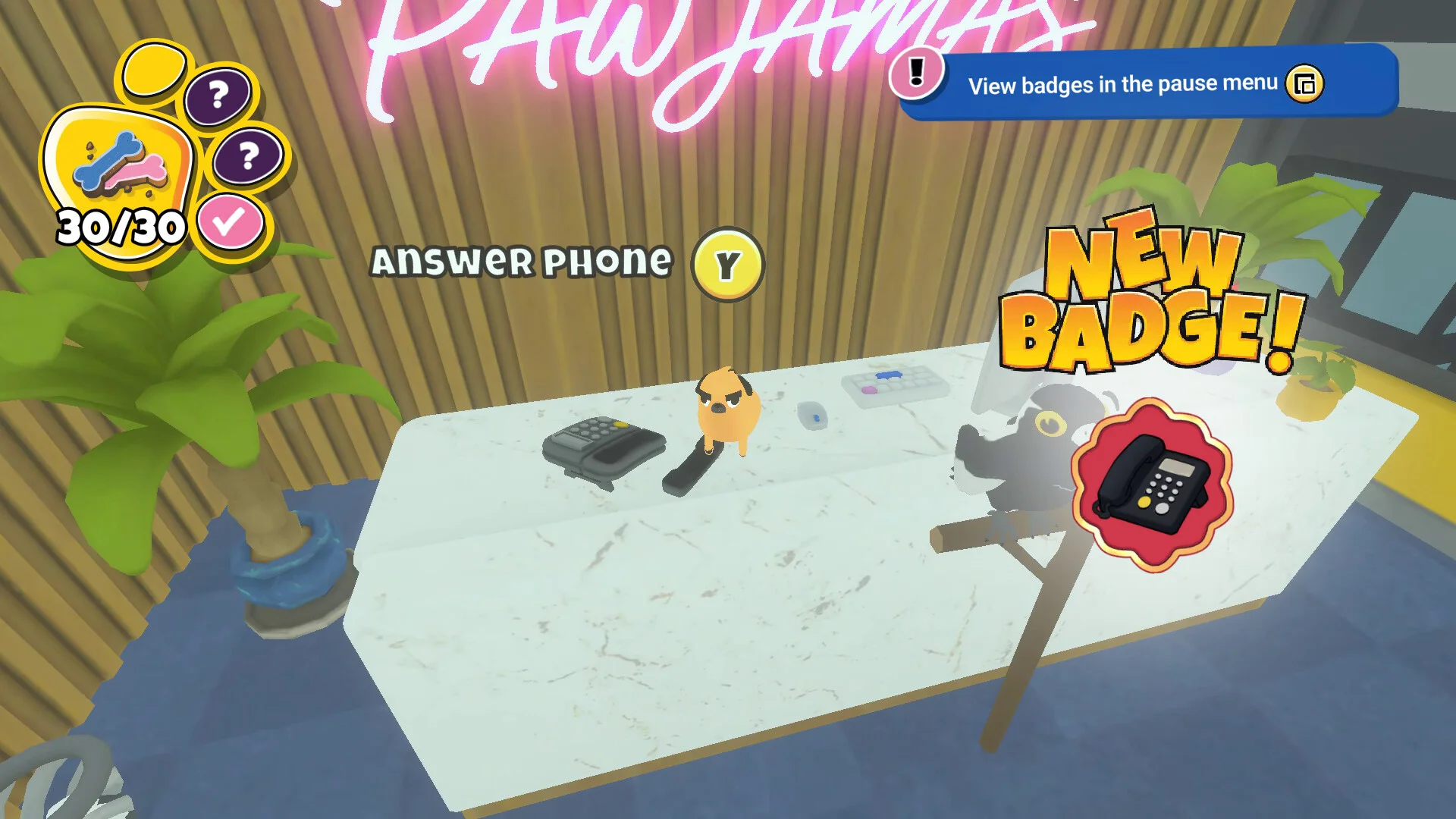
The cartoon presentation helps keep those surroundings inviting. Important objects stand out without the rooms and outdoor spaces needing elaborate detail, and Charlie’s exaggerated proportions fit comfortably into their simplified world. A squeaky toy or the sound of a tractor gives an interaction a recognizable response, helping a small action feel worth performing.
Charlie’s own bark is less expressive, repeating the same pitch and tone instead of extending the personality conveyed by his movement. The seventeen outfits offer another way to enjoy his appearance, though their appeal remains cosmetic. Dressing him differently cannot change what the next room asks your hands to do.
That limitation becomes noticeable during longer sessions. Fresh settings and connected puzzles help, but you spend much of the game returning to the same acts of carrying, jumping, urinating, and knocking things over. Once the pleasure of seeing Charlie do something outrageous begins to fade, another breakable object can feel like familiar business.
A larger map does not automatically restore the surprise. The sluggish camera adds a separate irritation: even with sensitivity turned up, looking around can take longer than it should. For a game that invites you to spot possibilities and follow impulses, that delay puts an unwelcome pause between curiosity and action.
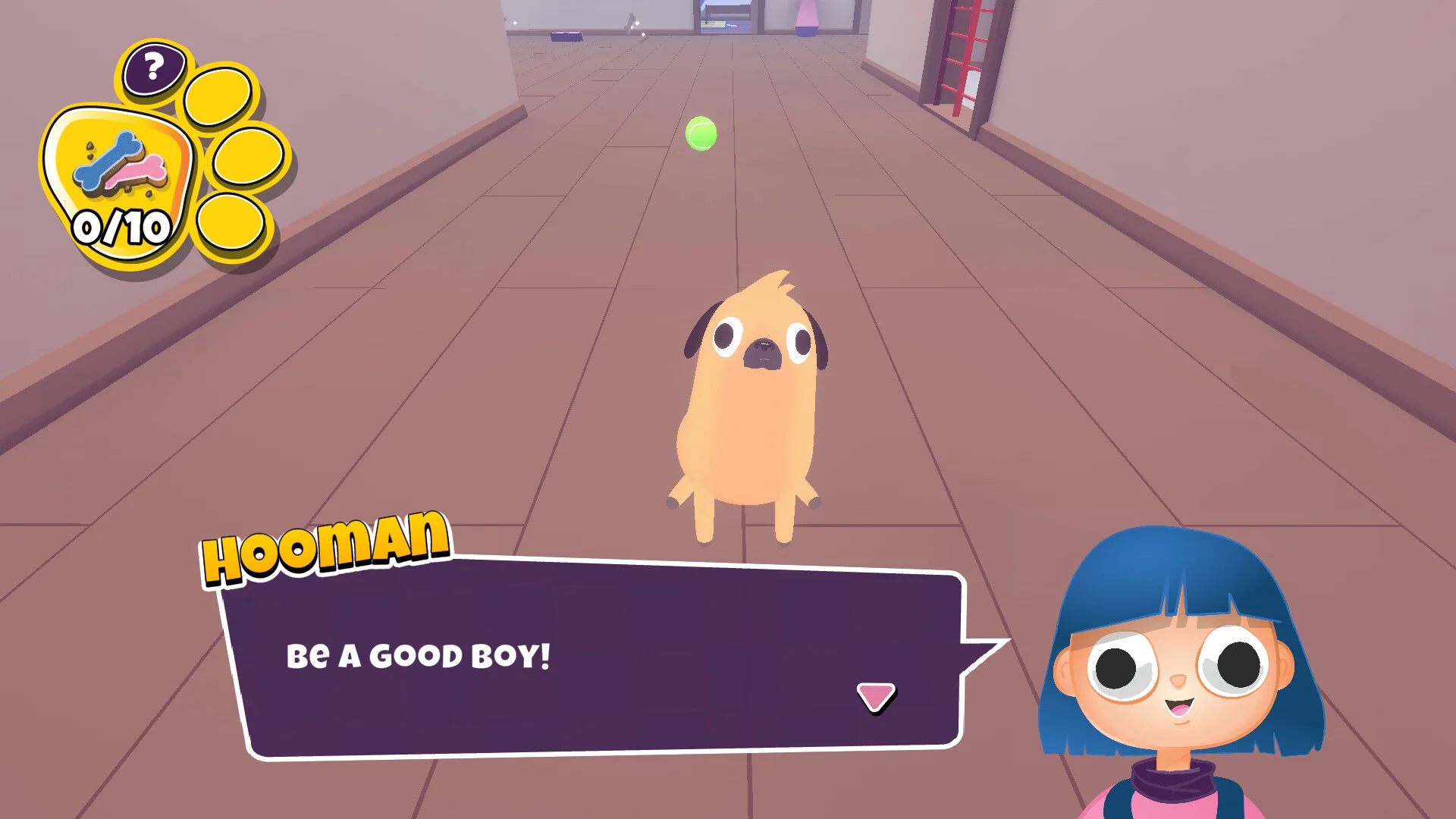
The dreamlike interludes briefly give Charlie a different purpose, sending him through surreal spaces in search of his owner. Seeking the person who left him behind introduces a softer feeling alongside his daytime disruption. The contrast is suggestive, but the story remains slight, and these sequences do not supply a developed explanation for his behavior. Their most useful contribution is the change in mood and activity. After so much attention to what Charlie can damage, being asked to look for someone lets his attachment register without requiring the game to abandon its playful scale.
I would give Charlie a level at a time, with enough space between visits to recover some interest in his habits. This small game deserves that attention because its approachable puzzles make discovery available without turning play into a test of endurance. It also asks you to recognize when the fun is thinning. Taking a break after a stretch of repeated destruction leaves the next location a better chance of becoming a place to investigate, with its own objects and connections to notice, instead of another badge list to clear.
The Review
Doggy Don't Care
Charlie’s determined little trot makes Doggy Don’t Care easy to love, and its approachable puzzles give that affection somewhere to go. Turning household objects into opportunities for mischief brings genuine pleasure, especially when later badges connect several discoveries. Repeated actions gradually dull the surprise, and the sluggish camera interrupts exploration. Give this small adventure a level at a time, and its playful curiosity has room to recover.
PROS
- Charlie’s expressive movement and personality
- Accessible puzzles with helpful visual clues
- Connected objectives refresh familiar actions
- Clear cartoon visuals support exploration
CONS
- Limited actions become repetitive
- Sluggish camera rotation
- Charlie’s bark lacks vocal variety