






























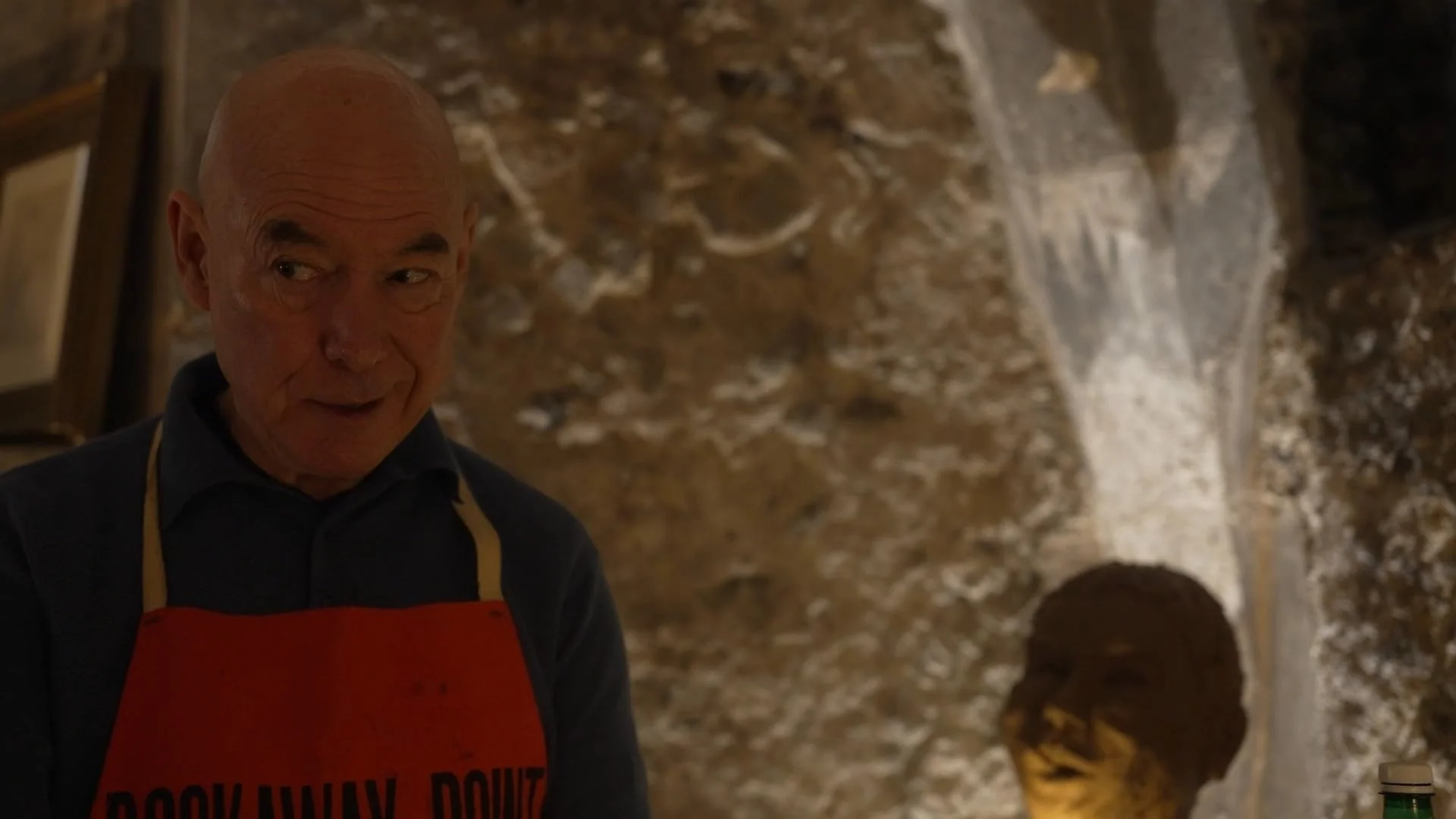
Robert Marlowe seems quite comfortable telling a young visitor that the manufacturer of his kiln also made ovens used in the Holocaust. The discomfort belongs to everyone else. Tommy, the 19-year-old sex worker he has invited into his basement studio, has arrived for a paid encounter with a married politician. Marlowe supplies the pottery tour and the appalling historical aside. Peter Benedict plays this hospitality with a relish that makes it difficult to settle into the scene: the host appears to be enjoying himself, and his idea of a pleasant evening already feels dangerous.
When an apparent death following erotic asphyxiation turns the visit into a disposal problem, that earlier conversation becomes horribly practical. The kiln is still there. So is the sealed door. Marlowe summons his assistant, Mark, and the basement begins to feel like a place equipped to absorb whatever happens inside it. Executioner gets considerable tension from this change in our understanding of the room. Objects associated with a private hobby become possible instruments of concealment, while the man who introduced them retains an unnerving degree of composure.
The sculpted heads and Gilbert and Sullivan give Marlowe’s retreat a cultivated fussiness. He has arranged somewhere to indulge his tastes, away from the public life upstairs, and expects to determine the terms of every encounter within it. His objection to being called “colourful,” with “maverick” offered as the preferred description, is funny because the correction matters so much to him. Even here, with someone hired for the night, he is managing his reputation. The joke also makes his company unpleasant in a precise way. Tommy must contend with a customer who wants control over both the encounter and its vocabulary.
Benedict’s performance supplies much of the film’s uneasy amusement, though his appetite for the role sometimes gets ahead of its effect. Marlowe’s elaborate speech and upper-class manner can make ordinary exchanges feel like opportunities for a speech. At his best, Benedict lets the character’s enjoyment disturb us: a man discussing terrible possibilities should perhaps find them less agreeable.
When the delivery becomes too emphatic, the threat loses some of its immediacy. We have time to notice how strenuously the villain is being presented. The opening stretch is especially vulnerable to this, asking us to spend time with Marlowe’s manner before the competing agendas give his talk sufficient resistance.
Christian Greenway provides that resistance as Mark. His physical assurance and less ornate delivery change the atmosphere without needing to compete with Benedict’s extravagance. Mark has arranged Tommy’s visit and is called upon to help handle its consequences; his work places him inside Marlowe’s secrets.
Greenway makes that practical involvement feel credible. Against Marlowe’s verbal flourishes, his presence gives the situation weight, reminding us that any proposed solution will require somebody to carry it out. Max Raphael’s comparatively natural performance helps too. The contrast keeps Marlowe’s theatricality attached to a particular personality instead of allowing it to become the film’s only register.
Benedict adapted Executioner from his play Deadlock and co-directed it with William Willoughby. Its theatrical construction remains clear in the single room, the arrivals and departures, and the dialogue that repeatedly changes the balance of knowledge.
There is pleasure in being held close to these exchanges. We cannot leave Marlowe’s basement to check an explanation against events elsewhere; we have to listen to the people making their claims. The enclosed setting gives each new account an immediate importance. It also exposes the stretches when conversation stops increasing the pressure and simply supplies another version of who has outsmarted whom.
That becomes the film’s persistent difficulty as the apparent death gives way to blackmail and overlapping deceptions. Following the revisions can be enjoyable. An exchange that seemed settled acquires a different meaning when someone reveals what they knew, and attention shifts from the immediate predicament to the information being withheld.
But curiosity and fear move at different speeds here. The film keeps providing reasons to reconsider the situation while struggling to make every reconsideration feel dangerous. Its three-act progression changes our understanding of the conflict without always changing the emotional experience of sitting through it.
Marlowe’s composure contributes to that problem. Early on, his lack of alarm makes him frightening because it suggests a readiness to do things that would horrify somebody else. Across successive reversals, the same assurance can make him seem protected by the writing.
Each new complication invites us to anticipate another explanation that will restore his advantage. The increasingly far-fetched plotting remains entertaining as a contest of nerve, but it asks for renewed investment each time the apparent stakes are rearranged. There are passages when guessing the next maneuver occupies the space where anxiety had been.
Christina Cole’s small role as his wife supplies another pressure: discovery would connect the hidden basement to the respectable household beyond it. Yet Marlowe’s treatment of the marriage as cover gives that possibility a particularly sour feeling. His concern invites us to imagine exposure as a crisis for him, while leaving the person being deceived largely outside the conversation. Even with a possible body to conceal, he remains intent on controlling what his wife is allowed to know.
Executioner was released on streaming platforms on July 6, 2026, via Reel2Reel Films, and is available to watch on Amazon Prime Video. Directed by William Willoughby and Peter Benedict and adapted from Benedict’s hit stage play Deadlock, this psychological thriller centers on a high-profile politician who successfully foils a sinister blackmail scheme and constructs a calculated, shocking plan of retribution.
Where to Watch Executioner (2026) Online







Full Credits
Title: Executioner
Distributor: Reel2Reel Films, Lovebomb Pictures
Release date: July 6, 2026
Rating: 16+ / Unrated
Running time: 1 hour 47 minutes (107 minutes)
Director: William Willoughby, Peter Benedict
Writers: Peter Benedict
Producers and Executive Producers: William Willoughby, Peter Benedict
Cast: Peter Benedict, Christina Cole, Christian Greenway, Max Raphael
The Review
Executioner
Executioner makes sharing a room with Robert Marlowe unpleasantly entertaining. His casual cruelty, the basement’s sinister practicalities, and Christian Greenway’s grounded presence create unease that survives some cumbersome dialogue. The accumulating deceptions hold your attention, though Marlowe’s persistent composure gradually turns fear into a guessing exercise. There is pleasure in this small thriller’s nasty humor, even when its elaborate plotting leaves you watching for the next explanation rather than worrying about its consequences.
PROS
- Basement setting gives the danger physical weight.
- Greenway brings credible resistance to Marlowe.
- Dark humor grows naturally from Marlowe’s behavior.
CONS
- Benedict’s emphatic delivery sometimes weakens the menace.
- Verbal maneuvering can leave scenes feeling static.
- Far-fetched reversals gradually erode anxiety.