



























Ringing bells to stop a dragon gives Ajira’s musical abilities an urgency that a score counter could never supply. During the first boss encounter in SURI: The Seventh Note, Phase becomes a way to answer something enormous and dangerous through timed movement. There is no conventional fight to interrupt the platforming. The same attention that carries Ajira between platforms becomes the means of surviving the chase, and the pleasure comes from discovering that she already has the language needed to respond.
Tathvamasi Studios gives that participation an audible reward across its rhythm platformer. Keep landing actions on the beat and the music fills out as the performance grade rises from C toward S. Ajira’s golden appearance at the highest rank is the obvious celebration, but the expanding instrumentation offers the warmer encouragement. You can hear your contribution. A passage completed cleanly feels different from one merely survived because the soundtrack has acquired a fullness that your actions helped produce. On PS5, DualSense pulses offer another physical cue for staying with that rhythm.
There is room for curiosity within this discipline, too. Echo lets Ajira hover or gain an extra airborne jump through timed interactions with designated objects. Fruit-spitting plants can be used to clear obstacles, then provide a springboard toward higher ground. These are lovely discoveries because they give the environment several possible uses. Learning the beat creates enough familiarity to start looking for opportunities inside it. The plants invite the player to think about an object’s possibilities before treating it as another point where a button must be pressed correctly.
That sense of participation suits Ajira’s reason for leaving home. Her mother is suffering from the illness that killed her father, and fruit from the sacred Kalpavriksha tree offers the hope of saving her. Leaving becomes necessary as her mother’s condition worsens, despite Ajira’s reluctance to go. The island’s sickness has its own mythology, involving a curse released through an attempt to steal the tree’s power, but the family situation supplies the immediate pull. Restoring balance has a person attached to it before it becomes an obligation to an entire world.
The musical design makes that larger task understandable through sensation. In a place where sound governs life, helping an arrangement fill out feels like a small enactment of recovery. The hand-drawn setting gives that idea a particular home: temple structures and mountain monasteries, spirits and creatures with painted faces, colors shaped by Theyyam influences. Idakka drums and Elathaalam cymbals help establish the pulse. I appreciate how these choices make the island worth attending to. The architecture and musical textures offer pleasures that survive even a sequence of failed jumps.
Ajira’s personal story has a harder time maintaining that attention. Illustrated scenes and text communicate the situation economically, while repeated nonverbal vocal sounds give conversations a monotonous texture. The mother’s illness remains an understandable reason to continue, but the immediate emotional activity increasingly belongs to the platforming: anticipation, concentration, satisfaction, irritation. The growing soundtrack can make the island feel responsive without bringing Ajira’s relationship with her mother into similarly close focus. Saving someone and completing a demanding passage occupy the same adventure, yet they do not always feel closely connected.
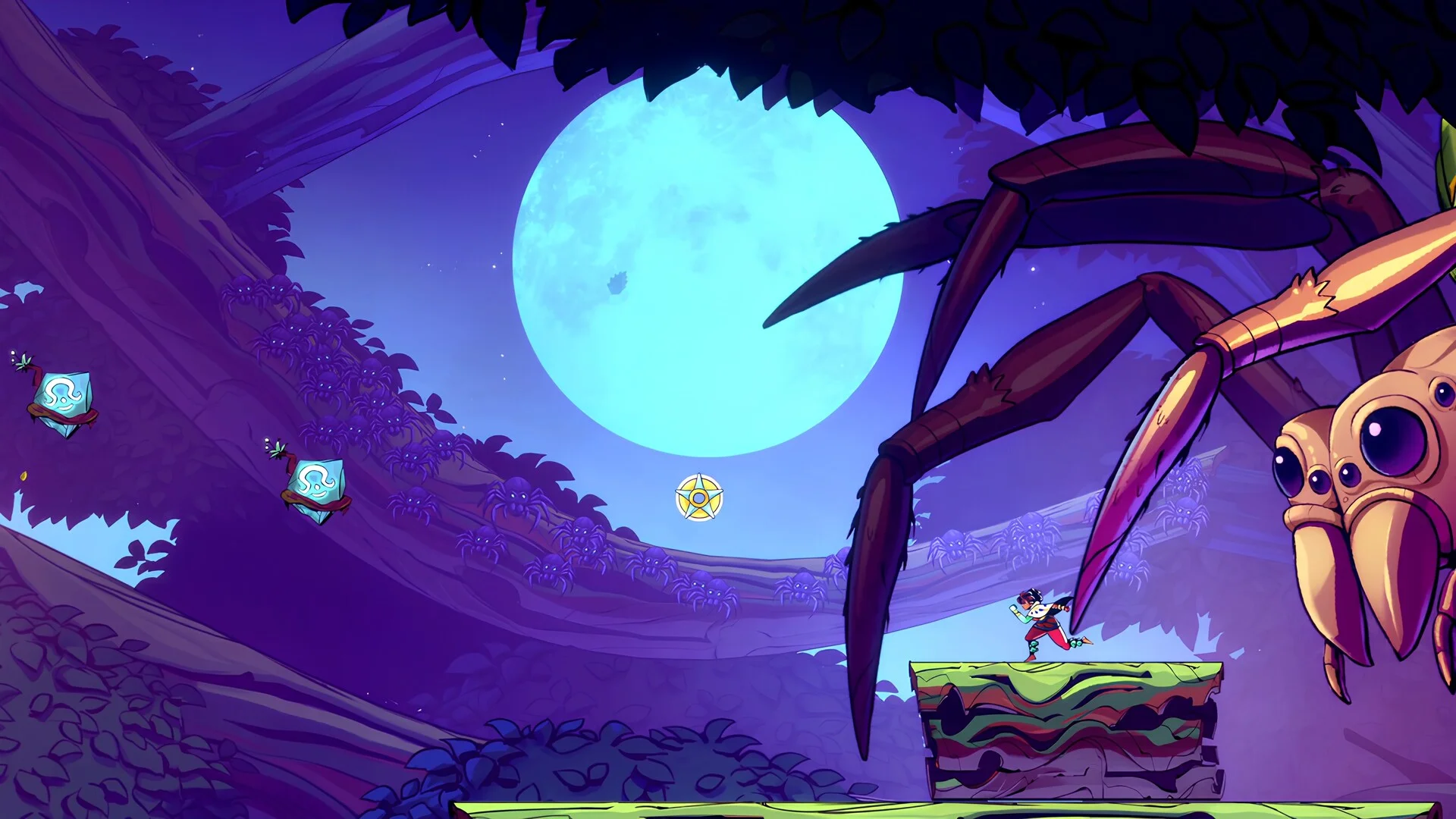
The strain becomes apparent in an early stretch involving spider webs. Ajira must keep contacting a platform to remain suspended, with little tolerance for a mistake in position or timing. Failure means repeating the screen. There is satisfaction available in learning that sequence, but several demands arrive together: staying on the beat, reaching the correct point, and reading the next movement. Repetition becomes tiring when attention remains fixed on securing one exact contact instead of gradually reaching further into the passage. The plant interactions’ invitation to experiment gives way to a much narrower task.
Visual richness can tighten that pressure. Platforms and hazards sometimes compete with the surrounding detail precisely when they need to be immediately legible. Following the music can help organize a busy screen, but particular late-game bell interactions can also make the audible pulse difficult to reconcile with the expected contact. The calibration procedure establishes an initial timing reference; it does not make every later failure self-explanatory. Calling all of this a single synchronization fault would be too neat. Strict timing, crowded imagery, and uncertain feedback can each interrupt the feeling of moving comfortably with the world.
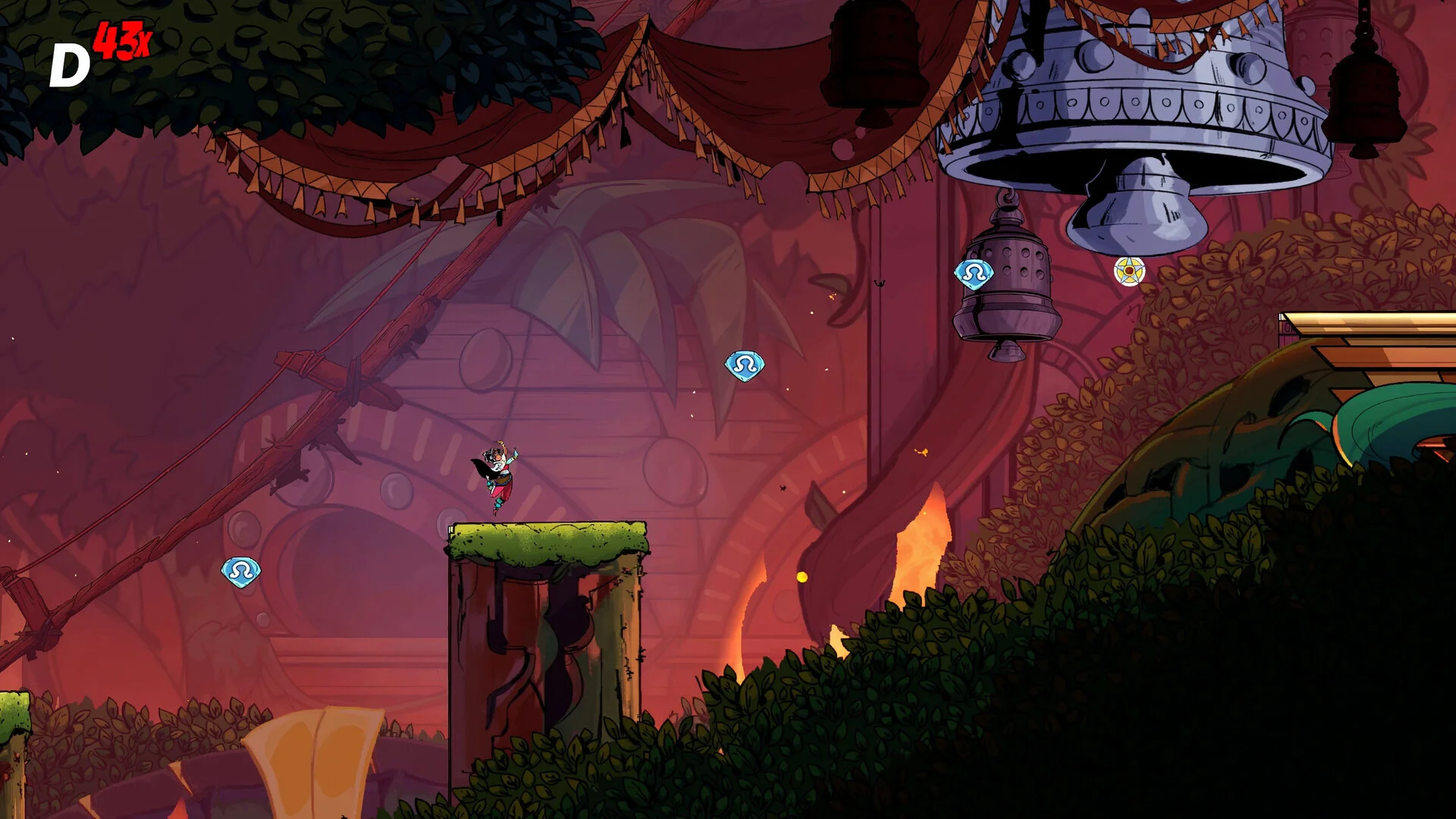
The campaign’s uneven preparation makes those interruptions harder to absorb. Earlier worlds spend considerable time introducing movement abilities through relatively simple passages. The final world combines them with much greater imagination and a sudden increase in precision. Some of the most interesting platforming arrives alongside demands the preceding stages have done too little to prepare the player for. Even later stretches alternate between quick progress and prolonged repetition. Screen resets limit how far a mistake sends Ajira back, but they cannot preserve momentum when the same small stretch keeps holding her in place.
Collection introduces another interruption: some Ghungroos require waiting for a visible state change before the pickup registers. Pausing to confirm collection pulls attention away from the next beat and toward checking that the previous action counted. That hesitation matters to the optional routes, where Mirats contribute to mosaic pieces and further information about the island. These paths offer a reason to explore beyond the required passage, giving curiosity something tangible to uncover. After a difficult run of screens, though, an optional detour becomes an estimate of how much repetition lies ahead. The player can still want to know this place better and take the direct route instead.
The Review
SURI The Seventh Note
SURI: The Seventh Note makes keeping time feel like helping a wounded world recover. Its expanding soundtrack, inventive plant interactions, and musical chases create moments of real affection for the island. Uneven difficulty and unclear cues repeatedly interrupt that connection, while Ajira’s family story struggles to stay emotionally present. There is enough imagination here to reward patient players, though sustaining the desire to explore takes effort the game does too little to ease.
PROS
- Expanding instrumentation makes successful play feel rewarding.
- Echo interactions encourage playful discovery.
- Boss chases give musical abilities dramatic purpose.
- Distinctive hand-drawn environments and Indian musical textures.
CONS
- Uneven difficulty weakens preparation for demanding later stages.
- Visual clutter and uncertain timing cues disrupt rhythmic flow.
- Ajira’s family stakes lose emotional presence during play.