





















Popo wants to know what her grandson plans to do with the life he is trying to prolong. Chris has begun fasting, following teachings that promise an extraordinary span of years, and her practical question disturbs the solemnity of his undertaking. A person can submit the body to discipline while leaving its purpose unattended. In Connor Sen Warnick’s Characters Disappearing, the grandmother’s concern makes that vacancy briefly intimate: someone still expects something of Chris, even as he makes himself increasingly unavailable to ordinary demands.
The teachings reach him through a death. After his grandfather Gong Gong dies, Chris takes possession of a book connecting his family’s past to a man reputed to have lived for 250 years. The inheritance gives bereavement a task, something to practice when the person himself can no longer be reached. There is a sorrowful possibility here: fidelity to the dead might begin to consume one’s obligations to the living. Warnick, who plays Chris, allows little agitation to disturb his composure. Grief could be present beneath it. So could the relief of having found a reason to postpone every other decision.
That uncertainty gives the performance its discomfort, though its emotional range becomes a restriction. Chris’s calm persists as his fasting and isolation take hold; the distance between spiritual absorption and simple disengagement remains difficult to measure. We watch a life being arranged around its own preservation, with few signs of what the preserved life might contain. Popo’s question gives his behavior a friction that the uniform delivery cannot always sustain. Her concern reaches toward a particular person. The performance sometimes leaves us contemplating a condition, with Chris himself receding behind it.
He shares the family home in Chinatown with his cousin Mei, played by Yuka Murakami, and the city surrounding them has its own unsettled relationship with duration. The story inhabits the 1970s, while contemporary cars, buses, jackets, and masked pedestrians remain plainly visible. Shot in 2022, the film lets these incompatible dates occupy the street together. A modern vehicle passes through a world whose inhabitants are considering futures that, for us, have already happened. The effect can be quietly disorienting. Chris dreams of surviving across generations; outside, the image has already admitted several generations into a single present.
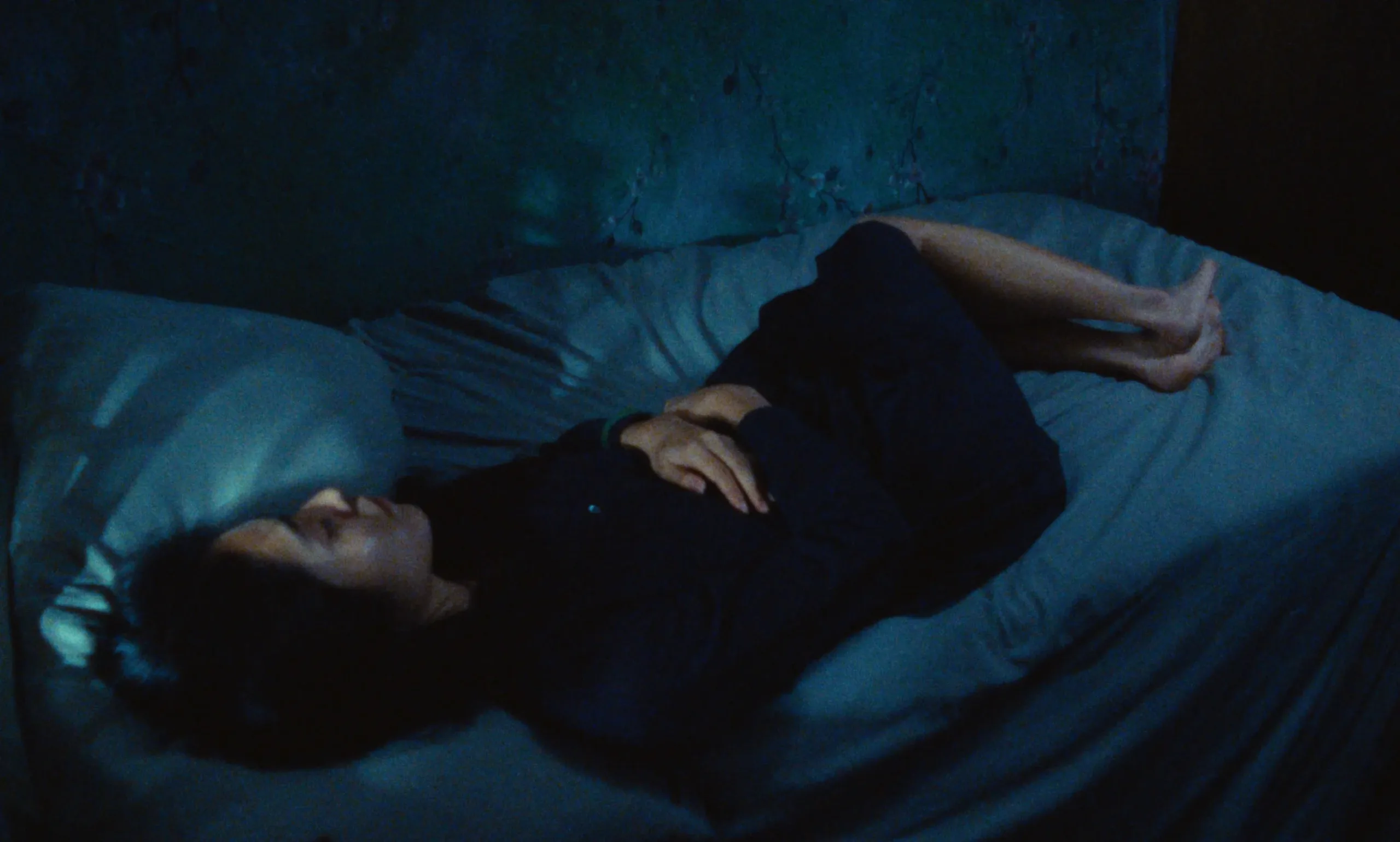
Warnick’s grainy 16mm photography makes that confusion physical. The image has a restless surface even when the camera stays still, while the cramped apartments, doorways, windows, and fish tanks divide space into further enclosures. There is always somewhere else to look, another rectangle through which a life might be observed without being entered. Long takes and slow pans give these arrangements time to settle around the people. Waiting acquires dimensions. The rooms remain occupied, yet their occupants can seem held apart by the very spaces they share, each continuing privately within the same small dwelling.
Mei’s affiliations make such separation harder to accept as a settled state. She belongs to I Wor Kuen, a radical Chinese-American political organization, and her attachments expose her to disappointments that Chris’s withdrawal largely avoids. Leonard, her boyfriend, sleeps with other women; a close friend prepares to leave for graduate school in California; Mei considers her own departure from New York. Murakami’s restrained delivery lets these possibilities accumulate without a decisive emotional release. Leaving becomes difficult to imagine even as other people demonstrate how readily they can loosen their ties. Her stillness carries the fatigue of remaining answerable to relationships whose terms keep shifting.
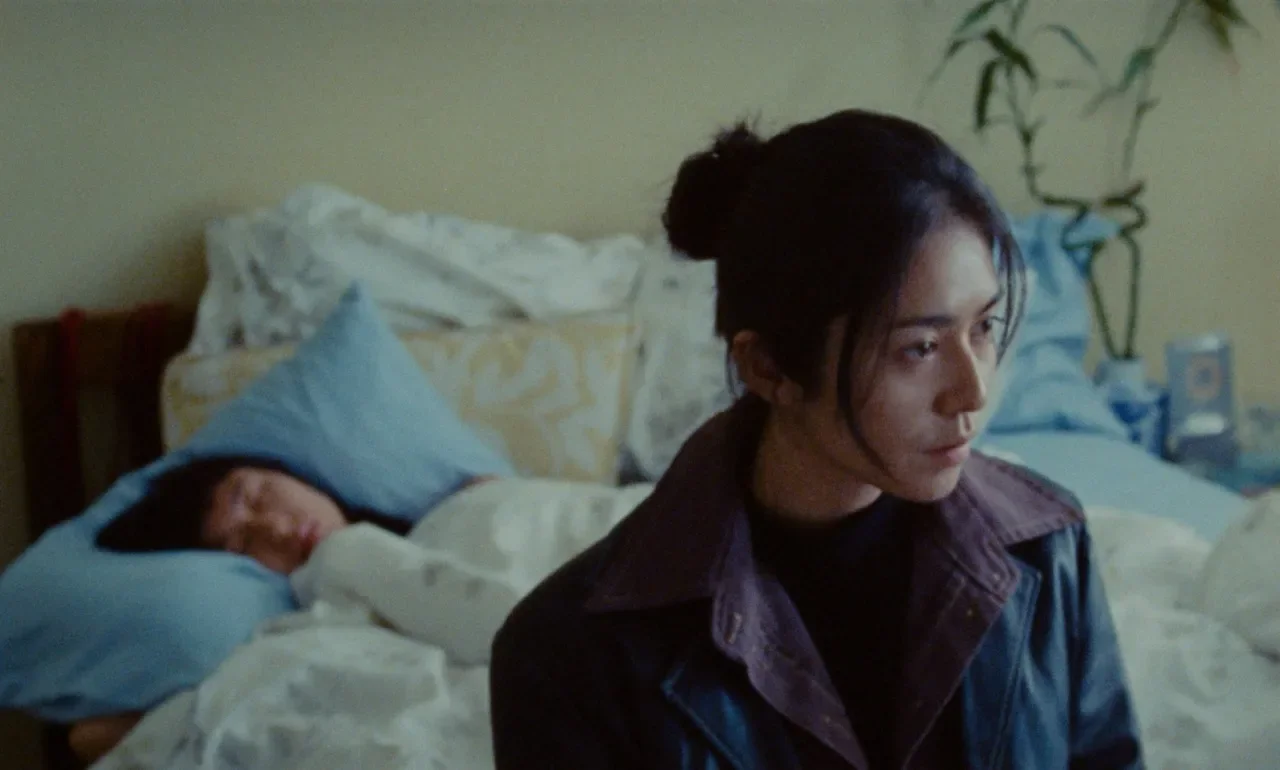
The same subdued register becomes less persuasive when the film turns toward political violence. Members of the organization disappear, and attacks threaten meetings and a public screening. These events enter a world already weighted with indecision and withdrawal, and Warnick’s patience permits violence to rupture its surface without turning the film into a conventional investigation. Yet the rupture does not sufficiently alter our proximity to Mei. Her romantic disappointment and the danger facing her political community arrive through a similar reserve. I can accept her difficulty expressing the difference; the film’s own attention needs to make that difference felt.
Chris can reduce his contact with others in pursuit of longevity. Mei belongs to a group whose ability to meet is being attacked. Their isolation has different causes, and the film’s enveloping melancholy sometimes makes those causes feel secondary to the isolation itself. Historical explanation alone would scarcely repair this. The missing pressure is a fuller sense of the shared life that violence endangers, something against which the cousins’ private drifting could be felt. Without it, collective loss begins to resemble another form of personal estrangement, absorbed into the same patient images and measured voices.
The outdoor screening offers the clearest resistance to that narrowing. Mei projects The East Is Red onto a bedsheet, with fellow activists watching from folding chairs on a basketball court. The projector’s warmth shares the scene with the white light of passing contemporary cars. Two periods remain visible, but the scene also gives duration an immediate use: people have gathered to spend it together. Mei has something to do, an image to keep before other people. The modest arrangements of sheet, projector, and chairs make participation tangible in a way the film’s political references alone cannot.
I wish the film allowed that activity to exert greater force on its surrounding desolation. The gathering provides a different measure of Mei’s life from the uncertainty of her relationship or her possible departure, and it complicates the cousins’ shared appearance of suspension.
She can be uncertain and still undertake work that involves others. The screening makes a demand on her attention that fasting allows Chris to escape. For the people seated on that court, the prospect of further meetings carries an obligation his search for additional years leaves untouched: their time together depends on someone continuing to arrange it.
Characters Disappearing made its festival debut through major independent showcases. Directed by Connor Sen Warnick, the drama follows the intersecting paths of Mei, Chris, and Leonard within a melancholic vision of Manhattan’s Chinatown and the Asian American Movement.
Full Credits
Title: Characters Disappearing
Distributor: Lunette Films / Independent Festival Release
Release date: 2026 (Festival Premieres)
Running time: 1 hour 24 minutes (84 minutes)
Director: Connor Sen Warnick
Writers: Connor Sen Warnick
Producers and Executive Producers: Joseph Eusebio, Connor Sen Warnick, Ruby Rose Krakower, Oliver Agger, Reina Bonta
Cast: Yuka Murakami, Dylan Breaux, Connor Sen Warnick, Eleanor Yung, Von Hyin Kolk, Giullian Yao Gioiello, Savannah Lyons Jeffreys, Ben Irving
Director of Photography (Cinematographer): Owen Smith-Clark
Editors: Noah Weisfogel
Composer: Chester Anand, Ray Freedman
The Review
Characters Disappearing
Warnick makes the wish to extend life feel strangely close to an abandonment of living. Grainy rooms and streets shared by different decades give that paradox a persuasive physical form. His restraint becomes limiting when Chris’s grief and Mei’s threatened political community remain held at similar distances. The outdoor screening offers a glimpse of the shared life that the surrounding melancholy too often submerges. This is a visually assured debut whose contemplation of absence sometimes obscures the people facing loss.
PROS
- Overlapping decades make Chinatown’s unsettled history perceptible.
- Patient 16mm images give isolation a physical texture.
- Popo’s practical question sharpens Chris’s pursuit of longevity.
- The outdoor screening makes communal participation tangible.
CONS
- Chris’s flat delivery restricts access to his grief.
- Personal disappointment and political danger receive insufficient tonal distinction.
- Shared political life remains thin beside private estrangement.