



























Jamal’s hands shake so badly that even ordinary physical tasks become difficult. The tremors are a side effect of medication intended to control the voices he hears, a treatment that makes his condition manageable by interfering with his ability to function. Call it the stability tax, a peculiar arrangement in which someone must surrender part of his independence to preserve the rest. My first instinct was to read this as an indictment of psychiatric treatment. The medication controls the symptoms, certainly, but what happens when the person receiving it feels increasingly disconnected from the life he wants to lead?
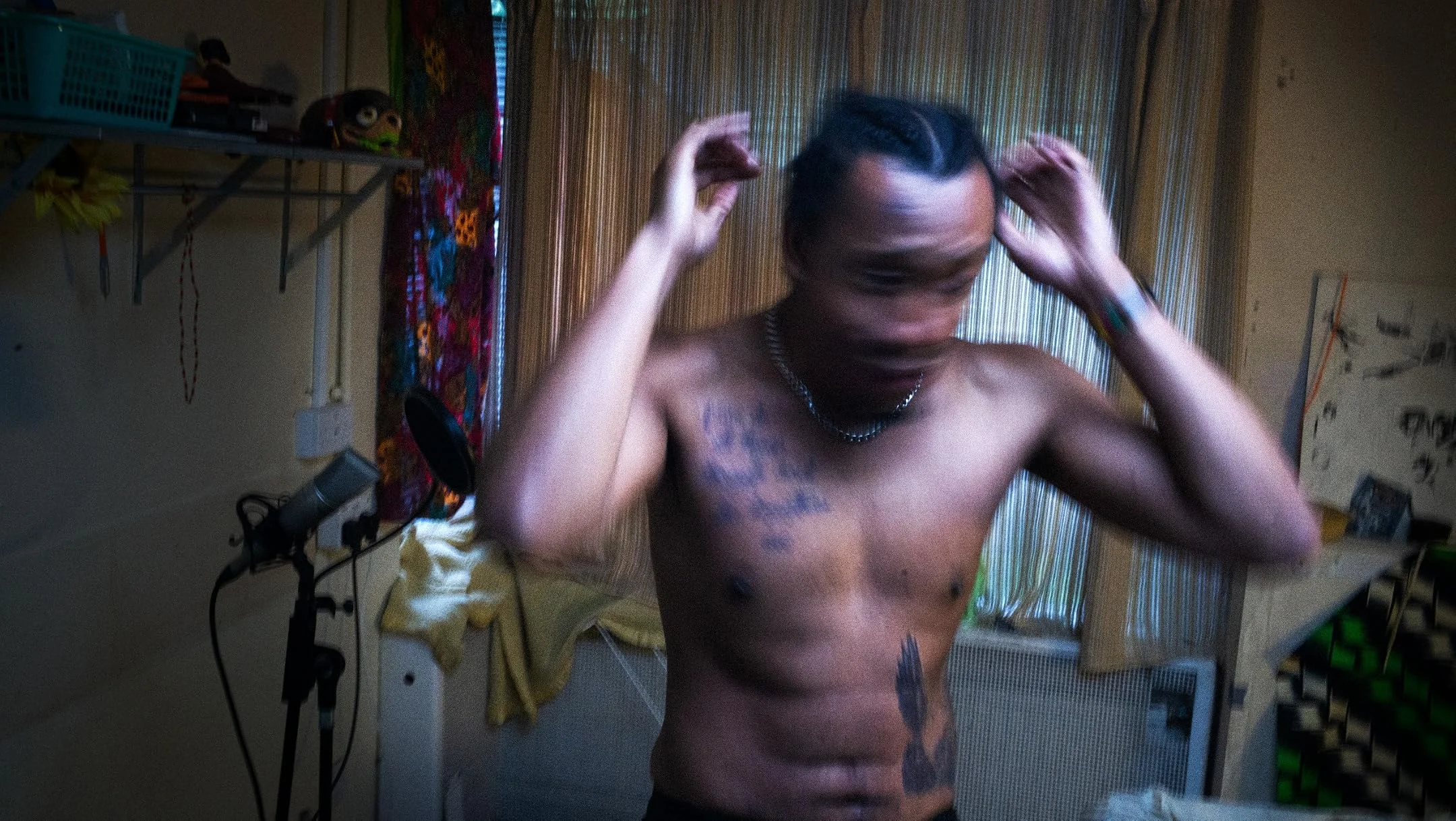
Billy Lumby’s Florid makes that question particularly uncomfortable because Jamal (Jonathan Jules) has ambitions that are neither unreasonable nor especially unusual. He is a young Black man living in supported accommodation in east London, hoping to establish himself as a rapper. Music gives him an identity beyond his schizophrenia. His small room serves as a makeshift studio, a refuge, and something resembling a prison. He spends much of his time making music and smoking cannabis, attempting to manage the distress and physical effects that accompany his treatment.
This is an exceptionally assured debut feature, one I would strongly recommend for the intelligence of its questions and the sensitivity with which it examines them. Lumby understands that portraying mental illness responsibly requires examining the circumstances in which someone experiences it. The result is occasionally overwhelming, frequently painful, and anchored by a remarkable performance from Jules.
The most audacious decision concerns the voices themselves. Rather than leaving Jamal’s auditory experiences beyond our perception, Lumby incorporates them into the film’s dramatic reality. They possess different personalities, offer competing interpretations of events, and sometimes contradict one another. One belongs to Hackney rapper Unknown T, an artist Jamal admires, connecting his psychological experiences to his ambitions.
Sound designer Dario Swade places these voices within an environment where they can compete with conversations and ordinary background noise. The audience must repeatedly distinguish between external events and Jamal’s private perceptions, even as the voices influence his decisions.
I wondered initially if the film was making a questionable exchange, turning psychiatric suffering into an elaborate exercise in sensory immersion (cinema has never been particularly shy about making distress look impressive). The opening montage establishes an aggressive audiovisual rhythm, and subsequent passages combine rapid editing, intrusive sounds, and fractured chronology. Such devices can turn a character’s condition into entertainment for people comfortably removed from its consequences. Yet these voices have specific relationships to Jamal’s confidence and decisions. They are rarely reducible to anonymous noises announcing that someone is unwell.
The quieter passages are equally important. Lumby allows silence to interrupt the auditory congestion, giving Jamal and the audience temporary relief. Blue-toned compositions, shifts in lighting, and subtle variations in camera presentation accompany his changing mental state. Flashbacks intrude upon the present as painful memories he has struggled to confront make themselves felt. The film’s nonlinear approach makes remembering itself seem like an activity over which he possesses limited control.
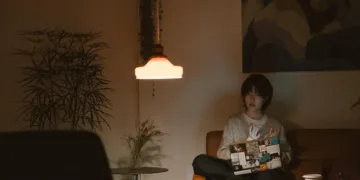
Adric Watson’s cinematography contributes another dimension to this confinement. The camera moves intimately through Jamal’s accommodation, examining the modest room, impersonal corridors, and basic communal kitchen. The spaces are ordinary to the point of anonymity. There is something quietly disturbing about an environment designed to accommodate a person that offers so few opportunities for him to establish a recognizable identity.
The building is functional, which is apparently supposed to be enough.
Institutions tend to measure success through outcomes that can be recorded and assessed. Stability, compliance, and reduced symptoms offer recognizable indicators of progress. Ambition, intimacy, and independence are harder to quantify (an inconvenience for anyone designing a form). Jamal’s circumstances expose the distance between those institutional categories and the life they are supposed to support. His limited resources restrict his opportunities for independence.
Lumby resists assigning responsibility to a conveniently indifferent professional. The care coordinators and medical workers appear sincerely invested in Jamal’s wellbeing, even as they operate within an overstretched system. Their concern is credible, and their limitations are equally visible. Institutional inadequacy becomes harder to dismiss when it persists despite the goodwill of those working inside it.
His relationship with his neighbour Kyla (Saskia Chana) brings these questions into a domestic register. Jamal wants companionship, affection, and the opportunity to be useful to another person. He approaches Kyla through music and cooking, at one point telephoning his grandmother for instructions. The call shows family affection, practical dependence, and Jamal’s wish to care for someone else. Kyla has difficulties of her own, and Jamal’s desire to help her does not automatically translate into an ability to do so.
These interactions sharpen the tragedy of his medication’s side effects. Jamal believes that coming off his pills might restore the confidence and physical control necessary to pursue music and build relationships. His reasoning becomes understandable even before its consequences become apparent.
And this is where I had to reconsider my original interpretation.
Jamal’s condition deteriorates after he stops taking his medication. The voices become increasingly influential, the division between perception and reality becomes uncertain, and his decisions grow dangerous enough to lead him back into hospital. The earlier suggestion that treatment represents an obstacle to personal freedom no longer adequately explains what we are watching. There is no credible emancipation in a state where Jamal struggles to establish which experiences belong to the external world. His determination to reclaim independence exposes him to another kind of captivity.
The stability tax remains real, but abandoning treatment does not cancel the bill. Lumby has constructed a dilemma in which both available paths carry consequences. I found this much harder to dismiss than the familiar cinematic treatment of psychiatric medication as something that suppresses a person’s authentic identity. Jamal’s identity is shaped by his illness, his treatment, his circumstances, and his desires. Removing any one of those elements cannot automatically restore the person he hopes to become.
Jules makes that complexity persuasive through a performance that extends well beyond visible distress. His physical vulnerability, especially the medication-related shaking, gives Jamal’s frustrations an immediate basis. Yet the performance becomes particularly affecting when he attempts ordinary connection. His enthusiasm for music, tentative pursuit of Kyla, and affectionate dependence on his grandmother establish a personality that persists through his changing psychological condition. During his deterioration, the person established in those earlier interactions remains recognizable.
The production drew on London’s mental health community, including people who hear voices and healthcare and social-care professionals. That involvement is especially meaningful in the later scenes involving a psychosis support group, where individuals can discuss their experiences with people who possess their own understanding of psychological distress. It gives participants an opportunity to define their experiences instead of existing solely as recipients of professional assessment.
I am less convinced by the speed with which the final stages of Jamal’s recovery develop. Having established the recurring difficulties of his condition, Florid moves relatively quickly toward an emotionally satisfying resolution. The support group becomes an important turning point, and Jamal’s eventual appearance onstage provides a moving return to the music that has sustained his ambitions. Yet the transition risks giving self-acceptance a therapeutic efficiency that the earlier film has spent considerable effort questioning.
I wanted Lumby to remain with the ordinary difficulties of recovery for a little longer. Earlier, a telephone call to his grandmother made something as modest as preparing food feel significant. Similar attention to the practical demands of life after hospitalization might have made his return to music even stronger, particularly after the film has shown how much effort can be required simply to maintain stability from one day to the next.
Florid had its world premiere as the closing film of the New Directors lineup at the San Sebastián International Film Festival on September 25, 2026, before screening at the BFI London Film Festival in October 2026, with wide theatrical and streaming release details pending. Written and directed by Billy Lumby in his feature debut and starring Jonathan Jules and Saskia Chana, the British drama follows a young man living in supported housing in London who struggles with schizophrenia and medication side effects while pursuing his musical ambitions and a budding romance.
Full Credits
Title: Florid
Distributor: Atar Studios (World Sales), Joi Productions, BBC Film, Film i Väst
Release date: September 25, 2026 (San Sebastián International Film Festival world premiere), October 8, 2026 (BFI London Film Festival screening)
Running time: 1 hour 24 minutes (84 minutes)
Director: Billy Lumby
Writers: Billy Lumby
Producers and Executive Producers: Rupert Lloyd, Joy Gharoro-Akpojotor, Sean Wheelan, Kristina Börjeson, Eva Yates, Phil Hunt, Compton Ross, Cyrus Massoudi, Medb Riordan, Simon Cooper
Cast: Jonathan Jules, Saskia Chana, Unknown T, Marlon Bravi, Louise “Lulu” Parr, Jennifer Greenidge, Clare Holman, Abdul Basith
Director of Photography (Cinematographer): Adric Watson
Editors: Omar Guzmán Castro
Composer: CJ Mirra
The Review
Florid
Florid examines the price of psychiatric stability with uncommon intelligence and compassion. Billy Lumby's immersive direction and Jonathan Jules's extraordinary performance expose the painful distance between receiving treatment and living independently. The film even forces us to reconsider our own assumptions about medication and personal freedom (a little intellectual discomfort never hurt anyone). Its hurried recovery arc weakens an otherwise remarkably thoughtful debut, but the questions it raises about identity, autonomy, and institutional care remain difficult to dismiss.
PROS
- Outstanding central performance from Jonathan Jules
- Immersive, psychologically effective sound design
- Intelligent exploration of treatment and autonomy
- Sensitive portrayal of institutional care and isolation
CONS
- Recovery arc feels somewhat rushed
- Limited exploration of everyday life after hospitalization