
























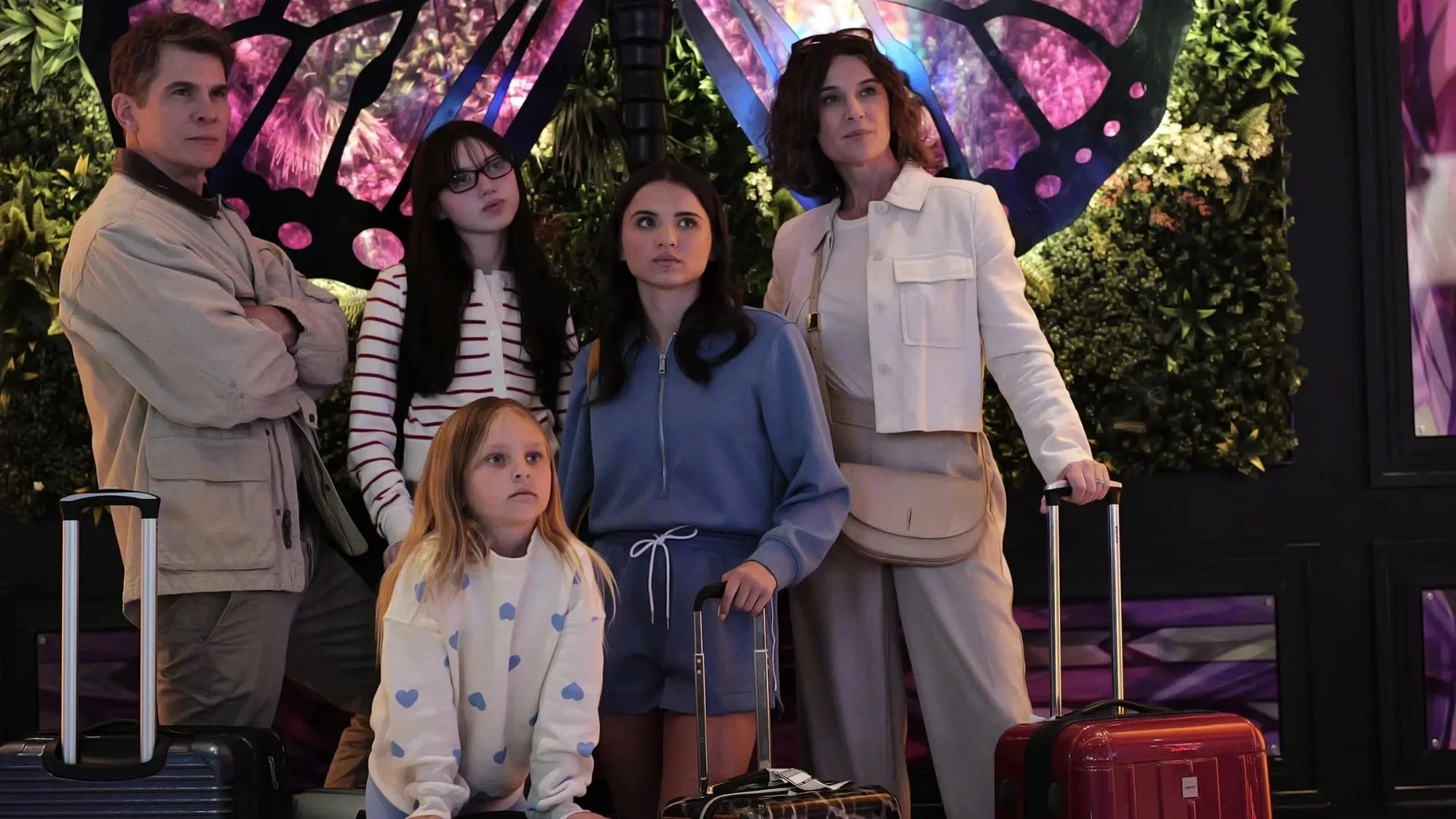

Can a Christmas comedy set in Las Vegas accommodate the cool professionalism of British spy fiction and the physical inventiveness of Hong Kong action cinema? Double Trouble attempts precisely that, placing a former intelligence operative alongside two bickering sisters in a hotel full of criminals, celebrities, and expensive jewelry. The combination has considerable potential.
Unfortunately, director Shaun Piccinino and screenwriter John Ducey struggle to make these different entertainment traditions work together. Their family adventure has occasional flashes of ingenuity and an appealing central relationship, but the filmmaking is too uneven to recommend beyond an undemanding afternoon with older children.
The setting is the Palms Casino, where Charlotte (Madeleine McGraw) and Willow (Violet McGraw) are spending Christmas with their family. Charlotte’s enthusiasm for visiting pop star Juniper (Jack Griffo) encourages the sisters to sneak away from their parents. They become lost in the hotel’s restricted corridors and encounter David (Andrew Koji), a security guard whose professional history is considerably less ordinary than his current employment suggests.
A robbery targeting Juniper’s diamond-encrusted gauntlet soon involves all three. Las Vegas should provide a splendid setting for such an adventure, with its concentration of luxury, celebrity worship, and spectacular artificial environments. Yet the film spends much of its time in kitchens and service corridors, making a city famous for extravagant entertainment feel surprisingly anonymous.
The McGraw sisters are easily the production’s greatest asset. Their real-life sibling relationship gives Charlotte and Willow’s arguments an easy familiarity that scripted family conflict often lacks. They describe their constant disagreements as “sister-speak,” a small joke that establishes something recognizable about their relationship. Madeleine brings an assertive energy to Charlotte, while Violet responds with an appealingly indifferent attitude toward her sister’s behavior.
Their partnership belongs to a particularly American tradition of children’s adventure cinema, where young protagonists outsmart adults who possess superior physical strength and resources. Home Alone remains the obvious reference, especially once Charlotte and Willow begin turning everyday objects against their pursuers. A kitchen confrontation involving salad tongs and a rubber spatula captures the intended appeal. Ordinary household implements become improvised weapons, and the girls’ apparent disadvantages create opportunities for comedy.
There is another cinematic tradition against which this material deserves examination. Hong Kong action comedies, particularly Jackie Chan’s Police Story, transform ordinary environments into elaborate physical playgrounds. Their humor develops through the relationship between bodies, objects, and carefully established spatial arrangements. A chair, a countertop, or an unexpected household implement becomes funny because the audience understands its practical possibilities before those possibilities are exploited.
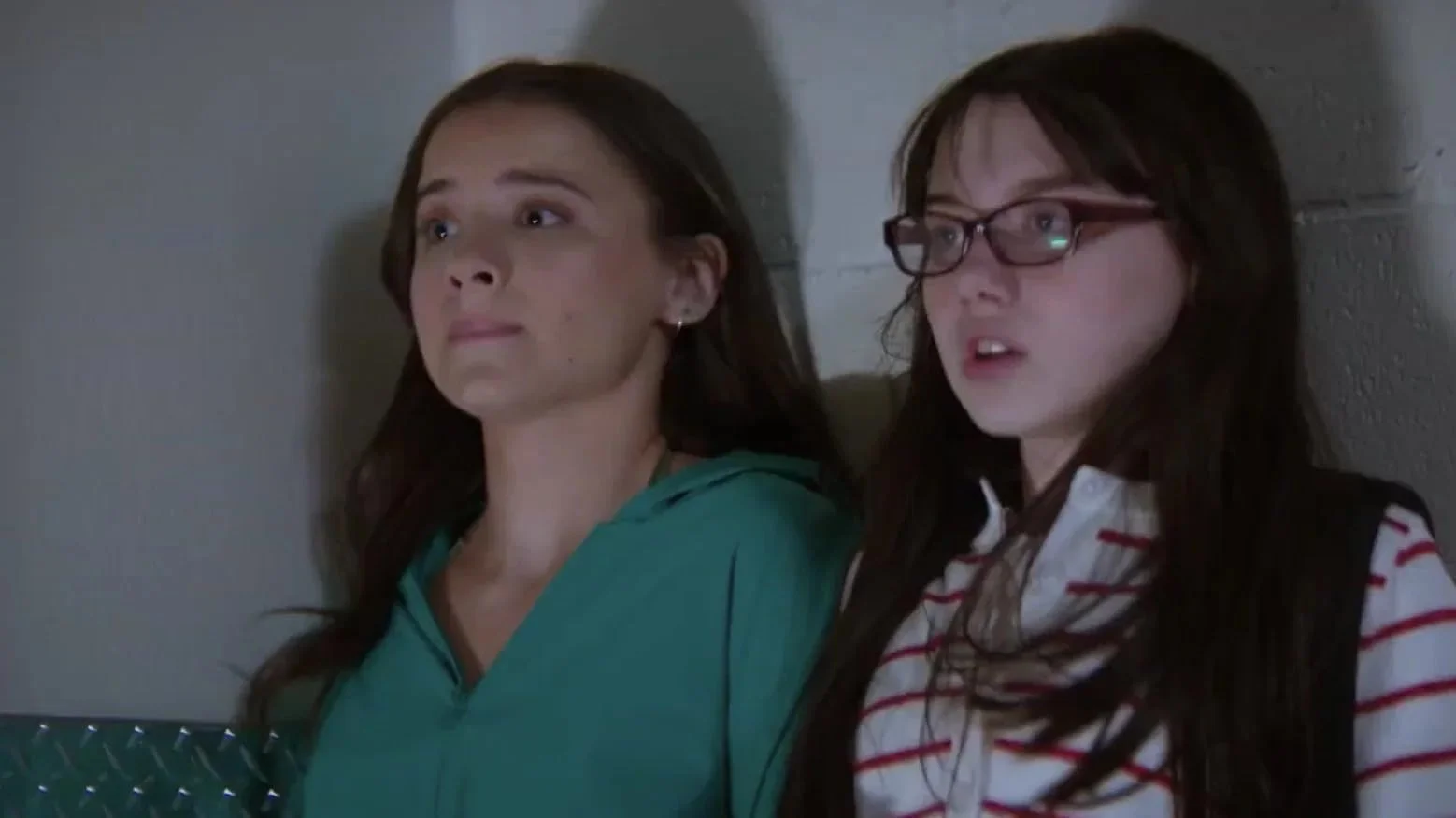
Double Trouble approaches this kind of invention through its kitchen combat, but the editing lacks the precision needed to sustain it. The girls’ improvised defenses offer amusing individual moments, yet the action seldom develops into a satisfying sequence of escalating physical jokes. Compared with the disciplined chaos of Hong Kong action cinema, the film’s disorder feels insufficiently controlled.
David introduces a second international reference point. A former operative who has left London behind, he carries the recognizable history of British espionage fiction into an American family comedy. His former partner Robyn (Aziza Donnelly), whose possible involvement with the thieves complicates the robbery, supplies the ingredients for betrayal and professional rivalry. Andrew Koji is physically credible in the action sequences, and his presence gives the confrontations an authority that the children’s improvisations understandably cannot provide.
However, the British spy tradition typically depends on establishing the protagonist’s competence through decisions that reveal intelligence, calculation, and an understanding of danger. David’s history offers the appearance of this characterization, but the screenplay does relatively little with his professional experience beyond making him a capable fighter.
The connection with Robyn should give the robbery personal significance. Instead, their shared past receives insufficient development to make the criminal plot especially absorbing. Koji performs adequately within these limitations, although his restrained approach sometimes seems disconnected from the exaggerated behavior surrounding him.
The uneven performances reveal a problem extending throughout the production. Dialogue exchanges frequently linger after their dramatic purpose has been served, leaving pauses that weaken the comedy. Other characters deliver their lines with an intensity suggesting a different kind of film. Jack Griffo’s Juniper is especially frustrating because the character offers an opportunity to satirize celebrity excess. His ridiculous behavior, including drinking vodka shots, establishes the intended caricature, yet the comedy rarely develops beyond the initial exaggeration.
Even the sound effects display this uncertainty. Early in the film, a familiar Wilhelm scream accompanies a man striking his head against a poker table. The effect has a long history in American cinema, where its repetition has gradually transformed it into an industry joke. Here, its placement draws attention toward the soundtrack rather than the physical incident. Other conspicuous sound effects create a similar problem, announcing jokes that the accompanying action or dialogue has not necessarily earned.
Las Vegas creates an additional cultural contradiction. American Christmas entertainment commonly associates the holiday with domestic reconciliation, familiar traditions, and the restoration of family relationships. Piccinino chooses a city whose public identity rests on commercial spectacle and conspicuous consumption. Juniper’s extravagant jewelry provides an obvious connection between the setting and the robbery. Unfortunately, the screenplay rarely explores the possibilities of this environment. The casino becomes a convenient collection of corridors where characters can chase one another, leaving the city’s peculiar identity largely unexplored.
The film’s intended audience is similarly uncertain. Its exaggerated villains, harmless-looking improvised weapons, and sibling rivalry belong comfortably within family entertainment. Yet strong profanity from a young character, Juniper’s drinking, and occasional suggestive material sit awkwardly beside the child-centered premise.
These elements are unlikely to trouble every family, and their significance depends partly on the expectations viewers bring from their own cultural environments. Audiences accustomed to the broader behavior permitted in American adolescent comedies may barely notice them. Families expecting the gentler conventions of traditional Christmas films could reasonably feel differently. The inconsistency becomes another obstacle to establishing a recognizable tone.
That uncertainty extends to David’s personal storyline. His separation from his wife and daughter Emma, whom he can contact only through video calls, introduces emotional material substantially heavier than the sisters’ holiday misbehavior. Their developing friendship offers a potentially effective connection between the two narrative worlds. Charlotte and Willow learn to cooperate and accept responsibility, while David encounters children whose presence might help him reconsider his own broken family relationships.
The final stretch attempts to deliver the emotional reassurance familiar from American Christmas cinema. Emma’s appearance and the apparent easing of David’s family separation are intended to reward his efforts during the adventure. There is genuine sweetness in the prospect of his reunion, especially after his earlier attempts to maintain contact through a screen. But the circumstances of their estrangement have been established as serious, and the screenplay gives their resolution remarkably little attention. The ending asks the audience to accept a repaired relationship before it has explained how David and his family managed to reach that point.
Double Trouble opened in select theaters on October 9, 2026, through Warner Bros. Pictures and Seismic Releasing, and is also available on digital platforms. Directed by Shaun Piccinino and starring real-life sisters Violet McGraw and Madeleine McGraw alongside Andrew Koji, the holiday heist action comedy follows two sisters in Las Vegas who team up with a former MI6 operative to outsmart a cunning thief and recover a diamond gauntlet before Christmas.
Where to Watch Double Trouble (2026) Online






Full Credits
Title: Double Trouble
Distributor: Warner Bros. Pictures, Seismic Releasing
Release date: October 9, 2026
Rating: 12 (UK BBFC)
Running time: 1 hour 29 minutes (89 minutes)
Director: Shaun Piccinino
Writers: John Ducey
Producers and Executive Producers: Ali Afshar, Daniel Aspromonte, Christina Moore
Cast: Violet McGraw, Madeleine McGraw, Andrew Koji, Brynne Kurland, Azizi Donnelly, Jack Griffo, Struggle Jennings, Shin Lim
Director of Photography (Cinematographer): Brad Rushing
Editors: Chance LaSalle
Composer: Jamie Christopherson
The Review
Double Trouble
Double Trouble brings British espionage, Hong Kong-style physical comedy, and American Christmas entertainment into a Las Vegas hotel, but the combination rarely comes together. Madeleine and Violet McGraw provide genuine sibling chemistry, and the improvised kitchen combat offers occasional amusement. Loose editing, inconsistent comic timing, and an underdeveloped emotional storyline undermine the film's potential. Andrew Koji lends the action some credibility, yet even his character struggles to escape the screenplay's limitations. Younger audiences may enjoy the mischief, but the film falls short of its international genre inspirations.
PROS
- Natural chemistry between the McGraw sisters
- Amusing improvised kitchen combat
- Andrew Koji's credible physical presence
- An appealing family-heist premise
CONS
- Loose editing and weak comic timing
- Underdeveloped espionage storyline
- Inconsistent performances and tone
- Unconvincingly rushed family reconciliation
- Underused Las Vegas setting