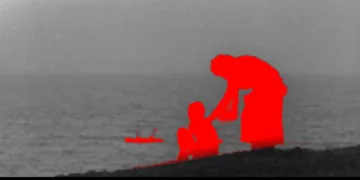























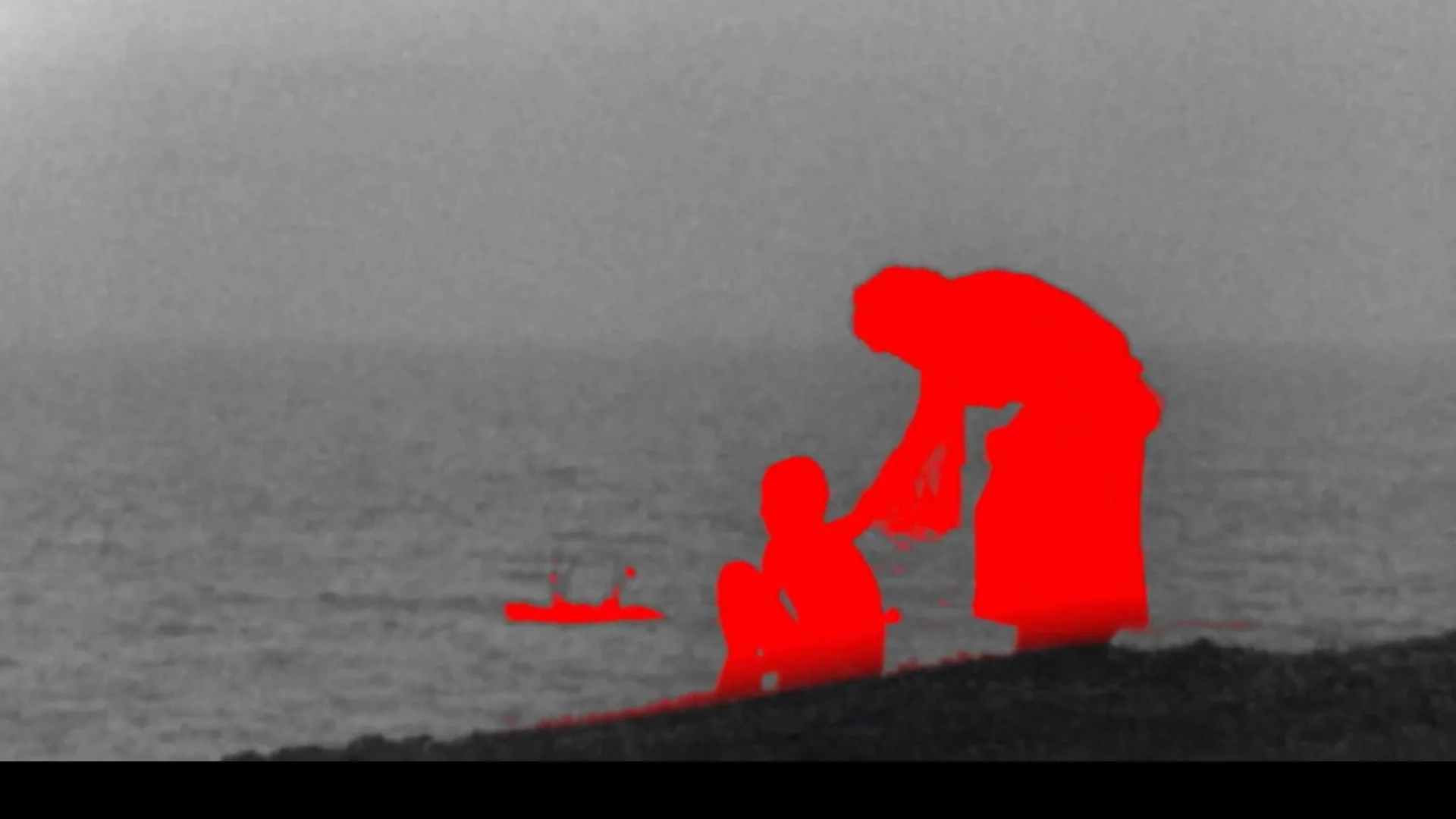

A streak of crimson red cuts across an archival image, obliterating a caption imposed by Israeli authorities. The image beneath survives. The words claiming the right to explain it do not. This simple intervention establishes the visual ethics of A Fidai Film, Kamal Aljafari’s extraordinary documentary about Palestinian history and the machinery of its suppression. Aljafari understands something that the cinema of occupation has demonstrated repeatedly: the camera’s apparent neutrality is often its most effective deception. A recorded event may be authentic, yet the framing that presents it can serve an entirely different truth.
The historical circumstances make that examination especially urgent. During Israel’s 1982 invasion of Lebanon, Israeli forces seized the Palestine Research Center’s extensive archive in Beirut, taking books, newspapers, films, and records of Palestinian cultural life. Much of this material remains inaccessible to its original custodians. Aljafari constructs his documentary from recovered fragments, including footage made by Palestinian filmmakers and images produced through the perspectives of British and Israeli authorities. The resulting film moves across decades of occupation, displacement, and resistance.
It is a remarkable achievement, and one I would recommend enthusiastically to anyone prepared for demanding experimental cinema. Its fragmented structure occasionally obscures the historical specificity of what we are seeing, yet its visual intelligence rarely falters. Aljafari makes the act of looking morally consequential, particularly when familiar compositions reveal the power relationships embedded in their original construction.
Consider the footage produced from the occupiers’ perspective. Soldiers and representatives of authority command the image, occupying its principal field of attention, while Palestinians frequently appear in the background. The framing establishes a hierarchy before any commentary can explain it.
Those exercising power become the historical actors; those experiencing its consequences are reduced to incidental figures. Aljafari reverses this relationship through selection and montage, drawing our attention toward the people the original cameras treated as peripheral. He does not need to alter their physical positions within the frame. By changing the circumstances in which we encounter these images, he changes the significance of their presence.
There is a distinctly noir sensibility to this distrust of photographic appearances, although Aljafari has little interest in conventional thriller aesthetics. Classical noir repeatedly questioned the reliability of vision, using restricted perspectives and compromised witnesses to undermine certainty. Here, the uncertainty belongs to the historical record itself. The images are authentic, but the authority that produced or catalogued them is compromised. Aljafari’s rearrangement exposes the perspective already built into the shot.
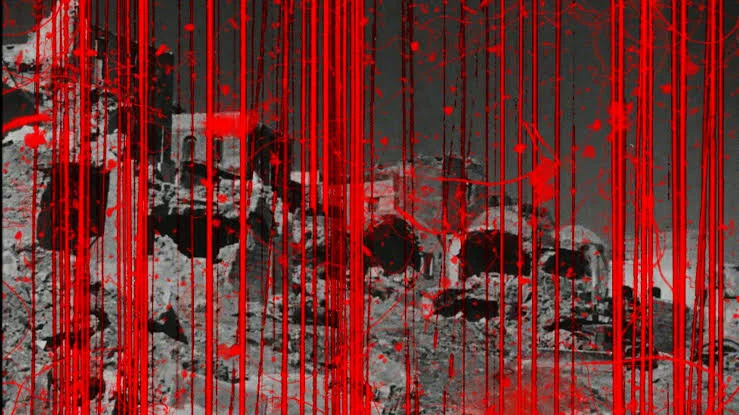
His red interventions make that conflict explicit. Crimson markings obscure degrading descriptions applied to archival material by Israeli authorities, interrupting an institutional attempt to define the people being recorded. Elsewhere, red spreads across landscapes and human figures, sometimes accompanied by digitally imposed flames. Against the monochromatic textures of the older footage, these additions are visually aggressive. They seize control of the composition, drawing the eye away from the apparent objectivity of the photographic document and toward the violence surrounding its production and preservation.
The ethical complication is considerable. Aljafari is attempting to reclaim a historical record by deliberately altering it. His censorship of an imposed caption can be understood as corrective, yet the red markings that extend across people and landscapes raise a less comfortable question about artistic authority. The film acknowledges this difficulty through the conspicuous nature of its interventions. Nothing about the crimson overlays suggests an attempt to pass the altered footage off as untouched historical evidence. The pigment remains visibly separate from the archival film beneath it.
The condition of the surviving material supplies another visual argument. Scratches, damaged frames, grain, overexposure, and technical inscriptions interrupt the illusion that archival footage offers transparent access to the past. A damaged film strip records its own history of handling, storage, and deterioration alongside the events photographed upon it. Aljafari allows those marks to remain prominent. Preservation, it turns out, is considerably messier than the orderly shelves of a respectable institution might suggest.
The editing by Aljafari and Yannig Willmann extends this attention to historical interpretation. Rather than arranging events into an explanatory chronology, they connect images through recurring visual patterns. Footage of ordinary Palestinian life gives way to streets under military control, refugee camps, destroyed buildings, and displaced families. The transitions establish a mounting sense of disruption, with the earlier images of inhabited streets and peaceful landscapes acquiring particular emotional force through what follows.
This method becomes especially disturbing when footage from the British Mandate period enters into visual conversation with later images of Israeli military activity. Soldiers patrol streets; houses are demolished; civilians endure the consequences of armed authority. The recurrence of these actions creates an anticipatory tension unusual for historical documentary. Once the pattern becomes recognizable, even an apparently ordinary street scene begins to suggest the possibility of approaching violence.
The danger is that repetition can eventually flatten the distinctions it seeks to expose. The documentary’s transitions between periods are frequently abrupt, and its reluctance to identify individual sequences leaves viewers with limited means of establishing their precise circumstances. An image of destruction carries considerable emotional authority, but historical understanding requires attention to the events that produced it.
British colonial rule, the Nakba, and subsequent military occupations possess connected histories, yet their specific circumstances cannot always be conveyed through visual resemblance alone. Aljafari’s associative editing is most effective when the recurring compositions illuminate these connections. At other moments, the accumulation of suffering threatens to replace historical development with an almost unbroken sequence of catastrophe.
There is an additional psychological cost. The repeated appearance of terrified children, bodies, and demolished homes can exhaust the viewer’s capacity to register individual experiences. Aljafari counteracts this through images of ordinary life, which restore a sense of what existed before displacement and destruction. Those passages offer necessary relief from the military imagery, granting Palestinian communities a visual existence independent of the violence inflicted upon them.
Sound deepens the film’s unease through a different form of intervention. Attila Faravelli and Jochen Jezussek construct an unstable acoustic environment of reverberant ambience and disruptive effects, frequently detaching what we hear from any immediately identifiable source within the image. Simon Fisher Turner’s music contributes to this atmosphere of dislocation. The footage belongs to previous decades; its accompanying sounds insist upon the immediacy of the present.
That separation matters because synchronized sound ordinarily encourages us to accept the audiovisual image as a coherent event. Aljafari deliberately weakens that assurance. A sound need not originate within the photographed space to alter our perception of it, and the documentary repeatedly exploits this capacity.
Where the montage establishes historical recurrence, the soundtrack introduces apprehension into the intervals between recognizable events. The audience is denied the comforting stability of a conventional documentary narrator who might identify each image, establish its significance, and declare the matter settled.
The incorporation of writing by Palestinian author Ghassan Kanafani offers a different form of testimony. His words introduce an intimate human perspective into material frequently shaped by institutional surveillance and military interests. Their presence is especially pointed after Aljafari’s earlier rejection of the derogatory captions attached to the archive. Language remains a source of authority, but its meaning changes when the words accompanying Palestinian images come from a Palestinian writer rather than the institutions that controlled their preservation.
The later return to refugee camps, checkpoints, forced evictions, and demolished homes gives the film’s historical associations an unsettling contemporary dimension. These images arrive after Aljafari has established the recurring visual grammar of displacement, making their placement especially severe. The editing invites us to recognize familiar patterns, even as the absence of detailed chronology leaves individual circumstances less clearly defined. The viewer has learned to identify the composition before possessing all the information needed to explain it.
A Fidai Film premiered at Visions du Réel in April 2024 before receiving a theatrical release in France on March 4, 2026, and is available to stream or rent on platforms including TrueStory, DocAlliance Films, and Tënk. Written, edited, and directed by Kamal Aljafari, the experimental documentary reclaims photographs and film reels seized by the Israeli army from the Palestine Research Center in Beirut in 1982, transforming the looted visual archive into a counter-narrative of Palestinian memory and resistance.
Where to Watch A Fidai Film (2024) Online
Full Credits
Title: A Fidai Film (فيلم فدائي)
Distributor: Kamal Aljafari Productions, DocAlliance Films, Tënk, TrueStory
Release date: April 2024 (Visions du Réel world premiere), March 4, 2026 (France theatrical release)
Running time: 1 hour 18 minutes (78 minutes)
Director: Kamal Aljafari
Writers: Kamal Aljafari
Producers and Executive Producers: Kamal Aljafari, Flavia Mazzarino
Editors: Kamal Aljafari, Yannig Willmann
Composer: Simon Fisher Turner
The Review
A Fidai Film
Through crimson interventions, fractured montage, and morally charged framing, Kamal Aljafari transforms a contested archive into an unsettling act of cinematic resistance. A Fidai Film exposes the political authority concealed within seemingly neutral images, reclaiming Palestinian lives pushed to the margins of the historical record. Its relentless repetition and elusive chronology occasionally diminish the specificity of individual events, but the film's visual intelligence and disturbing soundscape sustain its force. A demanding, exceptional documentary that makes looking an ethical responsibility.
PROS
- Powerful archival imagery and visual interventions
- Morally sophisticated use of framing
- Disturbing, atmospheric sound design
- Inventive, politically purposeful montage
CONS
- Sparse historical context
- Repeated violence can become numbing
- Visual alterations raise ethical questions