




















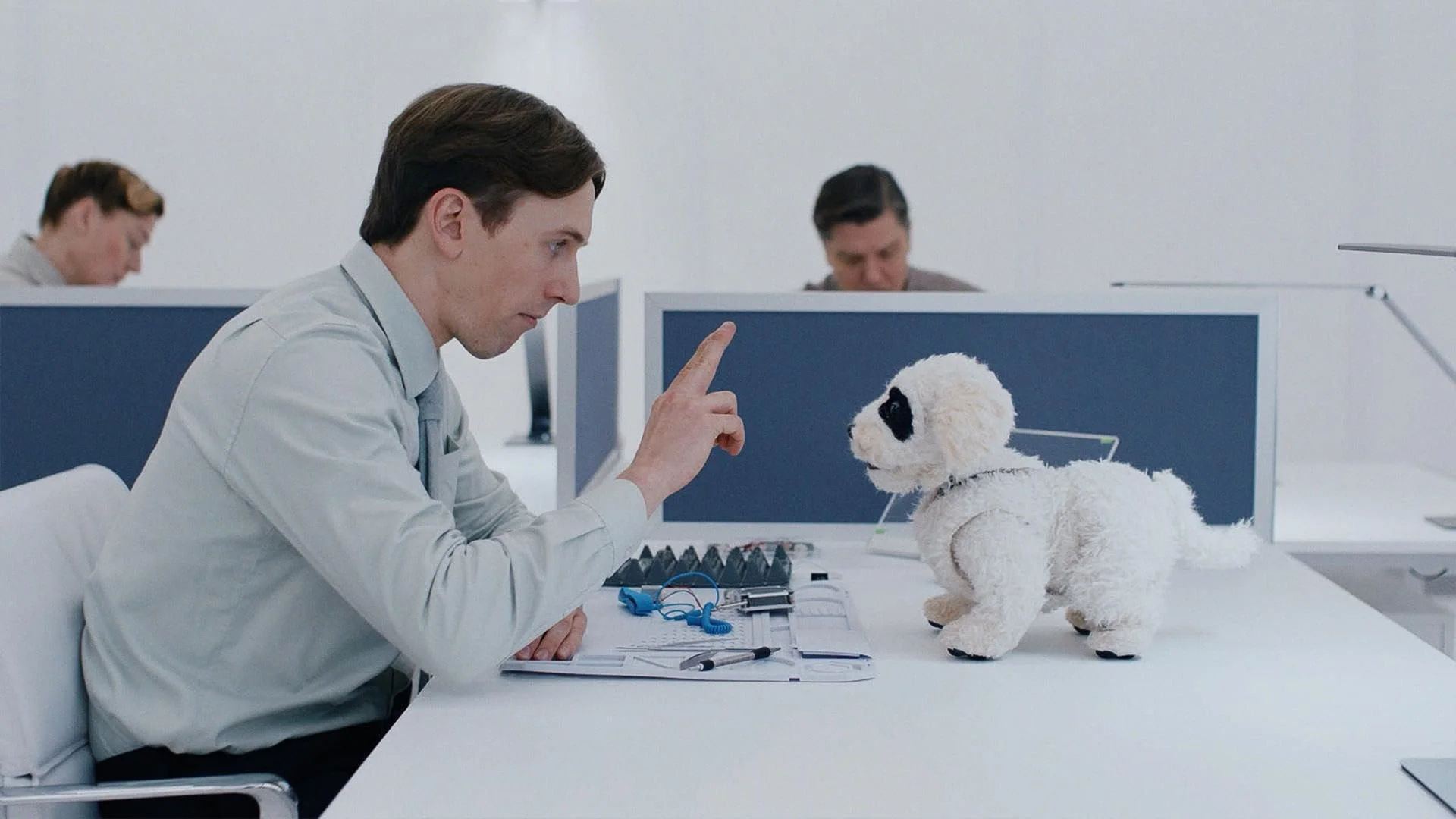

A Finnish science-fiction film built around a surviving squirrel makes a surprisingly small creature carry a big premise: humanity has eliminated nature and perfected personal comfort, leaving everyday existence almost unbearable. What impressed me immediately about Markus Lehmusruusu’s second feature, The Squirrel, was how little futuristic spectacle it needs to establish this world.
People commute to work, live in spotless apartments, and rely on technology to handle everyday inconveniences. At a company called SynBio, engineers are even developing robotic pets, although none of them has firsthand experience with the animals they’re trying to reproduce. Their latest challenge is designing a convincing dog.
That wonderfully absurd assignment tells us plenty about the society Lehmusruusu has imagined. Everything exists to make human life safer, cleaner, and easier to manage. People wear devices that monitor their health, artificial intelligence assistants supervise their behavior, and even caffeine consumption comes with restrictions.
The opening sequence introduces Pasi (Miro Lopperi) undergoing a mechanical procedure to regulate his hormones, suggesting that physical pleasure has become another routine maintenance task. Rather than interrupting the story with lengthy explanations about how civilization reached this point, Lehmusruusu allows us to discover its rules through everyday activities. I particularly enjoyed how casually the characters accept circumstances that seem completely ridiculous to us.
This approach gives The Squirrel much of its charm. It’s a clever, visually accomplished science-fiction comedy that I would happily recommend, especially to viewers who enjoy speculative stories built around recognizable human behavior. Its eventual destination becomes too predictable, and its restrained pacing occasionally works against the emotional development. The film’s carefully constructed visual environment, however, remains consistently entertaining.
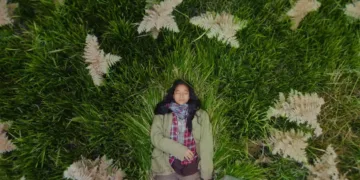
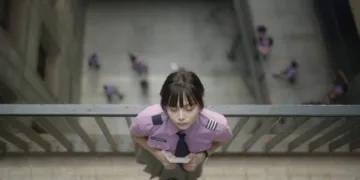
Much of that appeal comes from the cinematography of Max Smeds and the production design by Michael Randel. Pasi’s apartment is almost entirely white, brightly illuminated, and organized with the precision of a laboratory. Public spaces follow similar patterns, from the orderly escalators and staircases to the repetitive architecture surrounding the commuters. Smeds frequently employs symmetrical framing, a technique in which the visual elements on either side of an imaginary central line are arranged to create balance.
It’s an effective way of making an image feel controlled, and the film repeatedly places Pasi within these carefully organized compositions. Even the people returning home from work seem arranged into a larger pattern, wearing muted clothing and maintaining their distance from one another. I loved how these choices communicate the society’s obsession with predictability before anyone has to explain it.
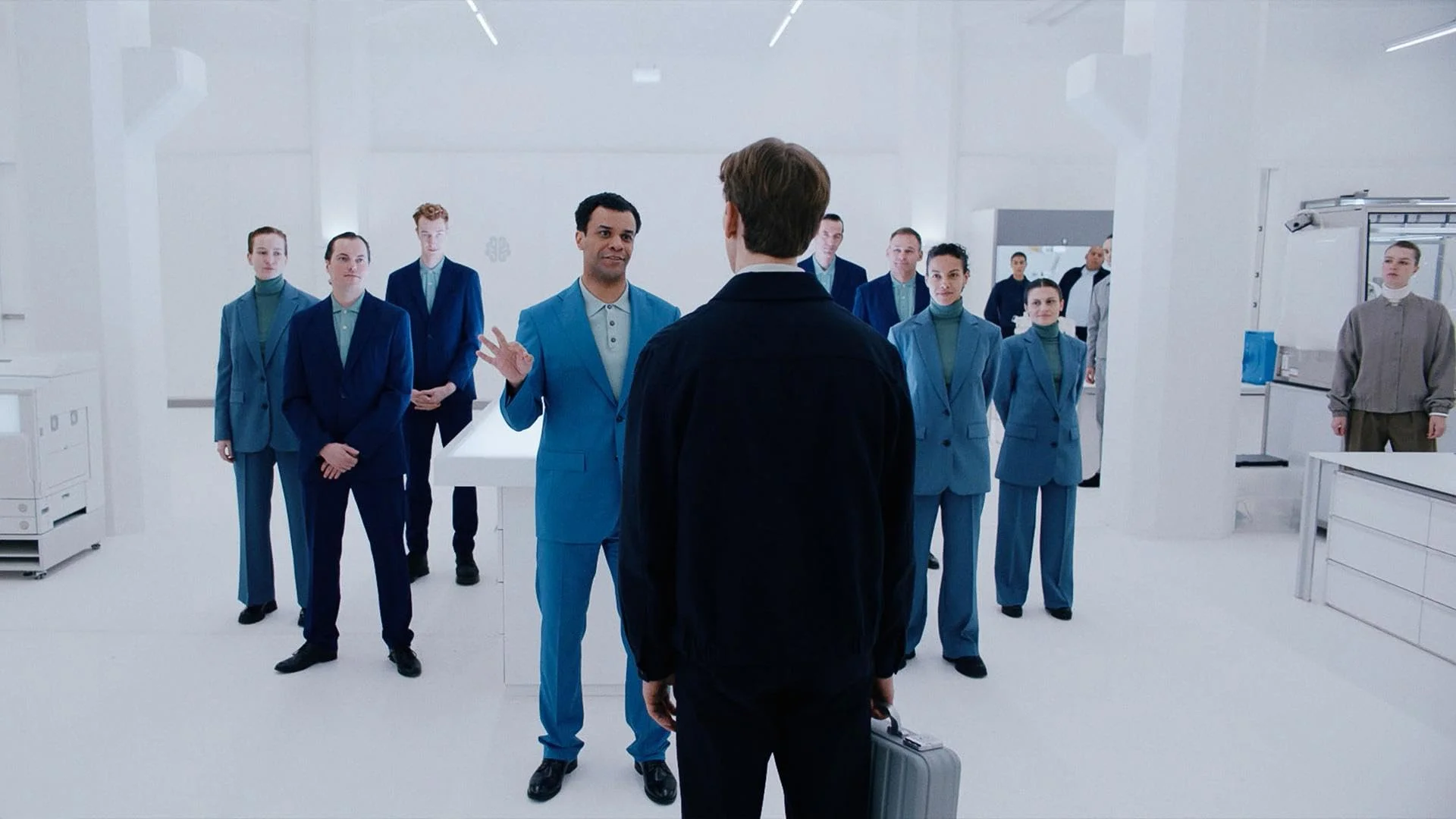
The visual consistency becomes especially effective when something finally interrupts Pasi’s routine. On his way home, he encounters a living squirrel, a creature supposedly eliminated along with the rest of the natural world. His initial reaction is fear, followed by the entirely reasonable decision, according to the standards of his society, to contact the authorities. Curiosity eventually wins. After researching the animal, he secretly brings it into his apartment, despite regulations prohibiting people from touching or keeping living creatures.
Lopperi handles this development with an appealing innocence. Pasi has spent his professional life trying to reproduce animal behavior through engineering, yet he barely understands what animals actually do. The squirrel moves unpredictably, makes a mess, and responds to its surroundings according to instincts that cannot be switched off.
Watching Pasi discover these characteristics is frequently funny because Lopperi never treats the encounters as obvious jokes. His cautious movements and increasingly delighted expressions belong to someone experiencing something genuinely extraordinary. There’s a particularly sweet quality to the faint smile that appears when he begins playing with the animal. For a character accustomed to having every sensation monitored, even that small expression carries considerable weight.
The decision to film with real squirrels is particularly valuable here. Lehmusruusu used living animals, supported by limited puppetry and digital effects, and their natural behavior provides a physical contrast to the artificial environment. A robotic pet can perform a programmed movement at precisely the right moment. A squirrel has no reason to cooperate with its owner’s expectations. Its unpredictable movements give scenes an energy that the human characters, conditioned to avoid spontaneity, rarely display themselves.
The film becomes considerably stronger when Pasi’s enthusiasm creates an unexpected problem. He constructs a cage with an exercise wheel and tries to provide everything he assumes his new companion needs. Yet the squirrel begins deteriorating. Pasi feels happier, but the animal is suffering, and his attempts to reproduce a suitable environment inside his apartment prove inadequate. This is where the screenplay develops its most worthwhile idea. Pasi has learned to appreciate a living creature without understanding what caring for one actually requires.
Jimi (Hannu-Pekka Björkman), an older employee familiar with the forgotten natural world, helps expose the problem. He explains that squirrels belong among trees and need the companionship of their own kind. Pasi’s ignorance initially makes these discoveries amusing, but the conversation introduces a serious complication. Keeping the squirrel safe from the authorities might be preventing it from living properly. When Pasi reports Jimi to protect his secret, his reaction reveals how readily he still trusts the institutional procedures that have shaped his life.
There’s an equally entertaining complication involving Emilia (Mimosa Willamo), an investigator whose work brings her into Pasi’s orbit. She is investigating a killing connected to marital infidelity when she begins noticing inconsistencies in his behavior. Their growing attraction proves nearly as disruptive as the squirrel itself. In this society, physical intimacy has become so unfamiliar that Emilia experiences nausea at its suggestion. Willamo makes these reactions amusing through her character’s genuine discomfort, and her interactions with Lopperi bring welcome energy to scenes that might otherwise become excessively restrained.
Their relationship also demonstrates how carefully Lehmusruusu balances different genres. The romance provides an accessible emotional thread, with two socially awkward people gradually discovering feelings they have never been encouraged to experience. The investigation supplies an external threat, since Emilia’s increasing suspicion could expose Pasi’s forbidden companion. These recognizable storytelling devices help make an unusual science-fiction premise accessible to audiences accustomed to romantic comedies and mysteries.
I found the connection to contemporary technology especially effective because the film concentrates on familiar habits rather than elaborate predictions. Pasi’s AI assistant can reveal information about his emotional condition when he would prefer to keep it private. Health monitoring has become a means of regulating behavior, and artificial companions are designed to provide affection without the inconveniences associated with living animals.
The resemblance to existing consumer technology makes the exaggeration understandable. One particularly sharp development occurs when Pasi realizes that robotic pets might benefit from greater unpredictability, including the possibility of biting. His professional insight earns approval because even apparent disobedience can become an attractive product feature.
For all its inventiveness, the storytelling eventually becomes rather conventional. Once the squirrel begins suffering and Pasi develops feelings for Emilia, the likely emotional direction is easy to anticipate. The film continues spending considerable time with characters who struggle to express themselves, even after the audience understands the significance of their discoveries.
Around the middle stretch, I began wishing Lehmusruusu would allow his characters to act on their growing awareness. The problem becomes particularly noticeable toward the end of the film’s roughly 90-minute running time, when Pasi and Emilia receive relatively little opportunity to experience the consequences of stepping outside their accustomed routines. I would have welcomed a longer exploration of their newfound freedom, especially after spending so much time watching them struggle with the smallest expressions of affection.
Pasi’s personal experience teaches him something that cannot be solved through another design update. As the squirrel’s condition worsens, he must consider a place beyond the controlled environment he understands, somewhere the animal could live according to its own needs. That possibility forces him to reconsider the cage, the exercise wheel, and the elaborate precautions he once believed were enough to keep his companion safe.
The Squirrel (Orava) opened in Finnish theaters on April 2, 2026, before making its international premiere at Fantastic Fest on September 20, 2026, and is available digitally on platforms such as Apple TV in select territories. Written and directed by Markus Lehmusruusu and selected as Finland’s submission for Best International Feature Film at the 99th Academy Awards, the sci-fi comedy-drama follows Pasi (Miro Lopperi), a synthetic pet designer in a sterile, animal-free future who discovers a living squirrel and develops an unexpected bond with Emilia (Mimosa Willamo), the welfare inspector sent to investigate the unauthorized creature.
Full Credits
Title: The Squirrel (Orava)
Distributor: Bufo, Progress Filmverleih, REinvent International Sales (World Sales)
Release date: April 2, 2026 (Finland theatrical release), September 20, 2026 (Fantastic Fest international premiere)
Rating: S/T (Finland)
Running time: 1 hour 33 minutes (93 minutes)
Director: Markus Lehmusruusu
Writers: Markus Lehmusruusu
Producers and Executive Producers: Misha Jaari, Mark Lwoff, Thanassis Karathanos, Martin Hampel, Denis Vaslin, Fleur Knopperts, Ronny Fritsche, Lizette Jonjic, Mikko Kodisoja, Roosa Toivonen
Cast: Miro Lopperi, Mimosa Willamo, Hannu-Pekka Björkman, Roderick Kabanga, Pirjo Heikkilä, Eero Ritala, Ella Mettänen, Pirjo Lonka, Jouko Puolanto
Director of Photography (Cinematographer): Max Smeds
Editors: Florian Miosge
Composer: Freya Arde
The Review
The Squirrel
The Squirrel is a clever, charming science-fiction comedy that finds surprising warmth in a meticulously controlled future. Markus Lehmusruusu's symmetrical compositions, deadpan humor, and delightful use of real animals make its unusual premise wonderfully accessible. Miro Lopperi and Mimosa Willamo bring genuine affection to characters learning how to experience life beyond their programmed routines. I loved its inventive world-building, even when the predictable storyline and sluggish middle stretch tested my patience. Its emotional breakthroughs deserve greater room to develop, but this is an imaginative film well worth watching.
PROS
- Excellent production design and symmetrical cinematography
- Endearing performances from Lopperi and Willamo
- Clever, accessible science-fiction world-building
- Delightfully awkward humor and natural animal interactions
CONS
- Predictable emotional developments
- Uneven pacing leaves little time for the characters' transformations