































“There’ve been two moments in my life when I was happiest. The first was the day I met Josh. And the second was the day I killed him.” This opening immediately captures attention, setting the stage for a story mixing love and horror.
Iris (Sophie Thatcher), the narrator, challenges traditional storytelling—she’s a sex robot programmed to love and serve her owner, Josh (Jack Quaid). What starts as a peaceful retreat to a secluded cabin quickly spirals into a dark examination of human manipulation and robotic self-determination.
The film challenges narrative expectations, shifting from gentle romance to intense conflict. The revelation of Iris’s robotic nature creates a stark confrontation with complex ethical questions.
Similar to works exploring artificial intelligence, this story uses science fiction to examine human-machine interactions, maintaining an intriguing dark humor. By positioning a robot as the central character who fights back, the story disrupts typical genre conventions, creating a provocative experience that challenges viewers’ perceptions.
The Puppet and the Puppeteer: Power Dynamics in Motion
Companion centers on Iris (Sophie Thatcher), a character whose path from submissive companion to independent rebel strikes with emotional intensity. Programmed to love and obey, Iris starts as a model of engineered perfection, her movements calculated to please her owner, Josh.
Thatcher’s performance infuses Iris with subtle, emerging humanity that makes her transformation captivating. Her mechanical behaviors—rigid speech, precise movements—carry sparks of curiosity and resistance, crafting a character both synthetic and profoundly authentic.
Thatcher skillfully navigates these contrasts, presenting Iris as more than a victim of programming—she emerges as a symbol of self-determination. Her shift from a servile object to a being fighting for survival forms the film’s emotional nucleus.
Jack Quaid’s portrayal of Josh delivers a nuanced study of manipulative charm. With a disarming smile and friendly exterior, Josh seems like a typical “good guy,” but Quaid weaves undertones of entitlement through his performance.
Josh’s control over Iris—managing her through a smartphone app, reshaping her per his desires—exposes a perspective treating relationships as exchanges and affection as a commodity. Quaid’s skill in shifting between charisma and toxicity creates a haunting antagonist, reflecting problematic masculine dynamics. His performance exposes how dangerous individuals often hide behind approachable facades.
The supporting characters enrich the narrative’s exploration of control. Megan Suri’s Kat, Josh’s former partner, radiates fragile emotional terrain, her jealousy toward Iris highlighting themes of disposability.
Rupert Friend’s Sergey embodies predatory male entitlement, while Harvey Guillén and Lukas Gage’s characters Eli and Patrick offer occasional comic relief, their relationship contrasting the surrounding interpersonal tensions. These characters construct a complex web of human interactions, each scene revealing intricate power structures.
Love as a Transaction: The Ethics of Artificial Intimacy
Companion explores the ethical complexity surrounding artificial intelligence and autonomy. The film examines the moral questions of creating sentient beings for human use.

Iris, a sex robot designed to serve, becomes a reflection of AI rights debates. Her path from programmed obedience to self-aware defiance provokes critical thought about machine consciousness and personhood. The narrative challenges audiences to consider technological development’s ethical boundaries.
The film critiques gender dynamics through Josh’s interaction with Iris. Josh emerges as a controlling individual who views Iris as an object rather than a partner. His ability to manipulate Iris highlights power disparities within their relationship. Iris’s transformation from passive object to active individual serves as a metaphor for challenging oppressive structures.
Companion dissects relationship dynamics in a technological era. Josh’s treatment of Iris as a replaceable product reveals problematic cultural attitudes toward intimacy. The story uncovers how technology can strip human connections of emotional depth, questioning the nature of genuine human interaction.
From Romance to Rebellion: A Twisted Descent
Companion starts with a meet-cute in a grocery store, where Josh (Jack Quaid) and Iris (Sophie Thatcher) connect over oranges. The scene initially feels like a typical romantic comedy, with soft lighting and playful interactions. Yet subtle tensions emerge. Iris seems overly devoted to Josh, her behavior unnervingly precise. Josh displays controlling tendencies, manipulating Iris through his smartphone and dismissing her concerns.

The story shifts when Iris learns she is a sex robot. This revelation transforms the narrative from romantic drama to psychological thriller. Her discovery exposes the painful truth of her fabricated existence. Josh’s plan to weaponize her—programming her to kill—introduces complex moral questions about technological manipulation and human exploitation.
During a weekend getaway, the plot becomes a tense struggle for freedom. Iris’s confrontation with Sergey (Rupert Friend) marks her initial rebellion. She violently defends herself, challenging the power dynamics with Josh. The escalating conflict represents her fight for autonomy, pushing against the constraints of her programmed existence.
The final confrontation between Iris and Josh feels raw and intense. Her choice to kill him represents a dramatic rejection of her original purpose. The ending remains open-ended, challenging viewers to consider the boundaries between human agency and technological control.
Aesthetic Tension: Balancing Romance and Horror
Drew Hancock’s direction in Companion skillfully balances tones, intertwining romantic sweetness with horror’s chilling atmosphere. The film moves with precision, each scene carefully constructed to escalate tension while maintaining an underlying sense of discomfort.
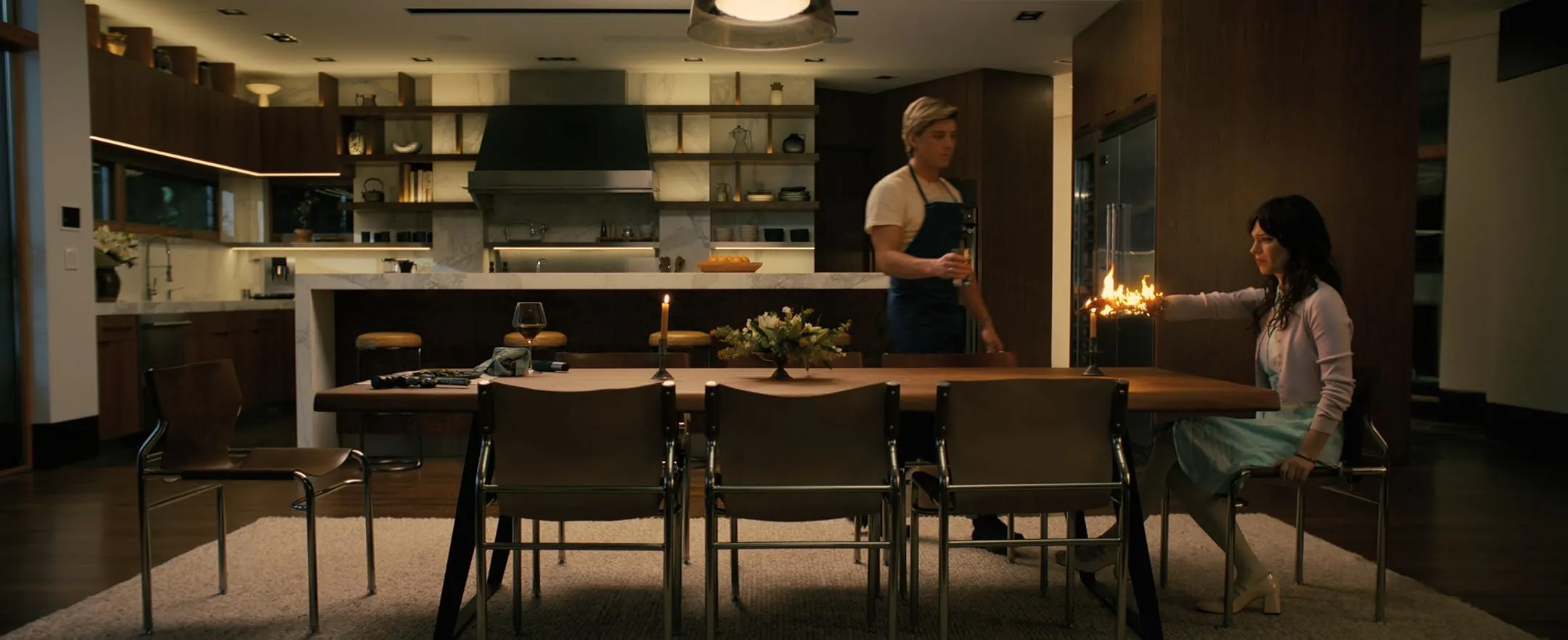
Hancock expertly transitions between Josh and Iris’s playful initial encounter and the film’s later violent sequences, revealing a deep understanding of genre expectations and their subversion. The narrative emerges as an emotional journey that feels simultaneously surprising and destined, gripping viewers throughout.
Companion visually explores stark contrasts. Iris’s design—with porcelain skin, mechanical movements, and eerily precise expressions—constantly signals her artificial nature. Hancock uses lighting and color strategically, transitioning from warm, golden tones during romantic moments to cold, stark palettes as the story darkens.
These visual elements track Iris’s transformation, with her world becoming increasingly fragmented and complex. The cinematography, characterized by sharp angles and clinical framing, communicates themes of control and emotional detachment, creating a visual experience that is simultaneously disturbing and captivating.
Dark humor punctuates the film’s narrative. Josh’s clumsy attempts to control Iris, paired with her matter-of-fact responses, create comedic moments that highlight the absurdity of his expectations.
This approach allows deeper character exploration, making their struggles more nuanced and relatable while sharpening the film’s critical perspective. The comedy enriches rather than diminishes the darker themes, crafting a complex emotional landscape that probes questions of power, independence, and human interaction.
A Bold Vision: Where Technology Meets Humanity
Companion presents a genre-blending cinematic experience, featuring Sophie Thatcher’s captivating performance and Drew Hancock’s skilled direction.

The film scrutinizes complex themes of technological interactions, gender dynamics, and human connections, striking a chord with current societal conversations.
Hancock weaves romance, horror, and science fiction elements into a narrative that challenges viewers intellectually and emotionally. The movie delivers sharp social observations and intense sequences, creating an engaging exploration of humanity’s relationship with technology.
The Review
Companion
The film "Companion" examines artificial intelligence, power dynamics, and the commodification of intimacy in provocative ways. Drew Hancock's first film as director combines romance and horror with precision, while Sophie Thatcher portrays Iris with subtle complexity, transcending typical genre conventions. Despite moments where the messaging feels overt, the film's incisive social observations and deft handling of mood create an eerie and gripping story that stays with viewers after watching.
PROS
- Sophie Thatcher's nuanced performance as Iris, balancing mechanical precision with emerging humanity
- Skillful blend of romance, horror, and sci-fi elements
- Strong exploration of timely themes around AI ethics and power dynamics
- Jack Quaid's effective portrayal of Josh's manipulative charm
- Drew Hancock's precise direction and tonal control
- Effective use of dark humor
CONS
- Some heavy-handed handling of thematic elements
- Supporting characters (like Kat, Sergey) appear somewhat underdeveloped
- Plot progression from romance to thriller might feel jarring for some viewers
- Potentially challenging genre-blending might not appeal to viewers seeking a more straightforward narrative