



























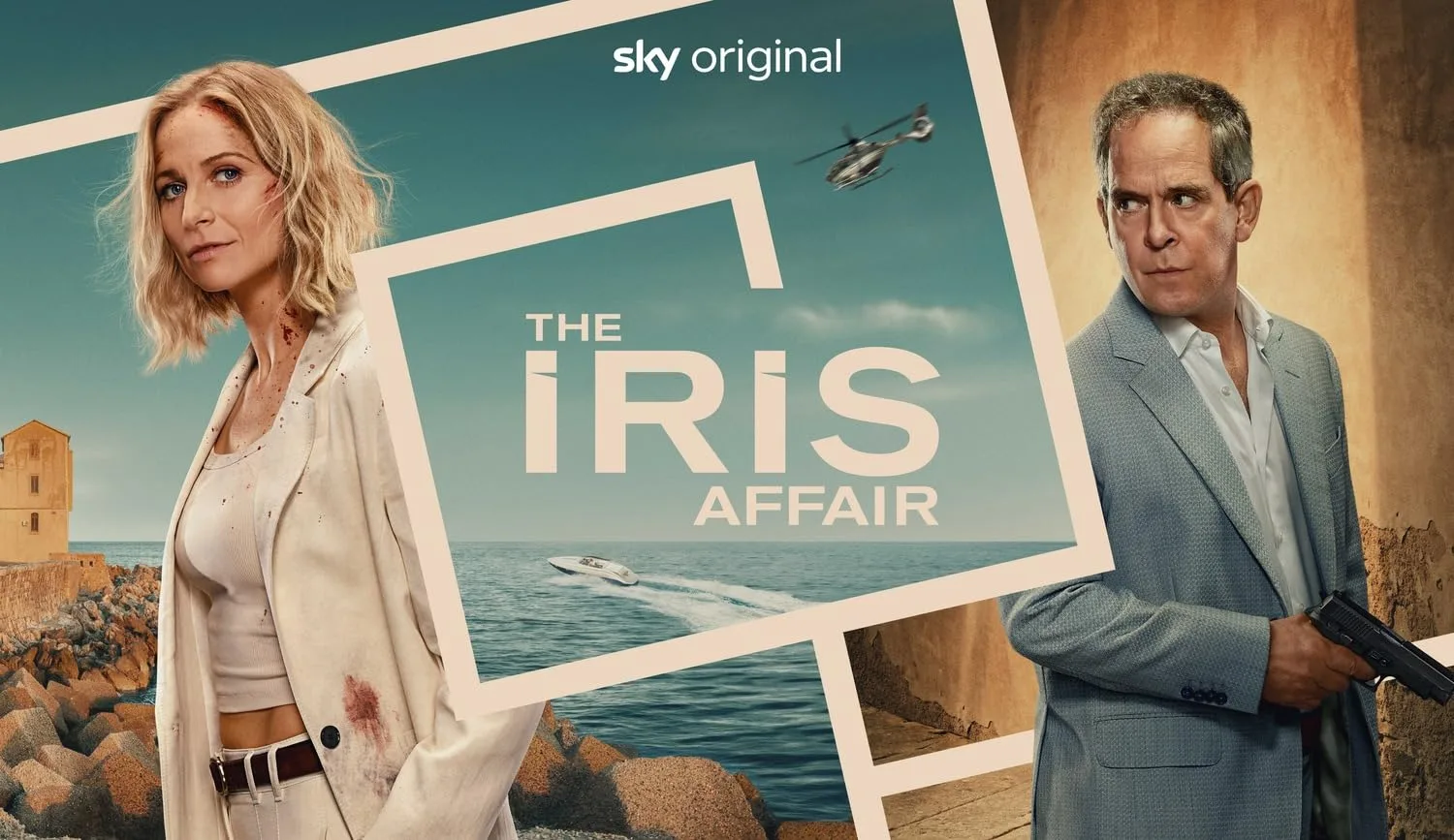

Answering a contemporary thriller requires acknowledging the current shape of the genre. The market for immediate, high-octane engagement often pushes creators toward stylistic decisions that privilege speed over layered storytelling. The Iris Affair exemplifies that tendency. It opens as a slick, frenetic, intentionally fragmented hunt across Europe and frames itself as a prestige drama about superhuman intelligence and corporate malfeasance.
The series, created by Neil Cross, sets up a high-stakes premise focused on Iris Nixon, played by Niamh Algar. Iris is introduced as a puzzle-solver with a formidable mind who has become a fugitive after stealing material tied to a potentially world-altering technology. She is first found hiding in Sardinia under the name Monica while tutoring a wealthy family’s daughter and carrying the weight of a €4.3 million bounty.
Powerful, unseen forces pursue her. The hunt is driven in part by Cameron Beck, portrayed by Tom Hollander, a venture capitalist intent on recovering the proprietary technology Iris compromised. The show aims high in visual ambition and in its cast, but its surface complexity prompts a question: does that complexity reflect meaningful depth or does it function as ornate distraction?
The Streamer’s Story: Fragmentation and Velocity
The Iris Affair is defined by a non-linear narrative architecture. The series treats fragmented chronology as a stylistic signature of streaming-era drama. Faced with a landscape of endless viewing options, the show assumes that audiences require instant intensity. The plot shuffles between the present-day chase in Sardinia, events that immediately precede the hunt, and moments two years earlier in Florence and at a secretive base in Slovenia.
That fragmentation delivers an opening surge of energy. The story starts in media res with a violent confrontation, launching the viewer straight into Iris’s desperation and creating immediate tension. The frequent, abrupt time-jumps soon strain that initial momentum by interrupting emotional accumulation. Constant re-orientation to place characters and motives in their proper points in time directs attention to when scenes occur rather than why they matter. The structure gives an impression of density, but the underlying narrative remains a fugitive tale. The series substitutes sustained anxiety with quick shocks and whip-cut excitement.
Beginning in media res carries a consequential effect on stakes. Early survival scenes show Iris moving through perilous situations and remaining alive, which reduces the sense of genuine jeopardy in preceding episodes. The narrative responds by introducing successive, sometimes arbitrary obstacles. The chase becomes a sequence of engineered near-misses instead of a measured contest of cunning. Pacing concentrates on relentless motion: Iris is repeatedly running, hiding, or manipulating circumstances. That constant activity often leaves little room for a coherent dramatic arc to take shape.
The central mystery that sets the plot in motion bears a deliberately high concept name: the Charlie Big Potatoes project. The device is described as a topological quantum mechanism, a self-sufficient, super-intelligent AI with organic elements. Iris has taken a notebook of encrypted research left by the project’s original, now-incapacitated creator, Jensen. The plot element reflects a widespread technological anxiety. Charlie is framed as a potential source of catastrophic consequence.
Cameron Beck seeks Iris so she will decode the notes and thereby unlock that power. That places Iris at the meeting point of physical pursuit and an ideological confrontation with unregulated capital and technological hubris. The series treats the AI subplot as contemporary material, yet the presentation of that material often stays vague and increases narrative opacity in early episodes.
The Burden of Representation: Intellect, Gender, and The Cast
A significant part of the series’ cultural conversation lies in how it treats Iris as an intellectual protagonist. Casting Niamh Algar in the role centers a strong Irish actor in a broadly European thriller, which reflects a movement toward cross-border casting and internationalized production. Algar delivers a controlled performance capable of registering the brittle reserve expected of a character defined by intense intelligence and isolation.

The writing, though, does not always sustain the protagonist’s declared acumen. Iris is described as a genius, a master mathematician and puzzle-solver, yet the series frequently places her in scenarios where her choices appear impulsive or illogical. This creates a persistent paradox around the portrayal of a brilliant woman. Her disguises are thin, limited to a change of clothes and colored contacts, and her operational security shows fragility when she is discovered peeking into a hidden cabin or is easily spotted on the street.
Her plans repeatedly depend on chance or on the incompetence of those pursuing her. The show asserts Iris’s intellect but often fails to display it through convincingly airtight strategies. That disconnect weakens a core premise and suggests writing that prioritizes plot movement over coherent demonstrations of world-class strategic skill.
The protagonist’s methods also expose a gendered distribution of power. Cameron Beck deploys institutional tools: corporate money, task forces, international bounties. Iris operates without those apparatuses and turns to personal leverage and emotional pressure. She manipulates the corrupt police officer Teo by exploiting his affair and planting evidence of a possible murder to make him act as an inside agent. That pattern places female agency within relational strategies rather than large-scale institutional command, which reads as an established trope for women who wield power in this kind of story.
Tom Hollander’s Cameron Beck supplies institutional weight. His performance anchors the series with a menace rooted in intellect and finance rather than theatrical villainy. Scenes between Beck and Iris carry particular charge. Their exchanges, often verbal and psychological, establish the stakes tied to gaining access to Charlie’s code.
Supporting performances underline the series’ concern with information flow. Alfie, an online conspiracy podcaster, acts as a modern chorus, passing along fragments of exposition about the bounty and circulating rumors. His role embodies current knowledge ecosystems where fact and rumor blur under unverified online voices. Joy, the teenager Iris tutors, gives the protagonist a rare human connection and functions as an emotional anchor, even when that relationship results in operational missteps such as trusting Joy with a crucial briefcase.
Surveillance, Corruption, and Cultural Flow
The Iris Affair leverages glossy production values to examine corruption and unregulated global finance. Locations like sun-drenched Sardinia function as more than postcard scenery. The series uses that setting to show how idyllic places can mask corporate conspiracy and compromised authority. Wealth enables powerful actors to co-opt local law enforcement and to exploit these places with relative ease.

The series addresses intelligence and its cost. Iris’s genius yields isolation, perpetual flight, and the sense of being a tool for others to exploit. Jensen, Charlie’s creator, endures a harsher outcome: he descends into madness after confronting what his creation might do. Jensen’s fear that Charlie is the “Lamentation of God” articulates deep cultural anxieties about unchecked AI and technological singularity. Those concerns feel timely in an era where algorithms and data increasingly shape political and economic life.
The show occupies a hybrid tonal space. It mixes intellectual paranoia about corporate espionage with the gritty facts of a survival action story. Sudden violence, from booby traps around Iris’s remote cabin to savage beatings and a fatal fall in a ravine, places philosophical questions about an advanced AI alongside immediate corporeal danger. That combination of slick production and physical grit appears designed to reach different audience segments across streaming platforms.
The subplot with Alfie and the circulating €4.3 million bounty speaks to contemporary media dynamics. Alfie profits from spectacle in a disinformation economy. The bounty creates a form of decentralized surveillance, turning ordinary citizens into potential informants. The series shows how technology and finance can erode privacy so that mere survival becomes fodder for online attention and monetization. That state of affairs produces a persistent sense that private life is exposed to the combined reach of corporate interest and continuous digital observation.
A Verdict on Velocity and Vision
The Iris Affair is a streamer thriller shaped by a demand for immediacy and constant motion. Its principal assets are the performances of Niamh Algar and Tom Hollander, whose confrontations supply much of the intellectual ballast missing from other parts of the show. The series constructs a visually polished, fast-moving environment that engages with corporate corruption and the moral hazards of advanced artificial intelligence.

Yet the show struggles to assemble its elements into a coherent whole. Fragmented chronology complicates what is, at base, a chase story and often obscures rather than clarifies. More undermining is the inconsistent writing of Iris Nixon as the purported genius; her choices frequently depend on contrivance and luck, which weakens the theme of intellect under pressure. The use of a dangerous super-AI, while timely, registers as a familiar trope within contemporary thrillers.
The series functions as a stylish diversion. It exemplifies a trend where contemporary drama often prefers immediate structural shocks over extended narrative development. Viewers who want polished visuals, brisk pacing, and the dynamic interplay between Algar and Hollander will find material to hold their attention. Viewers seeking a tightly reasoned, logically coherent thriller with clear dramatic throughlines may find the suspension of disbelief the storytelling requires to be too great a cost.
The Iris Affair is an eight-part British thriller television series that premiered on October 16, 2025. Created and showrun by Neil Cross, the mastermind behind Luther, the series stars Niamh Algar as Iris Nixon, an enigmatic genius and codebreaker, and Tom Hollander as Cameron Beck, a charismatic but mysterious entrepreneur. The story is a tense and cinematic chase thriller, following Iris as she goes on the run across Italy after stealing the activation sequence for a powerful, top-secret piece of technology she has uncovered, leading to a high-stakes game of cat and mouse with Cameron. The series is a Sky Original and is available to watch in the UK on Sky Atlantic and the streaming service NOW.
Full Credits
Director: Terry McDonough, Sarah O’Gorman
Writers: Neil Cross, Susan E. Connolly, Ian Scott McCullough
Producers and Executive Producers: Tim Bricknell, Neil Cross, Terry McDonough, Adrian Sturges, Dante Di Loreto, Jenni Sherwood
Cast: Niamh Algar, Tom Hollander, Kristofer Hivju, Harry Lloyd, Meréana Tomlinson, Sacha Dhawan, Maya Sansa, Peter Sullivan, Debi Mazar, Marco Leonardi, Angela Bruce, Lorenzo De Moor
The Review
The Iris Affair
The Iris Affair is a high-octane spectacle of style and performance, powered by Niamh Algar and Tom Hollander's electric dynamic. It brilliantly reflects contemporary anxieties about AI and unchecked corporate power against a gorgeous European canvas. However, its compulsive non-linear structure frequently collapses under its own weight, prioritizing manufactured confusion and relentless movement over character consistency and coherent plot mechanics. It’s ultimately a compelling, if structurally frustrating, streamer thriller.
PROS
- A commanding, often chillingly controlled performance as a gifted, isolated protagonist, successfully redefining the female genius archetype.
- The mind-game confrontations between Beck and Iris are the dramatic highlights, providing necessary intellectual tension.
- High production values utilizing stunning European locales (Sardinia, Florence) that elevate the visual experience.
- Engages directly with timely societal concerns regarding AI ethics, decentralized information, and corporate corruption.
CONS
- The excessive, rapid fragmentation of the timeline makes the plot unnecessarily difficult to follow, masking a simple "steal-and-chase" narrative.
- Iris’s actions sometimes contradict her stated genius, requiring convenient lapses in judgment or luck to advance the story.
- The use of a dangerous super-AI as the primary MacGuffin feels increasingly standard in the genre.