



















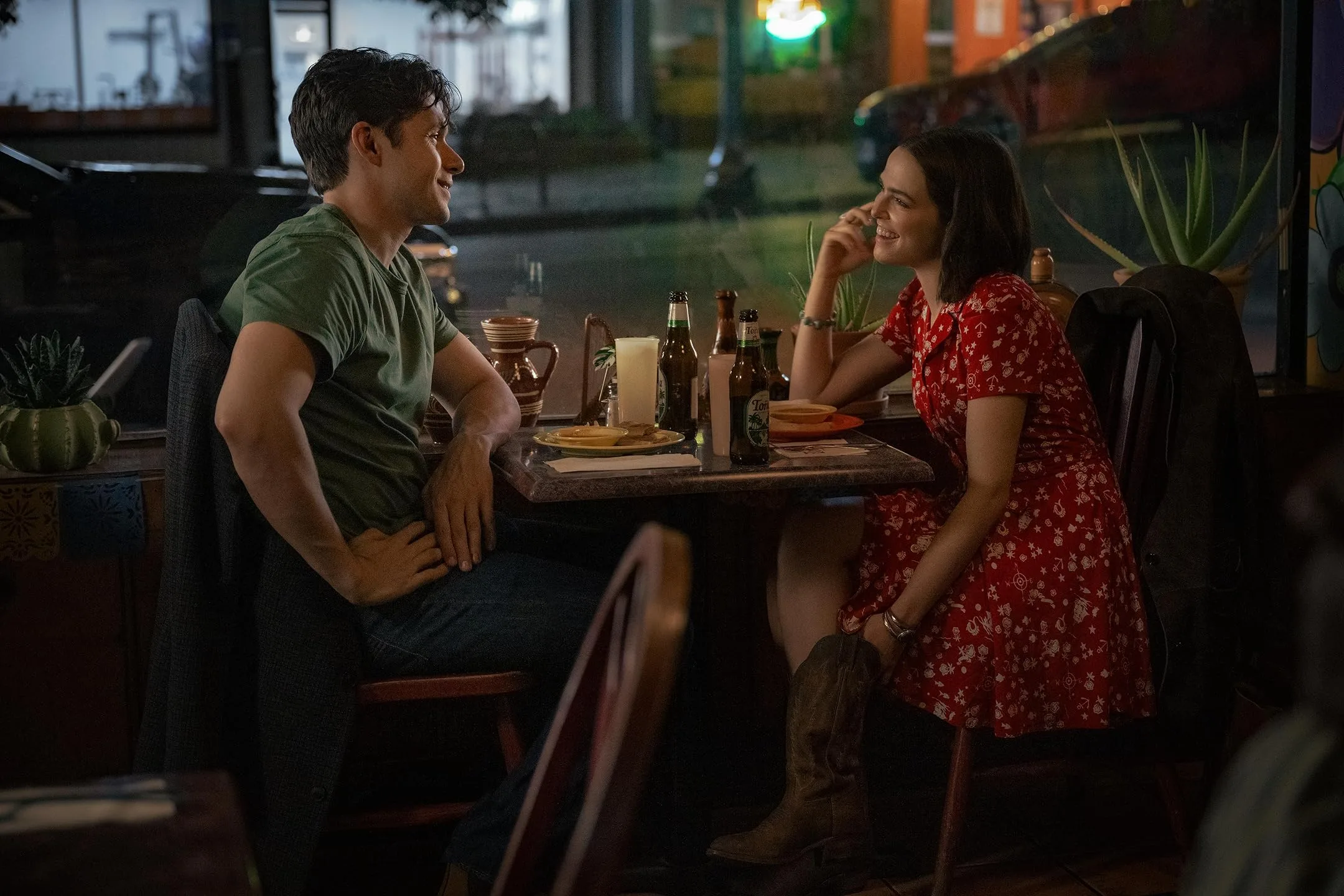
Voicemails for Isabelle reaches Netflix wearing the pedigree of a Black List screenplay, one that drifted for years and once carried Hailee Steinfeld’s name before landing with Leah McKendrick, who writes, directs, and tucks herself into the supporting cast. Sony produced it for the streamer, and the money is legible in every frame: the film looks slicker than the platform’s house style usually permits. Jill (Zoey Deutch) is a pastry chef who has carried her ambition from Austin to San Francisco.
Her younger sister Izzy (Ciara Bravo) has spent most of a short life housebound with cystic fibrosis, and the two keep each other alive to one another through a steady traffic of voicemails. Izzy dies in the first act. Jill keeps leaving messages on a dead girl’s line, which has quietly been reassigned to Wes (Nick Robinson), an Austin realtor who listens to all of it, falls for the voice, and crosses the country to engineer a meeting without confessing how he arrived at her park bench. Nick Offerman, Lukas Gage, and Harry Shum Jr. fill the margins.
Living Life Times Two
The film’s surest material is its grief, and it earns that surety the honest way, through specificity rather than announcement. The childhood flashbacks do their work in a handful of strokes: young Jill thrashing a boy on the playground for mocking Izzy’s illness, then savoring her suspension; the sisters’ kitchen experiments ending with their father charging in behind a fire extinguisher. Those scenes plant Jill’s culinary appetite and her habit of living loudly so that a bedridden sister can live by proxy.
When Izzy dies, McKendrick refuses to let the absence evaporate. Jill’s mother repeats the phrase “She didn’t make it” while Jill stands inside her own denial, then folds to the floor. An hour later, the discovery that Izzy’s saved voicemails have been deleted produces a single sob of “Please, no” that lands harder than anything the romance manages. The picture closes on “I love you, Isabelle,” which is its way of insisting the sister, not the suitor, was the love story all along.
That insistence is also the film’s tell. A movie confident in its grief lets the grief speak; this one stops to gloss it. When Jill turns to Wes and declares, “I don’t need a man. What I need is my little sister back,” McKendrick is underlining a theme her own staging has already proven. The mourning is real. The captioning of the mourning is a smaller, more anxious gesture, the work of a film that does not quite trust the audience to feel what it has so carefully built.
A Sick Reboot
Here is where the film’s reputation for cleverness deserves dismantling. Wes inherits a dead woman’s number, chooses to keep listening, mines the messages and Jill’s social media, then flies west “for work” and ambushes her with knowledge she never gave him: her bench, her restaurant, her hometown. The film knows precisely what this is. A character calls him a “creeper.” McKendrick herself, on screen, frames the situation as “a sick reboot of You’ve Got Mail.” The praise the film has collected treats this self-knowledge as a kind of absolution, as though a confession of stalking were the same as cleaning up after it.
It is not. Naming a violation is not metabolizing it. The film stages the only question that matters, will Wes tell her the truth, and then declines to reckon with the deeper one it keeps gesturing at: a man who arrives at devotion through deception may be worse than the loud cads Jill dates precisely because his sincerity launders the intrusion. McKendrick wants the discomfort acknowledged and forgiven in the same breath, and the breath is too short for both.
What carries the romance past this is not the writing but two faces. Deutch and Robinson play the Austin-rooted bonding scenes with a lived-in ease, and the late set-pieces, the hijacked bus tour where Wes seizes the microphone and conducts a sing-along to “I Left My Heart in San Francisco,” the obligatory run through the rain, the wink of “This is the scene where you run,” coast on chemistry the script has not actually justified.
No Tom Hanks
The picture cannot stop quoting its ancestors, and the quoting is meant to charm. Meg Ryan is invoked by name, Ephron is summoned like a patron saint, Wes compares himself to Tom Hanks and is told, accurately, that he is “no Tom Hanks.” There is a genuine lineage underneath the name-dropping, since You’ve Got Mail was itself an update of 1940’s The Shop Around the Corner, which means the chain of letters to emails to texts to voicemails is centuries deep and the film is right to feel itself part of it.
The same impulse runs through 2023’s Love Again, which reached the dead through text messages, and through this year’s You, Me & Tuscany. Modern romance keeps lifting a 1990s plot and adjusting the technology rather than inventing a feeling of its own.
That habit is the cultural object worth examining, and Voicemails for Isabelle is its most candid specimen. McKendrick layers the throwback bones with a poppy 2020s surface: the dialogue is salted with gaslit, secure attachment, love bombing, Jill’s “neurospicy”; two Taylor Swift needle-drops arrive courtesy of Este Haim on soundtrack duty; the outfit changes look auditioned.
The citation is constant and the invention is thin, and a film made by someone with this much affection for the genre ought to be smarter than the formula she clearly loves. Recognition is the easiest form of intelligence. McKendrick mistakes the pleasure of spotting a trope for the harder pleasure of bending one.
Deutch Hard-Sells It
Strip the picture of its lead and it collapses, which is the clearest verdict any performance can earn. Deutch makes Jill chaotic and bubbly and substantial in the same gesture, and her best showcase has nothing to do with Wes: the public evisceration she delivers to a hypocritical dating podcaster (Toby Sandeman) in front of his admirers, a comic aria that also tells you exactly who Jill is. She sells the grief with the same instrument that sells the jokes, and the film is shrewd enough to point the camera at her and stay out of the way.
Robinson is the weaker variable. He plays Wes as a sweetheart with unsteady boundaries, which keeps a potentially cynical role warm, and a colder actor would have exposed the premise entirely. Yet he is too indistinct to explain the intensity of Jill’s fall, and McKendrick papers over the early romance with a montage rather than a reason. The supporting bench is deployed with more discipline than the leads.
Offerman’s Chef Bastien, the “Temu Gordon Ramsay” of a Top Chef also-ran, works precisely because he is rationed; the comedy survives on his scarcity. Gage’s obnoxious culinary-class fling lets the film land a few jabs at kitchen chauvinism, though the part sits awkwardly between sharp character work and miscasting. Shum Jr. and McKendrick, as the friend couple, keep saying the sensible things Wes refuses to hear.
The direction has rhythm before it has stamina. The opening forty minutes cut chop-chop-chop in time with Jill’s prep work, and the comedy quickens with it. Then Wes meets Jill, the deception plot takes the wheel, and the film slumps into its near-two-hour length, every minute of which is felt. The compensations are real: a soundtrack that turns Robyn’s “Dancing on My Own” into a recurring pulse beneath “Electric Love” and “Marjorie,” and a San Francisco shot with the same proprietary affection Ephron lavished on New York, the skyline and the bench doing the romantic labor the script keeps outsourcing.
Voicemails for Isabelle is a romantic comedy-drama film that premiered on June 19, 2026, and is available to stream exclusively on Netflix. The plot follows Jill, an aspiring pastry chef processing the loss of her younger sister by routinely leaving deeply personal confessional messages on her old phone number. Unbeknownst to her, the number has been reassigned to Wes, an Austin-based real estate agent who begins to fall in love with her from afar after hearing her honest audio diaries.
Where to Watch Voicemails for Isabelle Online


Full Credits
Title: Voicemails for Isabelle
Distributor: Netflix
Release date: June 19, 2026
Rating: PG-13
Running time: 118 minutes
Director: Leah McKendrick
Writers: Leah McKendrick
Producers and Executive Producers: Todd Black, Becky Sanderman, Jason Blumenthal, Steve Tisch
Cast: Zoey Deutch, Nick Robinson, Nick Offerman, Lukas Gage, Toby Sandeman, Harry Shum Jr., Ciara Bravo, Spencer Lord, Gil Bellows, Tanis Dolman, Leah McKendrick
Director of Photography (Cinematographer): Julia Swain
Editors: Lee Haxall, Ryan C. Fill
Composer: Este Haim, Amanda Yamate
The Review
Voicemails for Isabelle
A film that mistakes self-awareness for wit, Voicemails for Isabelle names its own creepiness and calls the naming a cure. The grief is real and exactly observed, the sisterhood earns its tears, and then McKendrick captions every feeling she has already proven. Borrowed from Ephron without Ephron's intelligence, the romance survives entirely on Deutch, who hard-sells a chaotic, substantial Jill the writing does not deserve. Robinson is too faint to justify her fall, and the deception at the center stays unexamined past the point of confessing it exists. Charming in flashes, candid about its theft, and finally too stale to redeem the loss it depicts.
PROS
- Deutch's chaotic, substantive lead performance
- Specific, well-earned grief in the sister scenes
- Offerman rationed for maximum comedy
- Robyn-anchored soundtrack and a lovingly shot San Francisco
CONS
- Self-awareness substitutes for solving the stalker premise
- Themes captioned the dialogue has already proven
- Robinson too indistinct to justify Jill's fall
- Near-two-hour runtime that slumps after the meet
- Borrowed plot with thin invention of its own