

























![Kingdom Hearts Collection [I-III] Review](https://gazettely.com/wp-content/uploads/2026/10/Kingdom-Hearts-Collection-I-III-1-360x180.webp "Kingdom Hearts Collection [I-III] Review: KHII Holds Steady as Newer Entries Fluctuate 37")





A job title is a brutal form of editing. It removes childhood, migration, debt, marriage, grief, ambition, failure, and leaves two or three words that fit neatly beneath a name. Karla Murthy’s documentary takes those words, “gas station attendant,” and spends its running time restoring everything they exclude.
The attendant is her father, H.N. Shantha Murthy, an Indian immigrant working graveyard shifts at a Texas station after several business ventures falter. Karla, living in New York, calls him during those long nights and records their conversations. His voice guides the film through home videos, family photographs, old news footage, and present-day visits to the landscapes that shaped them.
At first, the title seems oddly narrow. Shantha held many jobs, and the gas station occupied only a brief period. The narrowness is deliberate. Murthy is examining what might be called occupational erasure: the ease with which strangers mistake a person’s current labor for the boundaries of their life.
Survival as Motion
Shantha’s history initially resembles a fable assembled from calamity and improbable luck. Following his father’s loss of a bank job, he moves from the city to a remote village in India. Poverty drives him to run away at around ten years old. He works exhausting shifts in restaurants and hotels, sleeps on streets, and considers walking into the sea. Something tells him not to.
The escape arrives through a small act of service. While working at a Mumbai hotel, Shantha finds hot meals for an American couple after the kitchen has closed. Mr. and Mrs. Kern later sponsor him to move to Houston. Even his arrival papers reduce him: his full name cannot fit inside the allotted box, so H.N. becomes the administratively convenient version of a human being. Bureaucracy has always preferred initials. They ask fewer questions.
American life gives Shantha opportunity in irregular doses. He works in engineering, sells children’s clothing and medical supplies, manages restaurants, attends jewelry conventions, runs Indian restaurants, struggles with a gift shop, and eventually takes the gas-station shift. To Karla as a child, each change appears to be another adventure. The recorded conversations expose a harsher pattern. Businesses close. Debt accumulates. A provider improvises because stability refuses to cooperate.
I initially read this pattern as restlessness, which is also how Karla once understood it. The film slowly corrects that judgment. Shantha’s movement is less a search for novelty than a survival reflex formed during childhood. Standing still once meant hunger. Why would adulthood cure the body of that lesson?
His generosity makes the contradiction sharper. At trade shows, he remembers people’s names and arrives at later meetings with gifts chosen specifically for them. At the gas station, customers describe a man who treats no visitor as a stranger. This kindness does little for the balance sheet. It does, however, explain why Shantha’s failures never shrink him into a tragic symbol.
The Time Loop
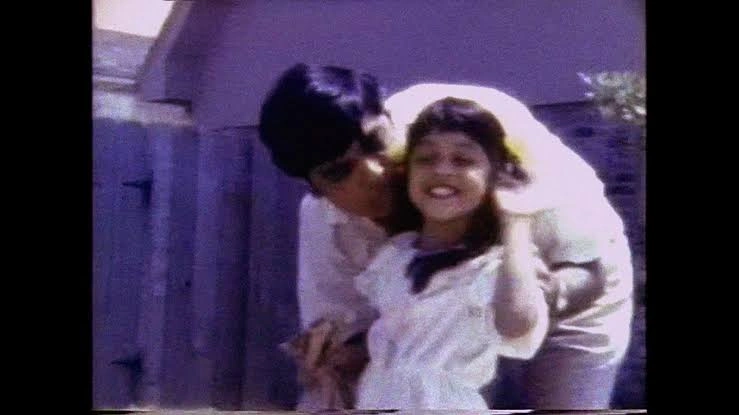
Murthy constructs the documentary from MiniDV tapes, photographs, recorded calls, Super 8 images, historical footage, and clean contemporary video of Houston suburbs, overpasses, beaches, and family homes. The changes in format give memory a physical texture. The past does not return as a complete account. It arrives scratched, cropped, poorly lit, and emotionally reclassified.
A family trip to the Taj Mahal carries one meaning in the original footage and another after Murthy reveals that her Filipina mother concealed a terminal cancer diagnosis from her children. Smiling images become documents of withheld fear. When Murthy visits the childhood landscapes of both parents, the camera performs a strange reversal: the daughter who once depended on them now studies the conditions that produced them.
She describes herself as caught in a “time loop” while sorting old videotapes. The phrase risks sounding like an easy metaphor, yet the editing earns it. A tape does not preserve the past intact. It preserves the viewer’s future misunderstanding of it. Karla once filmed her father’s job changes without grasping the debt beneath them. Years later, the same images accuse her innocence.
The structure sometimes loses confidence in this material. Newsreel commentary explains images that already communicate their historical function, including footage surrounding Gandhi’s funeral. Passages concerning Karla’s college years, restaurant work, website design, debt, and move to New York enter the chronology awkwardly. The narration occasionally behaves like a nervous museum guide, pointing at the object while the object is speaking perfectly well.
Still, the phone calls maintain an emotional line through the drift. Shantha’s voice, detached from a visible face, prevents the archive from turning into family mythology. He sounds tired, amused, worried, and candid. During a drive home from a New Orleans trade show, he admits the weight of his debt and offers Karla advice about marriage: “Make peace no matter how long it takes.” It is tender counsel from a man whose working life has rarely allowed peace to remain employed for long.
The Person Behind the Counter
Karla’s career begins to mirror the pattern she once resisted in her father. She leaves for New York, works as a hostess, designs websites, falls into debt, and continues pursuing filmmaking. The resemblance is uncomfortable because inheritance rarely announces itself as inheritance. It appears as a personal decision until the family archive supplies evidence.
Their closeness is clearest in casual footage. Shantha speaks to Karla with patience when she is young, treating her as slightly wiser than her age. Later, he responds to her camera with playful irritation while moving around the house. These exchanges reveal the foundation beneath the film’s guilt. Arguments about money and reduced communication matter because affection was never absent. It was crowded by time.
The visit to a memorial for a Nepalese gas-station worker killed during a robbery sharpens Murthy’s purpose. Customers knew the man through a counter, a uniform, and a transaction. His history remained inaccessible until death made its absence conspicuous. Karla fears the same reduction for her father.
This raises the film’s most difficult question: how many lives do we encounter only in their edited form? Shantha can be seen as an attendant, debtor, failed businessman, immigrant success story, or endlessly optimistic father. Each label contains evidence. None contains him.
The last movement passes from footage of Shantha as a young parent to Karla’s children running barefoot near the water. The archive has changed hands. So has the anxiety. Somewhere between those generations, a daughter finally learns that seeing a parent clearly requires surrendering the simpler person childhood invented.
The Gas Station Attendant premiered at the Sheffield DocFest on June 19, 2025, and has since been screened at various international film festivals and select independent cinemas. Directed by Karla Murthy, the documentary follows an intimate reflection on her South Asian immigrant father’s life, tracing his journey from an impoverished Indian village to working nights at a Texas gas station in pursuit of the American Dream. The film makes its broadcast debut today on PBS’s POV (at 10 PM/9 C, check local listings) and is available to stream on the PBS App through October 3, 2026.
Full Credits
Title: The Gas Station Attendant
Distributor: Greene Fort Productions, Independent Television Service, Firelight Media, Center for Asian American Media
Release date: June 19, 2025
Running time: 83 minutes
Director: Karla Murthy
Writers: Karla Murthy
Producers and Executive Producers: Karla Murthy, Rajal Pitroda, Carrie Lozano, Geeta Gandbhir, Rekha Maholtra, Stanley Nelson, Marcia Smith, Stephen Gong, Donald Young
Cast: Karla Murthy, H. N. Shantha Murthy
Director of Photography (Cinematographer): Karla Murthy, Andrew Fredericks, Raúl O. Paz-Pastrana, Andy Sarjahani
Editors: Karla Murthy
Composer: Bobak Lotfipour
The Review
The Gas Station Attendant
The Gas Station Attendant turns a temporary job into a warning about how easily labor erases the person performing it. Karla Murthy’s narration occasionally explains images that have already made their point, and the chronology wanders when her own career enters the frame. Yet the phone calls with her father carry an intimacy no polished structure could manufacture. His business failures gradually stop resembling restlessness and begin to look like repeated acts of survival. This is a family archive transformed into an argument against reducing any life to its visible occupation.
PROS
- Vulnerable father-daughter conversations
- Rich home-video archive
- Nuanced portrait of immigrant labor
- Moving parallels across generations
CONS
- Overexplains certain archival images
- Uneven chronological structure
- Some themes remain underdeveloped
- Personal passages can feel awkwardly placed







