
























A man who can read a hostile room in seconds becomes frighteningly easy to control once MI6 learns the name of the woman he loves. The Agency Season 2 understands that this is the real violence of espionage: find the soft point, apply pressure, call it statecraft. Paramount+’s spy drama returns with Martian (Michael Fassbender) trapped inside the bargain he made at the end of Season 1, agreeing to serve MI6’s James Richardson (Hugh Bonneville) for a chance to save Dr. Samia Zahir (Jodie Turner-Smith) from imprisonment in Sudan.
The first season of The Agency had the patience of a show convinced that every spreadsheet mattered. Sometimes it was right. Sometimes it made viewers prove their loyalty through paperwork. Season 2 benefits from that earlier groundwork by making the operations feel connected from the start. Operation Felix, the rescue of Coyote from Valhalla, Danny Morata’s undercover arrival in Tehran, and Martian’s private betrayal no longer sit like separate case files on the same desk. They begin to contaminate one another.
The show’s most telling visual idea remains its least flashy one: the CIA’s London Station looks like a place where toner cartridges go to die. Beige walls, sealed rooms, clipped conversations, people waiting outside doors with the stiffness of employees about to be fired. The Agency turns that dead office texture into a battlefield. A folder carried down a corridor can create the same dread another series would assign to a car bomb. An interrogation becomes a duel of pauses. Someone hesitates before leaving an office, then says the sentence that detonates the episode.
That approach is not accidental. In a television landscape crowded with spy shows that sell espionage as lifestyle fantasy, The Agency frames it as managerial decay with passports. The glamorous parts exist, including gunfights, car chases, torture, and global movement through Ukraine, Iran, London, and the Central African Republic. The more revealing scenes involve people trying to retain authority under fluorescent light.
Season 1’s Patience Finally Pays Rent
The main improvement in Season 2 is structural. The first season often treated its Ukraine and Iran plots as neighboring shows sharing a lead actor. Season 2 tightens that distance. Valhalla, the Russian-linked mercenary force that dominated the previous season’s hostage storyline, returns in altered form through Viking (Clayne Crawford), a former U.S. Marine whose brutality has been converted into public spectacle. His videos of executions with a sledgehammer are ugly by design, less villain branding than political messaging.
That matters because The Agency is most alive when it shows modern power as something outsourced, franchised, and deniable. The CIA is not simply facing another country. It is facing a corporate war machine with military instincts and media literacy. Viking’s chess-grandmaster intelligence could have been a cartoon trait in a lesser series. Here it works because the season treats strategy as labor. Everyone is always calculating, and nobody gets to clock out.
The ten-episode binge release helps the show. Season 1’s weekly rhythm exposed its slower stretches, giving viewers seven days to forget which operative had lied to which superior about which asset. Season 2, dropped at once, asks for sustained attention and rewards it. The early episodes still carry a heavy recap load, with dialogue doing the work of restoring names, missions, and institutional grudges. Once the momentum clicks, the density becomes part of the pleasure.
The Butterworths, Jez and John-Henry, write all ten episodes again, and that consistency matters. The season rarely feels farmed out to separate writing rooms with competing ideas of what kind of show this is. A line about an office procedure can carry character, plot, and threat at once. The price is that some scenes become thick with operational explanation. The reward is a show where betrayal has a paper trail.
Martian’s Love Becomes Institutional Property
Michael Fassbender plays Martian as a man trying to keep panic inside his bones. His face rarely gives the room what it wants. The jaw tightens, the eyes settle, the answer arrives half a beat too calmly. That restraint could become dull, yet Fassbender keeps exposing the fracture underneath it. Martian is most frightening when he appears most composed, because the audience knows composure is just another cover identity.
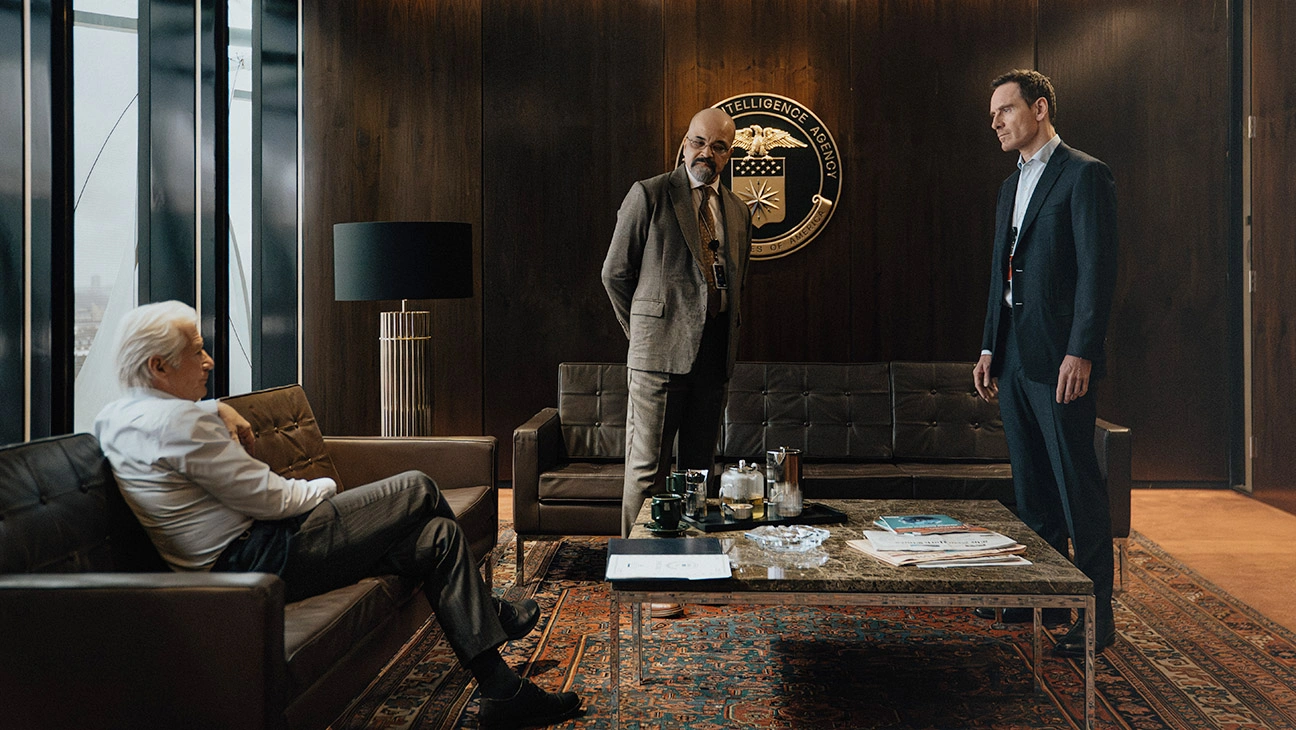
His arrangement with Richardson gives Season 2 its sharpest moral tension. Martian is still working inside the CIA’s London Station under Henry Ogletree (Jeffrey Wright) and Bosko (Richard Gere), yet he is feeding another master. This is not a simple double-agent plot built for twist value. It is a study of how institutions weaponize intimacy. Richardson does not need to defeat Martian in a battle of ideals. He needs Samia’s captivity to remain useful.
The show’s smartest adjustment is that it stops asking the Martian and Samia romance to carry every ounce of emotional weight. Turner-Smith has limited screen time, and that absence is felt. Samia is too often a force acting on the plot from a distance, and the season cannot fully escape the sense that a politically imprisoned woman has been turned into the moral weather around a male spy’s crisis. The Agency is aware enough to make her absence purposeful, since Martian’s decisions orbit the danger she is in. Awareness does not erase the imbalance.
Still, the romance works better this season because it becomes dangerous rather than decorative. Martian’s love does not humanize him in the usual prestige-drama sense, where a hardened man is softened by feeling. It exposes him. His sparse apartment, his controlled tone, his careful movements all suggest a life designed to remove personal leverage. Samia proves that leverage remains. The state finds it. The state always does.
The Ensemble Gets Its Clearance Upgraded
Season 2 expands its supporting cast in ways Season 1 promised and only partly delivered. Jeffrey Wright’s Henry remains one of the show’s strongest figures because Wright plays authority as fatigue sharpened into instinct. Henry looks like the one honest adult in the building until the job reminds us that honesty in intelligence work is always conditional. His scenes with Martian gain tension from what Henry suspects, what he cannot prove, and what he may choose to ignore for operational survival.
Richard Gere’s Bosko brings a different institutional register. His calm has a weathered quality, the manner of someone who has seen enough disasters to stop performing shock. In meetings, Gere makes Bosko’s stillness feel like command rather than passivity. The show uses him well in rooms where younger operatives are still reacting and he is already weighing consequences.
The biggest upgrade belongs to Danny Morata, played by Saura Lightfoot-Leon. Season 1 spoke often about Danny’s promise. Season 2 lets her earn it. Her undercover work in Tehran, especially through her proximity to Hassan (Keanush Tafreshi) and an influential family network, gives the Iran plot a human volatility it previously lacked. Danny’s scenes depend on tiny calibrations: how much curiosity to show, how quickly to trust, how to let someone believe they are leading the conversation. Her skill is social before it is tactical, which makes the storyline fit the show’s best instincts.
John Magaro’s Owen gets a sharp arc of his own, moving from anxious desk presence to field agent under pressure. The role could have become comic relief, the office guy dropped into danger for easy tension. Magaro keeps the anxiety human. Owen looks like a man discovering that paperwork was never separate from violence, only upstream from it. Ambreen Razia’s Blair becomes stronger through her scenes with him, giving the season one of its more effective workplace pairings.
Katherine Waterston’s Naomi and Harriet Sansom Harris’s Dr. Rachel Blake help widen that office ecosystem. Naomi’s clarity cuts through the fog of competing agendas, while Rachel’s presence as the station psychologist reminds the viewer that this workplace knows its employees are being psychologically damaged and has created a department for it. How efficient. How bleakly American.
A Prestige Spy Drama With A Streaming Problem And A Streaming Advantage
The Agency belongs to a wave of adult spy dramas made for viewers tired of espionage as superhero cosplay. It does not mock the genre, and it does not apologize for seriousness. That alone feels almost rebellious in an era where many shows hedge their sincerity with jokes, winks, or algorithm-friendly velocity. The Agency has velocity, especially by its second half, but it still trusts a closed room and a hard stare.
The streaming model cuts both ways. Releasing all ten episodes at once makes the season easier to follow, especially because the plot asks viewers to track Valhalla’s movements, Richardson’s pressure on Martian, Danny’s deepening Iran operation, and the CIA’s internal suspicions. It also risks turning carefully built tension into content consumption. The show is designed like a long fuse. The platform invites viewers to burn through it before lunch.
The direction maintains clarity across locations. London’s CIA interiors feel sterile and compressed. Tehran scenes carry a social charge because Danny’s cover depends on reading rooms where every gesture has status attached to it. The Central African Republic material linked to Viking feels harsher and more exposed, giving Valhalla’s corporate violence a different texture from the bureaucratic menace of London. Neil Burger, Grant Heslov, and Zetna Fuentes keep those spaces legible, which matters in a season with this many moving parts.
The Agency Season 2 does not become a different show. It becomes a better version of the same one. Viewers who found Season 1 too slow may still resist its appetite for coded conversations, institutional suspicion, and adult misery in conference rooms. Yet the second season makes a persuasive case for its method. In this world, the gun is rarely the scariest object in the room. The scariest object is the signed agreement everyone pretends is administrative.
The sophomore season of the political espionage thriller premieres on June 21, 2026. Viewers can stream all ten episodes of the new season at once exclusively on Paramount+. The storyline follows a deep-cover CIA agent who struggles to balance his secret identity and his personal feelings amidst high-stakes international intrigue at the London Station.
Where to Watch The Agency Season 2 Online










Full Credits
Title: The Agency Season 2
Distributor: Paramount+
Release date: June 21, 2026
Rating: TV-MA
Running time: ~50-60 minutes per episode
Director: Joe Wright, TBA
Writers: Jez Butterworth, John-Henry Butterworth
Producers and Executive Producers: George Clooney, Grant Heslov, Keith Cox, David C. Glasser, Ron Burkle, Bob Yari, David Hutkin, Michael Fassbender, Jez Butterworth, John-Henry Butterworth, Alex Berger, Eric Rochant
Cast: Michael Fassbender, Jeffrey Wright, Jodie Turner-Smith, Katherine Waterston, Harriet Sansom Harris, John Magaro, Saura Lightfoot-Leon, Richard Gere, Christian Ochoa Lavernia, Clayne Crawford
Director of Photography (Cinematographer): Seamus McGarvey
Editors: Valerio Bonelli
Composer: Emilie Levienaise-Farrouch
The Review
The Agency Season 2
The Agency Season 2 turns espionage into a brutal office ritual, where a signed agreement can wound deeper than a bullet. Its early exposition still creaks, and Samia deserves richer material, but the season’s connected plotting, sharper Danny arc, and Fassbender’s locked-jaw performance make the show colder, smarter, and harder to look away from. This is adult spy television with a stapler in one hand and a knife in the other.
PROS
- Fassbender’s controlled performance
- Stronger connected plotting
- Danny’s improved Iran arc
- Excellent workplace tension
- Sharp ensemble work
CONS
- Heavy early exposition
- Samia feels underused
- Viking needs more screen time
- Still demanding for casual viewers