































That first clean knockout in EA Sports UFC 6 tells you where EA Vancouver spent its best design time. The punch does not trigger a canned fall. Your opponent’s neck snaps back, the knees vanish, and the body lands with a loose, ugly collapse that makes the replay feel like data worth studying. The game sells mixed martial arts through consequence: the limb that fails, the face that swells, the stamina bar that punishes panic, the style meter that tells you to fight like the athlete you selected.
This sixth entry is the series’ strongest package in years because the fight model has a clearer personality. Flow State gives elite fighters signature patterns. Simplified Controls and Time Dilation Assists help new players survive the control map. The Legacy folds Chris Carter’s story into Career Mode onboarding.
Hall of Legends gives Max Holloway, Alex Pereira, and Zhang Weili curated spaces built around their histories. Yet the game still hesitates in familiar places. Ground fighting has not received the same rethink as striking. Career Mode has new dialogue wrapped around an old loop. Created fighters feel underbuilt next to the licensed roster.
Contact Has Memory
The stand-up game is the cleanest system here. A jab, calf kick, hook, or uppercut reads through timing and spacing rather than a hidden animation queue. Step in cleanly and a punch feels planted. Throw from poor range and the strike glances, whiffs, or leaves you exposed. Each exchange is legible in the way a good fighting system should be: you usually understand why you were punished.
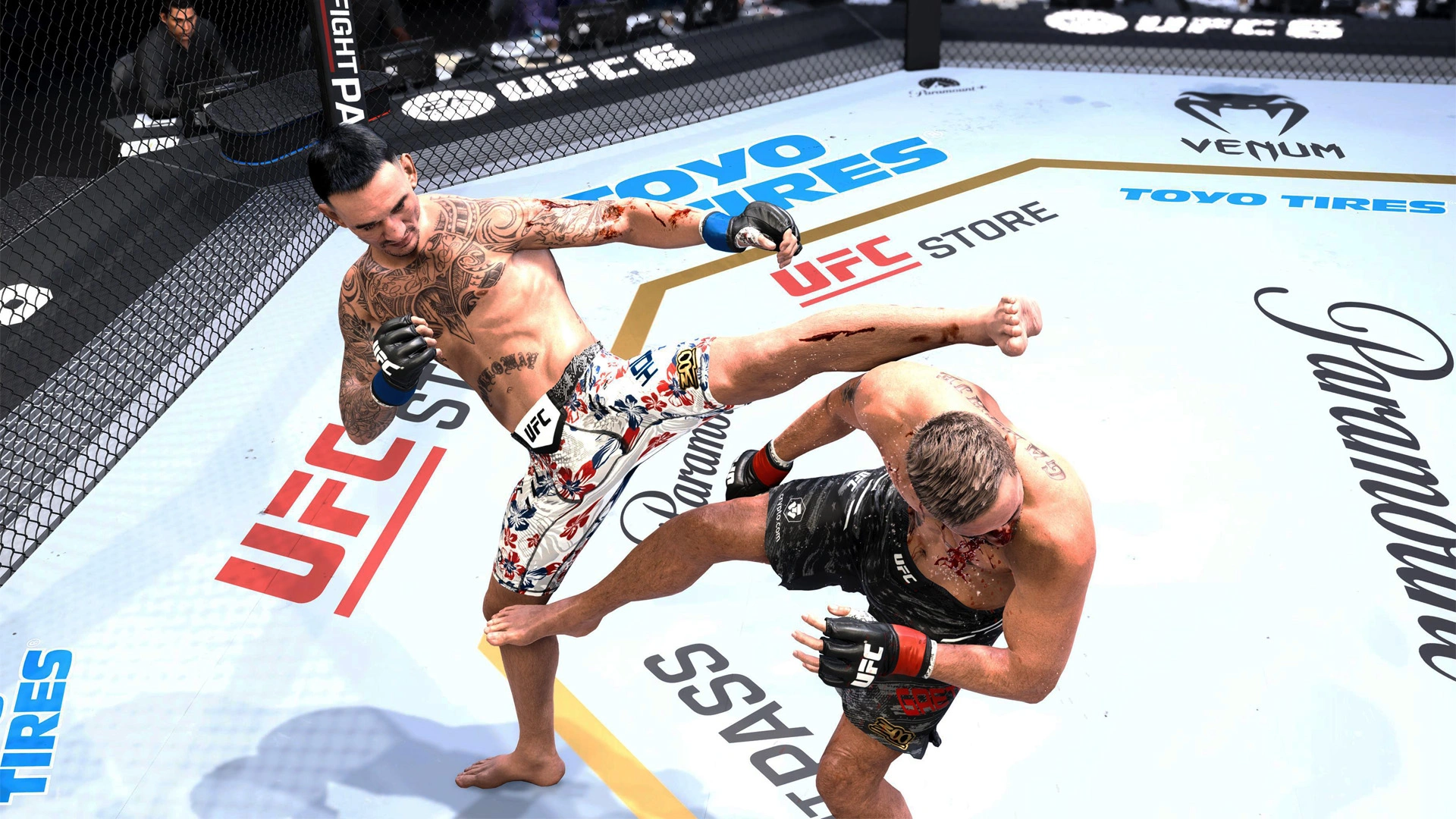
The physics work gives those exchanges their best feedback. A clean uppercut sends a fighter collapsing differently than a body kick. A head kick can fold someone sideways in a way that feels brutal without looking identical to the last knockout. Some ragdoll moments tip into accidental comedy, which is part of the pleasure. The game creates clips you want to send someone, then makes you want to run the same matchup again.
Visible damage has a useful design role too. Cuts, swelling, and blood on the canvas tell you which side of the exchange is losing the body war. A fighter trapped on the mat can redden under pressure. A face starts carrying the receipt for repeated mistakes. Sometimes the injury model goes too loud, but the feedback helps the player read momentum without staring only at bars and meters.
Stamina is the one piece that can interrupt the rhythm. It drains quickly enough to make reckless players pay, which is good. It also sometimes throttles a fight before the exchange has fully developed.
Flow State Gives Fighters a Job Description
Flow State is the smartest new system because it shifts fighter identity from numbers into behavior. The idea is simple: play in a way that fits your athlete’s real tendencies, build the meter, then activate a state that sharpens their strengths. In practice, it changes how you approach the roster.

Max Holloway rewards pressure and volume. Alex Pereira asks for patience, distance, and sudden violence. Zhang Weili changes the pace through speed. Gregory Rodrigues feels dangerous because heavy boxing power turns small openings into major threats. These differences matter because they alter your decisions before the fight even starts. Picking a fighter is no longer just choosing reach, power, and ratings. It is choosing a preferred problem.
That is excellent sports design. A simulation should teach players something about the sport through input. UFC 6 does that when it encourages a Holloway player to press forward or a Pereira player to wait for the counter window. The mechanic turns MMA knowledge into in-game advantage without burying the player in menus.
It also carries a balance risk. Flow State can swing a fight hard, and the bonuses sometimes feel too dramatic for a game that wants every exchange to look earned. Casual players may enjoy the sudden comeback power. Competitive players will likely question matches where one meter activation overwhelms several rounds of careful work.
Accessibility That Teaches Instead of Solving
UFC has always had a control problem for new players, partly because MMA itself is a control problem. Punches, kicks, clinches, takedowns, transitions, blocks, feints, and submissions all need space on the controller. UFC 6 addresses that without sanding every edge flat.

Simplified Controls are the clearest fix. Punches, kicks, and grabs move into a cleaner layout that lets new players focus on reading the fight instead of hunting for the correct limb command. It is less expressive than the default scheme, but it gives newcomers a way into the sport.
Time Dilation Assists are even better. Slowing key defensive moments helps players learn the timing for blocks, takedown denials, and reactions. The game still requires the correct decision. It gives you a longer window to understand the threat, then asks you to respond.
Ground exchanges do not benefit from the same level of reinvention. They remain deep enough to intimidate a newcomer and functional enough to satisfy basic match flow, but returning players will recognize the stiff rhythm from UFC 5. Clinch exchanges and transitions feel like tactical menu contests inside a physical fight. That can be engaging once you understand the mind game, but it lacks the fluid readability that striking now has.
The Legacy Works Better as Onboarding Than Drama
The Legacy follows Chris Carter, a decorated collegiate wrestler trying to build an MMA career under the shadow of his father’s reputation. Coach Thompson gives the story its inherited-pressure angle, while Danny Lopez fills the role of friend turned rival after Chris gets opportunities Danny believes should have been his. It is familiar sports-drama material, but the mode uses that familiarity well.
Its real value is onboarding. The Legacy puts players through early WFA fights, story scenes, a nightclub brawl, and back-alley scraps before passing them into Career Mode. Those scenarios give the tutorial structure some texture. The nightclub fight works because it breaks the clean arena rhythm and reminds the player that the game can stage combat outside standard presentation rules.
The story itself runs out of track fast. Chris, Danny, and Coach Thompson are likable enough to carry a longer mode, yet the arc ends right when the rivalry begins gaining shape. As design, The Legacy succeeds. As drama, it feels like a prologue to a version of itself that never arrives.
Career Mode benefits from that setup. Creating a fighter and turning them from unknown prospect into champion remains satisfying because the growth is visible. You select camp length, spend action points, promote fights, respond on social media, spar, manage fitness, learn moves, study opponents, and fight. The loop is familiar, but shaping a kickboxer, wrestler, or boxer still has pull.
The best Career moments happen when the game remembers what you did. Knocking out a trainer during a drill can lock boxing training for weeks while they recover. That is exactly the kind of system response Career Mode needs. Too much else remains abstract: dialogue choices, sponsor beats, social posts, and Dana White interactions often feel like menu flavor between fights.
Modes Built for Fans, Menus Built for Patience
Hall of Legends is the best side mode because it understands that UFC history can be played, displayed, and walked through. The spaces dedicated to Holloway, Pereira, and Zhang use real footage, curated storytelling, museum-like environments, and selected challenges to make each fighter’s career feel placed rather than listed. There are only nine fights, so the mode is short, but the format has promise.
Fight Now does the expected work cleanly. Three-round and five-round fights, Backyard, Kumite, Knockout, Stand & Bang, Competitive, and Simulation presets make it the mode for quick CPU matches or couch play. Fight Week adds prediction hooks tied to real UFC cards, while Contracts offer selected challenges for in-game currency.
The Gym has a stronger idea than execution. Recruiting fighters, earning XP, moving them across 10 levels, unlocking trainers, boosts, coins, profile items, and cosmetics gives the game a reward structure outside Career. The problem is friction. A hub built on repeated check-ins cannot afford sluggish menus. The Gym often turns reward collection into a chore.
Presentation Wins the Walkout, Customization Loses the Mirror
This is EA UFC’s visual peak. Skin tones, eye shaders, hair density, Sapien Scaling, markerless motion capture, and cloth simulation all contribute to the sense that fighters have physical identities rather than shared bodies with different heads.
The broadcast layer works. Walkouts, lighting, close-ups, crowd noise, commentary, and replays give fights the shape of an event. The soundtrack leans into hype in a useful way, with tracks like “Boom,” “X Gon’ Give It To Ya,” and “Crazy Train” doing exactly what walkout music should do: raise the pulse before input takes over.
There are flaws in the frame. Some likenesses and body proportions miss the mark, and the HUD can get too busy during defensive moments that need clean attention. The issue is customization. Real fighters have detailed styles, signature movement, and visual specificity, while created fighters lack the same expressive range. Gear, entrances, move presentation, body tools, and personality options feel behind what sports games now train players to expect.
That gap matters because Career Mode asks for long-term attachment. If the game wants my created fighter to become my personal champion, the toolset needs to let that fighter feel authored rather than assembled. UFC 6 proves EA Vancouver can make licensed athletes feel distinct. The next step is letting the player build someone who can stand beside them without looking like a guest in their world.
The Review
EA Sports UFC 6
EA Sports UFC 6 lands hardest inside the cage, where Flow State, sharper striking, readable damage, and wild knockout physics give each fight a stronger design identity. Its weaker systems are familiar ones: grappling still feels under-refreshed, Career Mode leans on the same camp loop, and created fighters lack the detail given to the licensed roster. Even with those gaps, this is the series’ best-playing entry in years, built around contact that feels earned and consequences the player can read.
PROS
- Flow State gives fighters identity
- Striking feels weighty and readable
- Knockout physics stay unpredictable
- Strong new-player assists
- Hall of Legends has real texture
CONS
- Grappling feels too familiar
- Career loop repeats quickly
- Created-fighter tools feel thin
- The Gym menus drag