




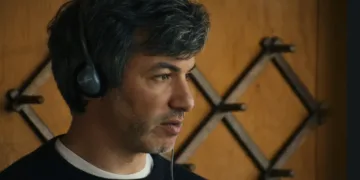















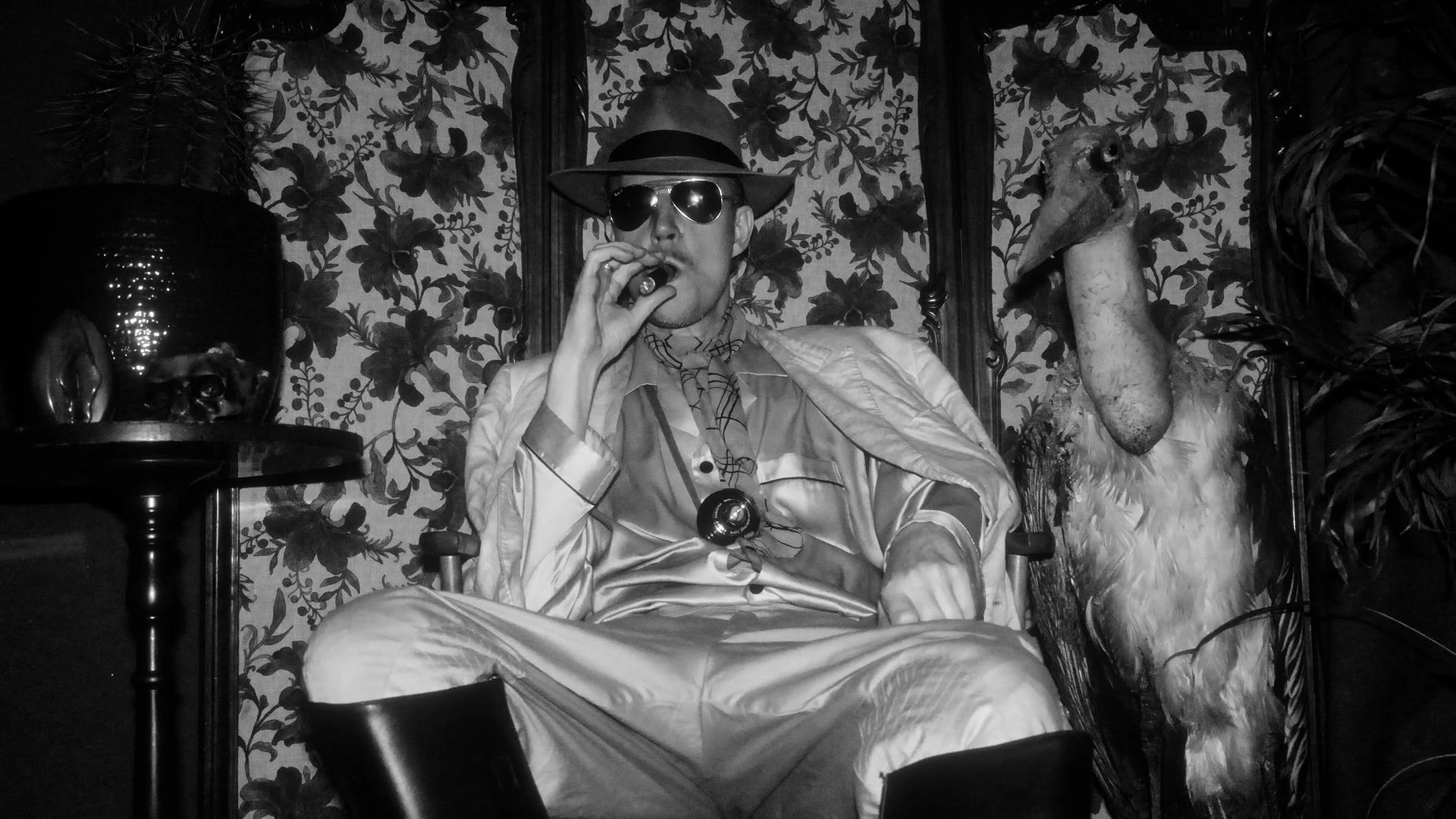
Tom Six has always understood that disgust works best with a ringmaster. The Human Centipede trilogy gave him the perfect circus act: an obscene premise, a filmmaker willing to advertise his own transgression, and audiences daring one another to watch. The End of Tom Six finds that ringmaster largely trapped inside his Amsterdam apartment, dressed in a silk robe, Panama hat and aviator shades, smoking cigars while directing a documentary about himself.
Shot in black and white, the film initially treats his confinement with the grammar of old noir. Amsterdam canals sit beneath street lamps, a mournful classical score hangs over the images, and an old-fashioned title card announces “The End” before appending Six’s name. Death is being teased before biography has even begun. Six then sabotages the solemnity.
He plays both subject and director, barking instructions while Maartje Willems’ Marci serves as his producer and companion. Edwin Alofs cycles through cameraman, boom operator and butler duties. Demian Kurosa appears as a tattooed assistant director communicating through an electronic voice device.
A child, Oliver Julius Willems, supposedly handles the editing. Servaes Nelissen patrols the production in Nazi uniform as the resident censor, appearing whenever Six wants another joke about trigger warnings or offended sensibilities. The apartment becomes a theatrical cell. Six controls every prop inside it. What he cannot control is why he rarely leaves.
Darkness Behind the Costume
Multiple sclerosis changes the visual meaning of Six’s performance. His elaborate clothes initially register as exploitation-showman affectation. Once he describes spending years largely confined to bed, taking oxycodone for chronic pain and struggling through medication-induced brain fog, the costume begins to resemble armor.
The film is most effective during these collisions between performance and physical reality. Six describes leaving home for painful walks to obtain decaffeinated coffee because ordinary coffee is too much for his damaged nerves. He then punctures the misery with a crude joke.
He discusses his thoughts becoming scrambled by medication and moves straight back toward movie talk. There is discipline in that refusal of sentimental framing. Six has spent his career transforming discomfort into spectacle, so naturally he tries the same operation on himself.
The black-and-white photography assists him. Faces sit against the apartment’s darker spaces while props, smoke and clothing crowd the frame. There is little traditional noir mystery here, yet the lighting supplies a moral ambiguity the screenplay cannot manufacture through argument. Is Six a defiant artist abandoned by a frightened industry, or a professional provocateur unable to accept that cultural appetites changed around him? The shadows leave both versions alive.
His health gives that question weight. It also makes several recurring gags feel especially trivial. Nelissen’s “Censor Nazi” keeps returning to complain about potentially offensive material, a joke whose target becomes obvious on its first appearance and barely develops afterward. A literal Nazi uniform is an unusually expensive visual device for saying the same thing repeatedly.
An Outlaw Writes His Own Legend
Six spends much of the documentary reconsidering the strange afterlife of The Human Centipede films. Their grotesque surgical premise entered mainstream popular culture through television jokes, movie references and internet notoriety, yet Six says that visibility never translated into the fortune someone might assume followed such recognition.
His self-portrait belongs to the carnival tradition of exploitation directors who sold personalities alongside films. Herschell Gordon Lewis marketed gore. John Waters turned filth into authorship. Six cultivated the image of the man prepared to film what polite cinema would reject.
That mythology survives intact here, perhaps too intact. Every cigar, insult and staged crew member reinforces the outlaw persona. The method is funny when Marci exchanges dry lines with him or the fake production hierarchy interrupts his monologue.
It becomes limiting whenever the film needs to examine Six’s claims from somewhere outside Six. His account of illness receives painful specificity. His account of the industry receives far less resistance. That imbalance matters once The Onania Club enters the picture.
The Film Nobody Will Release
Completed in 2019, The Onania Club concerns wealthy Los Angeles women who become sexually aroused by other people’s misery. Six describes it as a story about the disappearance of empathy, with the horror kept metaphorical rather than expressed through the surgical grotesquerie that defined his earlier trilogy.
He expected his notoriety to help sell it. Instead, distributors refused it. Six recalls hearing that “the marketplace has changed,” and interprets that phrase as fear of controversy. He also argues that the stress surrounding its rejection worsened his condition.
The documentary cannot establish that medical connection, and its censorship argument suffers from treating commercial reluctance and ideological suppression as interchangeable forces. Distributors can be cowardly without becoming censors. They can also reject a film for reasons a filmmaker dislikes. Six rarely permits those distinctions into the room. Yet an uncomfortable fact remains: The Onania Club exists, reportedly includes Chloë Sevigny, has drawn praise from John Waters, and remains unreleased.
That unresolved film gives Six’s ranting a harder edge than the repetitive culture-war comedy deserves. The most interesting image in The End of Tom Six is therefore an invisible one: a finished feature sitting beyond public view while its director, physically confined and professionally stranded, stages one last freak show inside his apartment. The camera may belong to Six, but the locked door behind it has become the real composition.
The End of Tom Six was released digitally on August 15, 2026, and is available for streaming on platforms such as YouTube and VOD. The satirical documentary follows infamous Human Centipede creator Tom Six as he reflects on his career, battles with film industry censors over unreleased projects, and confronts his personal struggle with multiple sclerosis.
Full Credits
Title: The End of Tom Six
Distributor: Six Headquarters
Release date: August 15, 2026
Running time: 1 hour 29 minutes
Director: Tom Six
Writers: Tom Six
Producers and Executive Producers: Maartje Willems, Tom Six
Cast: Tom Six, Maartje Willems, Edwin Alofs, Servaes Nelissen
Director of Photography (Cinematographer): Tom Six
Editors: Tom Six
The Review
The End of Tom Six
The End of Tom Six is strongest when its theatrical vulgarity collides with something the performance cannot disguise: physical decline, isolation, and the possibility that a filmmaker built on provocation has outlived the industry willing to finance it. The “Censor Nazi” routine wears thin, and Six sometimes mistakes abrasion for argument. Yet the black-and-white confinement of his Amsterdam apartment turns his self-mythology into a strange kind of noir chamber piece, with illness slowly swallowing the light around the showman.
PROS
- Unusually candid illness passages
- Striking black-and-white presentation
- Sharp exploitation-cinema self-portrait
- Effective clash of performance and vulnerability
CONS
- Repetitive censorship satire
- Culture-war jokes feel stale
- Self-mythologizing overwhelms some arguments
- Limited perspective beyond Six himself