

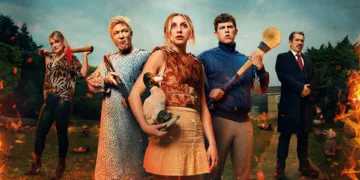



















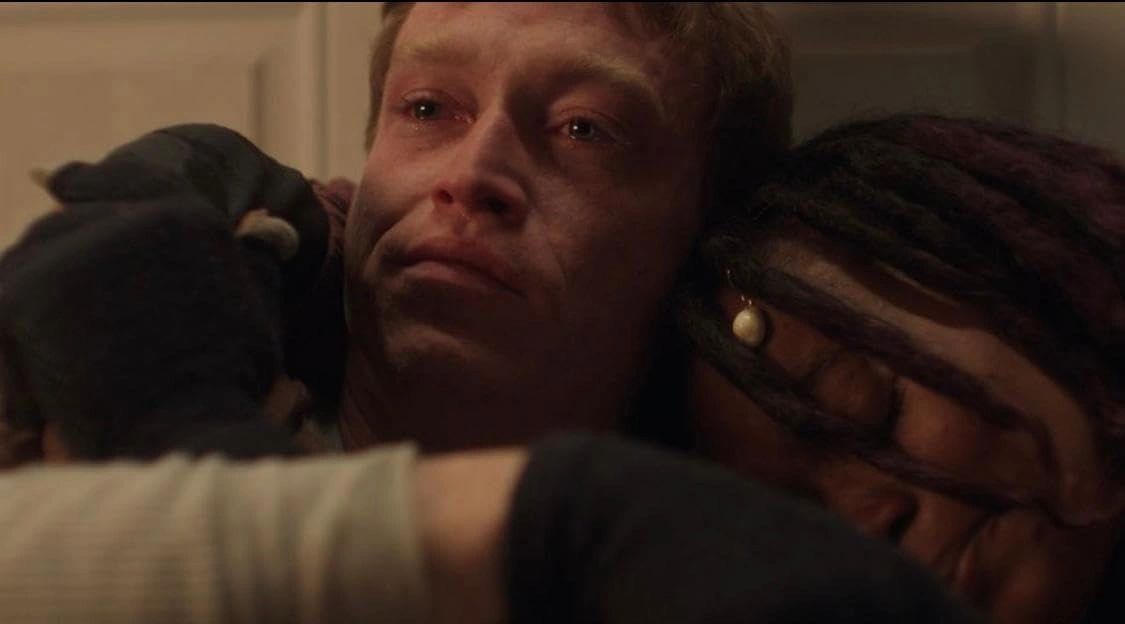

Peter Brunner’s Down The Arm Of God places a European filmmaker inside a distinctly American moral contradiction: a church community fluent in the language of Christian charity becomes far less comfortable once charity requires surrendering space, safety and routine.
The setting outside Amarillo matters. This is a landscape shaped by evangelical culture, frontier mythology and the expectation that people should solve their own problems, even when the temperature drops low enough to make that philosophy lethal.
Caleb Landry Jones plays Nick, a young pastor arriving to lead a small congregation. He trims his long hair before settling into town and later asks for a John Wayne-style cut, a funny, revealing gesture in a film increasingly interested in the mythology of American self-reliance. Nick does not fit neatly inside it. He curses, carries hints of a troubled past and seems far more comfortable at Deb’s Road House than among parishioners who initially welcome him with smiles and rat poison as a gift.
The conflict begins when Nick discovers tents outside town and meets a group of unhoused residents living through a freezing Texas winter. His first attempts at contact receive suspicion rather than gratitude. Brunner understands that distrust works both ways.
The Distance Across a Dinner Table
The film becomes especially sharp during Nick’s attempt to organize a potluck between the congregation and the people living in the encampment. Food is available, the church doors are open and everyone can technically claim that hospitality has been offered. Then the parishioners hesitate to sit at the same tables. That physical separation carries greater force than any sermon Nick delivers.
Raven, played by India Marie Cross, becomes one of his main links to the encampment. Around her are veterans, pregnant women, people living with addiction and others managing physical or psychological illness. Many performers have direct experience of homelessness, drawing on years of development Brunner and Jones conducted with grassroots organizations. Their presence gives conversations inside the church an unusual texture. People interrupt, argue, joke and care for one another without behaving like characters assembled to teach the audience a lesson.
There is a useful cultural distinction here from films that frame homelessness primarily through individual tragedy. Brunner’s perspective is closer to strands of European social cinema, where institutional failure becomes visible through ordinary routines. Yet the material remains firmly American.
Nick searches for emergency support before an approaching storm and encounters organizations already overwhelmed. The school gym is rejected as a shelter. The machinery exists, but each part seems designed to pass responsibility elsewhere. Nick eventually stops asking. He brings the group into the church and lets them sleep between the pews.
Christianity Meets Property
Charity is easy while it remains a potluck. Permanent proximity changes everything. Chris, played by Nick Stahl, and Anna, played by Mena Suvari, become increasingly hostile toward the church’s new residents. Concerns about hygiene, disruption and the safety of children gradually harden into resentment. Their son’s sympathy toward the homeless makes their anger uglier because it reveals a generational crack inside the same household.
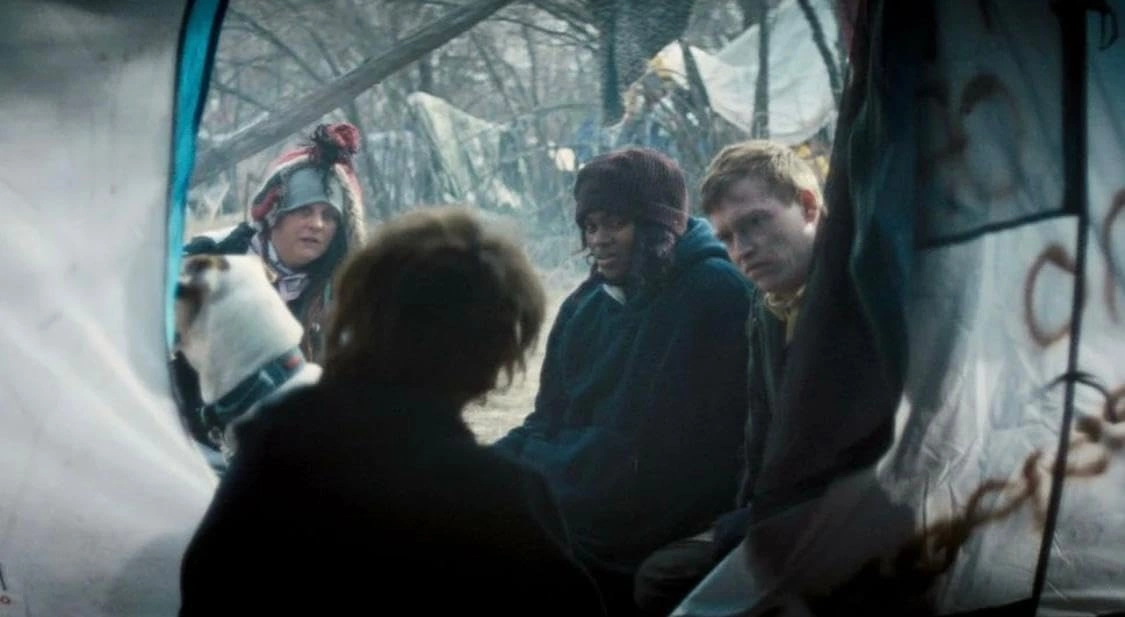
Nick responds by quoting scripture and pushing harder. Jones keeps him from becoming a saintly mouthpiece. His exhaustion turns into anger, and his refusal to compromise starts resembling the stubbornness he condemns in his congregation. A joking comment to a piano-playing child about learning to build bombs on YouTube carries the actor’s familiar edge. Even dressed like a respectable pastor, he never entirely loses the sense that something volatile sits underneath.
John, played by real-life Marine veteran John Jones, gives that volatility another shape. Alcohol and military trauma make him unpredictable, yet his history prevents his behavior from being reduced to danger alone. The film’s best scenes keep this kind of contradiction intact.
Brunner also photographs West Texas with a severity that places the film somewhere between social drama and frontier tale. Peter Flinckenberg’s half-lit skies, exposed fields and winter-grey exteriors make cold a material force. The church is shelter in the most literal sense, which makes every objection to sharing it harder to hide behind theology.
When the Western Takes Over
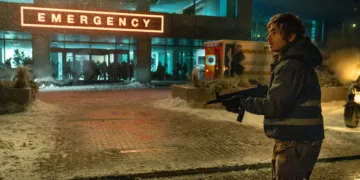
The American genre lurking beneath the film eventually steps fully into view. Protests gather outside the church. Guns enter the conflict. Racial hostility becomes explicit, including a child holding a “White Lives Matter” sign. What began as a tense social drama starts taking on the grammar of a Western, with Nick protecting occupied territory while an increasingly angry town closes around him.
That shift is understandable given the setting, yet it weakens some of Brunner’s earlier precision. The first hour thrives on uncomfortable gestures: an empty seat at dinner, a cautious conversation in the camp, someone trying to make a church pew livable. Later scenes push the antagonism into louder territory, and several townspeople begin functioning less like members of a community than representatives of prejudice.
Nick’s troubled family history creates a similar problem. His relationship with his father gives Jones additional material, but the film already has enough pressure without furnishing its pastor with another private wound.
The faces inside the church remain harder to simplify. Their histories, tempers and small acts of protection keep pulling the film back toward the people who inspired it. That tension gives Down The Arm Of God its strongest cross-cultural quality: Brunner approaches a specifically American crisis from outside its political habits, then allows Texans who have lived through homelessness to supply the film with the details no outsider could manufacture.
Down the Arm of God made its world premiere on August 12, 2026, screening in Locarno’s Piazza Grande. Set in a small Texas town during a harsh winter, the drama follows a dedicated young pastor whose efforts to assist the local homeless population run headfirst into deep-seated biases within his congregation.
Where to Watch Down the Arm of God (2026) Online
Full Credits
Title: Down the Arm of God
Distributor: EuropaCorp, Kinology
Release date: August 12, 2026
Running time: 2 hours 10 minutes
Director: Peter Brunner
Writers: Peter Brunner, Caleb Landry Jones
Producers and Executive Producers: Luc Besson, Caleb Landry Jones, Christian Sosa, Jon Wroblewski
Cast: Caleb Landry Jones, India Marie Cross, Nick Stahl, Mena Suvari, John Jones
Director of Photography (Cinematographer): Peter Flinckenberg
Editors: Peter Brunner
Composer: Tim Hecker
The Review
Down The Arm Of God
Rooted in West Texas yet painfully recognizable far beyond it, Down The Arm Of God finds its strongest voice when lived experience cuts through the screenplay’s heavier machinery. Peter Brunner and Caleb Landry Jones build a humane portrait of homelessness around faces, conversations and acts of mutual care that refuse easy pity. The later turn toward guns, racial hostility and Western-style confrontation strains that restraint, but the film’s anger remains grounded in a crisis that crosses borders with depressing ease.
PROS
- Caleb Landry Jones’s volatile, layered performance
- Authentic supporting cast
- Strong winter cinematography
- Humane depiction of homelessness
- Sharp church-community tension
CONS
- Overloaded third act
- Some townspeople feel simplified
- Nick’s backstory feels overworked
- Heavy-handed protest imagery