



















A dead father should not be this good at organizing a golf trip. Jack Finnegan, played in brief but defining strokes by Ian McElhinney, exits Finnegan’s Foursome early, then keeps directing traffic from the urn. His last wish sends his family to Ireland to spread his ashes at four meaningful locations, a request that turns mourning into itinerary, inheritance into sport, and emotional avoidance into a scorecard.
Edward Burns writes, directs, produces, and stars, which by now almost feels like one job title. Burns has built a career out of families who talk around pain until the talking becomes the pain. Here, the family is Irish, Catholic-coded, competitive, sentimental in self-defense, and allergic to silence. Golf gives them a ritual sturdy enough to hold feelings they do not quite know how to name. Call it fairway mourning. Everyone is grieving, yet nobody wants to look too dramatic doing it.
Favorite Sons and Other Family Myths
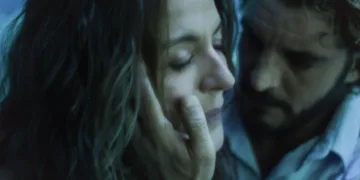
Freddy Finnegan, played by Burns, has carried one emotional fact through adulthood: his father loved golf better than he loved him. That may be unfair. It may be accurate. The film is at its best when it allows both possibilities to sit in the same golf cart without forcing a neat settlement. Freddy remembers absence. Teddy, played by Brian d’Arcy James, remembers a flawed man worth defending. Their argument is less about Jack than about ownership of the past.
The Finnegan Cup, the family’s golf tournament, becomes a wonderfully absurd device for measuring inherited damage. Every putt has a little accusation in it. Every joke carries the smell of an old room. Freddy’s resentment sharpens during the early family match, especially once Jack’s death turns what looked like another bruising competition into the beginning of a farewell tour. Teddy’s loyalty has its own evasions, too. He keeps defending Jack as if filial devotion were a legal brief.
The Ireland trip gives the film its cleanest emotional idea. Jack’s ashes are divided across places that formed him, so the family must confront him in fragments. The farm visit, with Uncle Mike’s irritation and the threat of family land being sold, widens the wound. Jack is no longer only a father. He is homeland, myth, property dispute, golf coach, ghost.
The younger Finnegans soften the pattern without escaping it. Frankie, Freddy’s son, is adrift after his band and relationship collapse. Marie, Teddy’s daughter, enters the tournament as the first woman allowed into this masculine little chapel of grudges. Erica Hernandez gives Marie a welcome charge, especially when her presence exposes how ridiculous the boys’ club has always been. The film sees that, then moves on too quickly. That is a recurring problem. Each character gets a wound. Few get enough blood flow.
Ball-Busting as Love Language
Burns and Brian d’Arcy James carry the film through rhythm. Their scenes work because the two actors understand that sibling rivalry rarely sounds like grand confession. It sounds like correction, mockery, complaint, and the strategic deployment of an old humiliation.

Freddy’s deadpan bitterness suits Burns, particularly in scenes where he refuses to join the saint-Jack campaign forming around him. Teddy’s warmth has a defensive edge, and James plays that edge with a nice mix of charm and denial.
The best exchanges arrive on the course, where competition gives the dialogue shape. A bad swing invites ridicule. A sand trap becomes moral evidence. A score update feels like family history being filed in real time. Burns understands this kind of talk. He has always been comfortable with characters who need banter to keep sincerity at a safe distance.
Hernandez cuts through the male atmosphere with the cleanest energy in the ensemble. Marie does not merely watch the men perform tradition. She changes the temperature of it, especially during the tournament scenes where her inclusion makes the Finnegan Cup feel less like inheritance and more like a ritual being revised. Brian Muller’s Frankie is gentler, slightly underwritten, yet useful. His stalled music life gives the film a faint echo of generational drift: Jack gave his descendants golf, and the younger ones are left wondering what they are supposed to pass on.
McElhinney’s Jack functions less as a character than as a pressure system. He is present through argument, memory, ritual, and resentment. That choice works because the film understands a basic truth about dead parents: once they are gone, they become edited by everyone who loved and resented them. Families are amateur historians with terrible citation standards.
The Long Walk Between Feelings
Burns loves golf here with a devotion that occasionally becomes a hostage situation. The sport is meant to be emotional language, and at times it is. The Finnegans do not sit in rooms delivering grief monologues. They drive balls, place bets, argue over scores, and carry Jack’s ashes across green landscapes. There is a touching logic in that. For this family, the course is where affection learned to disguise itself as competition.
The issue is repetition. At 122 minutes, Finnegan’s Foursome spends too much time moving from hole to hole, wager to wager, swing to swing. Jeff Muhlstock’s cinematography sometimes catches the Irish courses with postcard calm, giving the film a soft travelogue pleasure. Still, too many golf sequences have the same visual grammar: someone hits, someone reacts, someone explains who is ahead. For viewers who love the sport, this may feel like comfort. For others, the movie risks becoming grief with tee markers.
The scenes away from the links hint at a sharper film. The pub visit with local musicians has warmth because it lets the family breathe outside the tournament’s constant arithmetic. The hotel booking complications and sleeping-arrangement wagers add small comic sparks. Uncle Mike and the family farm bring history into the room with more force than another score dispute can manage.
Burns is aiming for a casual, lived-in tone, and he often gets it. The problem is proportion. Freddy’s anger toward Jack, Teddy’s protective memory, Frankie’s stalled adulthood, and Marie’s outsider position all need scenes that press harder. Too often, the film circles an emotional hazard, takes a safe drop, and plays on.
That may also be its philosophy, accidentally or not. Some families never resolve grief. They make a joke, take the next shot, and pretend the cup is what they came for.
The American sports comedy-drama Finnegan’s Foursome celebrated its world premiere at the Tribeca Festival on June 7, 2026, ahead of its wide home entertainment rollout. Viewers looking to watch the film can buy or rent it digitally through video-on-demand services starting tomorrow, June 19, 2026, courtesy of Republic Pictures. The story centers on two highly competitive, estranged Irish-American brothers who travel to their ancestral homeland with their adult children to complete a four-man golf tournament in honor of their late father’s final eccentric wish.
Where to Watch Finnegan’s Foursome (2026) Online






Full Credits
Title: Finnegan’s Foursome
Distributor: Republic Pictures, Paramount Movies
Release date: June 7, 2026 (Tribeca Festival), June 19, 2026 (United States Digital Release)
Rating: R
Running time: 121 minutes
Director: Edward Burns
Writers: Edward Burns
Producers and Executive Producers: Aaron Lubin, Ellen H. Schwartz, Edward Burns
Cast: Edward Burns, Brian d’Arcy James, Erica Hernández, Brian Muller, Ian McElhinney, Stuart Graham, Owen Rowe, Callum Maxwell
Director of Photography (Cinematographer): Jeff Muhlstock
Editors: Janet Gaynor
Composer: Dillon Baldassero
The Review
Finnegan's Foursome
Finnegan’s Foursome has warmth, a sharp sense of family resentment, and a cast that knows how to turn bickering into affection. Its problem is discipline. Edward Burns finds a real idea in golf as inherited grief, then spends too long proving he loves the sport. The film works best when Freddy and Teddy argue over Jack’s memory, less so when another shot needs tracking. Pleasant, sincere, overextended. A clean par, with too many practice swings.
PROS
- Strong Burns and Brian d’Arcy James chemistry
- Smart grief-through-golf concept
- Erica Hernandez brings fresh energy
- Warm Irish setting and family ritual
CONS
- Too much repeated golf footage
- Thin younger-character arcs
- 122-minute runtime feels stretched
- Emotional conflicts resolve too softly