


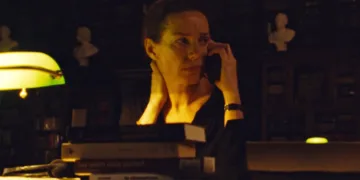









The most frightening prop in Sam Benstead’s documentary is a wall decorated to deceive a murderer. Annsar Shahoud, an Amsterdam-based Syrian academic, builds “Anna” from objects arranged for the camera: portraits of Hafez and Bashar al-Assad, a Shia sword pendant, the controlled poise of a woman pretending ideological kinship with a regime she knows through terror. The lie is theatrical, yet the stage is a laptop screen. No smoke-filled room, no trench coat, no dead drop. Just a video call, a false name, and the old human weakness for being understood.
Killing Anna follows Shahoud and genocide studies professor Uğur Ümit Üngör after they watch footage of the Tadamon massacre, where civilians in Damascus are murdered and thrown into a tyre-lined pit. From that horror, they trace one suspected perpetrator, intelligence agent Amjad Youssef, through Facebook. Shahoud then becomes Anna, a regime-sympathetic Syrian expat claiming academic interest in the world Youssef served.
That setup gives Benstead’s film the skeleton of a thriller, and a very efficient one. The investigation moves through digital crumbs, ideological signals, and carefully managed intimacy. The weapon is attention. The trap is vanity. The evidence arrives through conversation.
Confession by Screenlight
Marcus Aurelius would have had a grim week with this material. So would anyone else who believed reason could reliably discipline the soul. Youssef’s apparent willingness to speak with Anna is the film’s darkest psychological fact. A man trained by a system of secrecy responds to signs on a wall and the flattering premise that his version of events matters. The camera, in those moments, becomes less a recording device than an accomplice to moral exposure.
Benstead understands the procedural pull of the story. Shahoud and Üngör identify the man from massacre footage, search online, make contact, and slowly move from tentative exchange to dangerous extraction. The film’s best tension comes from the calls because every pause contains several possible disasters. Anna could press too hard. Youssef could retreat. Shahoud could lose the mask for half a second. Digital silence becomes suspense.
The documentary also leaves a hunger for more of those exchanges. Not for lurid access, but for the texture of confession itself. What does Youssef think he is doing when he speaks? Boasting? Explaining? Asking to be absolved without saying the word? The film gives enough to make the question poisonous, then returns to the cleaner forward motion of the investigation. That choice works as pacing. It costs the film a deeper moral excavation.
Killing the Mask
Shahoud is the film’s true battleground. The thriller structure depends on Anna’s usefulness, but the emotional pressure comes from watching a woman inhabit a voice that poisons her. She describes Anna as a dissociative mechanism, a protective false self that lets her speak with men tied to the machinery of Syrian violence. Protection, here, has teeth. It saves her from direct contact with the horror and slowly becomes another form of contact.
Benstead is careful with the massacre footage. The film shows enough to make evasion impossible, then steps back before atrocity becomes spectacle. That restraint matters because Killing Anna is dealing with images already born from cruelty. To replay them too freely would risk serving the same appetite the film wants to condemn. The documentary knows the pit is there. It does not need to keep pushing our faces into it.
Shahoud’s performance as Anna is brave, but the film’s most unsettling idea is that bravery does not protect a person from contamination. Pretending belief still requires rehearsing its gestures. Speaking to Youssef still means giving him one more attentive listener. The mind can know the work is necessary while the body experiences it as betrayal. That is the film’s cleanest ethical cut.
The ceremonial farewell to Anna gives Shahoud a visible release from the persona. It is moving because it names the psychic cost of the operation. It is also a little too neat for a wound this jagged. Dissociation rarely observes ceremony. Trauma is famous for missing appointments.
The Thriller and the Abyss
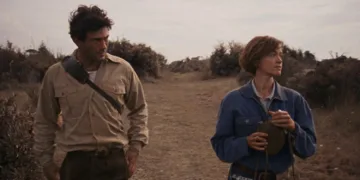
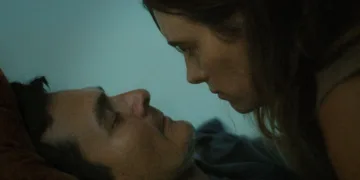
Benstead shapes the film with tight, accessible force. The re-enactments, dramatic shots, and assertive music cues bring it close to the polished true-crime grammar now common on streaming platforms. Some viewers will feel the machine working. I did. The score leans on tension that the material already possesses, and the staged imagery sometimes underlines danger with a marker pen.
Still, the approach keeps the investigation legible without softening its horror. The 2022 report naming Youssef changes the film’s pressure from covert pursuit to public consequence, while his continued safety in regime-controlled Syria leaves justice suspended. His later arrest gives the narrative a legal hinge, but Benstead’s sharper material lies before that point, in the void between proof and accountability.
The film’s largest absence is Youssef himself as a formed moral subject. We hear fragments: grief over a brother lost in the fighting, rage, the self-justifying logic of a man who appears to have converted personal wound into state violence. Yet these fragments remain fragments. Shahoud suggests trauma and shame run across Syria as a national fracture, but the film mostly keeps that idea at the edge of the frame.
That is where Killing Anna becomes both powerful and limited. It captures the courage required to expose a suspected perpetrator, the intelligence of a deception built from symbols, and the private damage carried by the person wearing the mask. It reaches toward the abyss of perpetrator psychology, then chooses the surer footing of pursuit. Fair enough. The pursuit is gripping. The abyss keeps staring from just outside the shot.
The British independent documentary psychological thriller Killing Anna celebrated its world premiere at the CPH:DOX festival in March 2026 before its UK premiere at Sheffield DocFest on June 12, 2026. Audiences can watch the film in select cinemas starting tomorrow, June 19, 2026, with a wider television broadcast scheduled for Channel 4 later in the year. The film explores the dangerous true story of a Syrian academic living in Amsterdam who creates a fake, pro-regime Facebook persona named “Anna” to trace, friend, and extract a bone-chilling confession from an intelligence officer responsible for a civilian massacre.
Full Credits
Title: Killing Anna
Distributor: Dogwoof, Channel 4
Release date: March 2026 (CPH:DOX), June 19, 2026 (United States and United Kingdom Theatrical Release)
Running time: 76 minutes
Director: Sam Benstead
Writers: Documentary film (unscripted/no credited writers)
Producers and Executive Producers: Matt Cole, Charly Wai Feldman, Andrew Palmer, Eliot Higgins, Uğur Üngör
Cast: Annsar Shahhoud, Amjad Youssef, Uğur Üngör, Eliot Higgins
Director of Photography (Cinematographer): Sam Benstead
Editors: Leigh Brzeski
Composer: Nir Perlman
The Review
Killing Anna
Killing Anna is a tense, morally jagged documentary that turns a laptop screen into an interrogation chamber. Sam Benstead’s film is strongest with Annsar Shahoud, whose false identity becomes both weapon and wound. Its thriller shape gives the investigation force, but it leaves Amjad Youssef’s psychology partly in shadow, where the hardest questions remain. Still, the film lands with rare ethical pressure.
PROS
- Tense digital investigation
- Strong focus on Shahoud’s psychic cost
- Careful use of massacre footage
- Sharp moral pressure in the video calls
CONS
- Perpetrator psychology feels underexplored
- Music and re-enactments can overstate tension
- Anna’s farewell feels too tidy
- Wider Syrian trauma stays partly out of frame