
























![Kingdom Hearts Collection [I-III] Review](https://gazettely.com/wp-content/uploads/2026/10/Kingdom-Hearts-Collection-I-III-1-360x180.webp "Kingdom Hearts Collection [I-III] Review: KHII Holds Steady as Newer Entries Fluctuate 37")




Albert has chosen a cabin because secrecy looks cleaner when it has walls. That is the smartest dramatic instinct in Shadows of Willow Cabin, Joe Fria’s low-budget debut about a married English teacher, a younger paramedic, and a weekend that turns a private hookup into a supernatural reckoning.
Willow Cabin belongs to Albert’s past before Devon ever arrives there. It once belonged to his uncle, it carries memories of childhood, and it is tied to Albert’s first sexual awakening with his cousin. That history gives the location a job beyond creaking doors and ominous corners.
The setup is simple enough to sound like a two-character stage play with ghosts: Albert, played by Bryan Bellomo, meets Devon, played by John Brodsky, after an online flirtation, and the two retreat to Big Bear for intimacy they cannot have in public.
Albert has a wife and son. Devon has a history of seeking closeted married men and then resenting the emotional wreckage. The cabin becomes the one place where both patterns can stop hiding. Horror, being a rude houseguest, arrives to make sure they do.
A Haunting With a Structural Point
Fria’s strongest idea is that the haunting is not attached to the cabin alone. It is attached to habit. Albert keeps his life split into compartments: husband, father, teacher, lover, guilty child of the past. Devon keeps returning to men who confirm his worst fear, which is that desire will always arrive with someone else’s shame already packed. The film’s time loop gives those patterns physical form. These men are stuck because the story has designed them to be stuck.
That makes the supernatural material most effective when it acts like pressure on a character choice. Albert telling Devon the story of how he met his wife should sound like a harmless romantic anecdote. Fria lets it curdle. Devon listens, and the scene turns the meet-cute into evidence of self-erasure. A life that might look stable from the outside becomes, inside this cabin, another kind of trap.
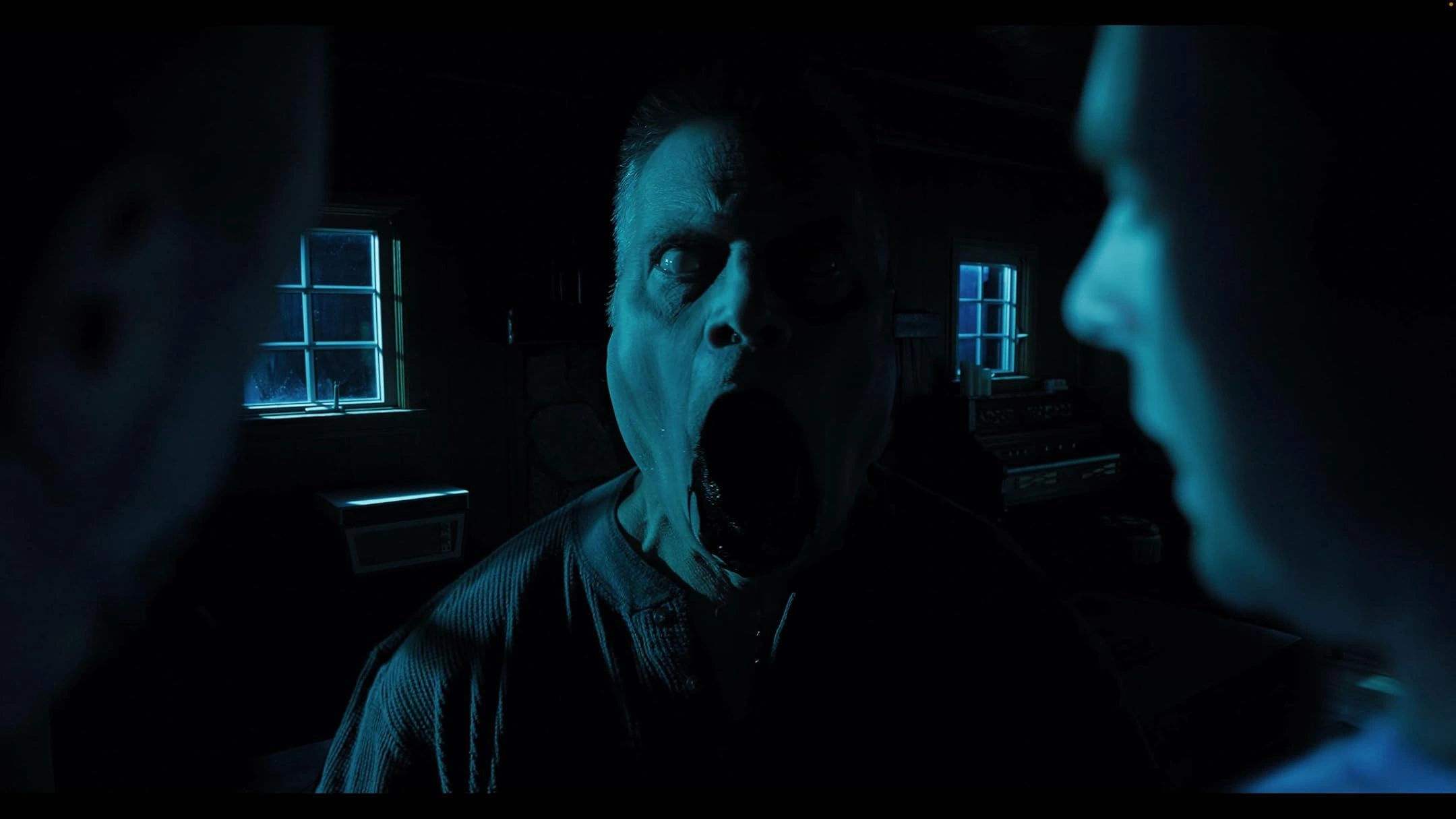
The ghostly figures, including the presence of Albert’s uncle and Devon’s abusive father, work best in this register. They are memories with bodies. The trouble is that the script too often explains what the structure has already made clear. Long speeches about trauma, shame, hell, and escape keep arriving like footnotes with a flair for melodrama. The film has a fine metaphor. Then it occasionally stands in front of it with a pointer.
Performances That Hold the Room
Bellomo gives Albert a credible defensive architecture. His voice can sound cultured and controlled, yet his jaw keeps tightening as if the body is filing objections the mouth will not read aloud. In the quieter scenes, especially when Albert tries to keep Devon at a safe emotional distance, Bellomo understands that closeted panic is rarely one large confession. It is a series of tiny evasions, each one trying to look polite.
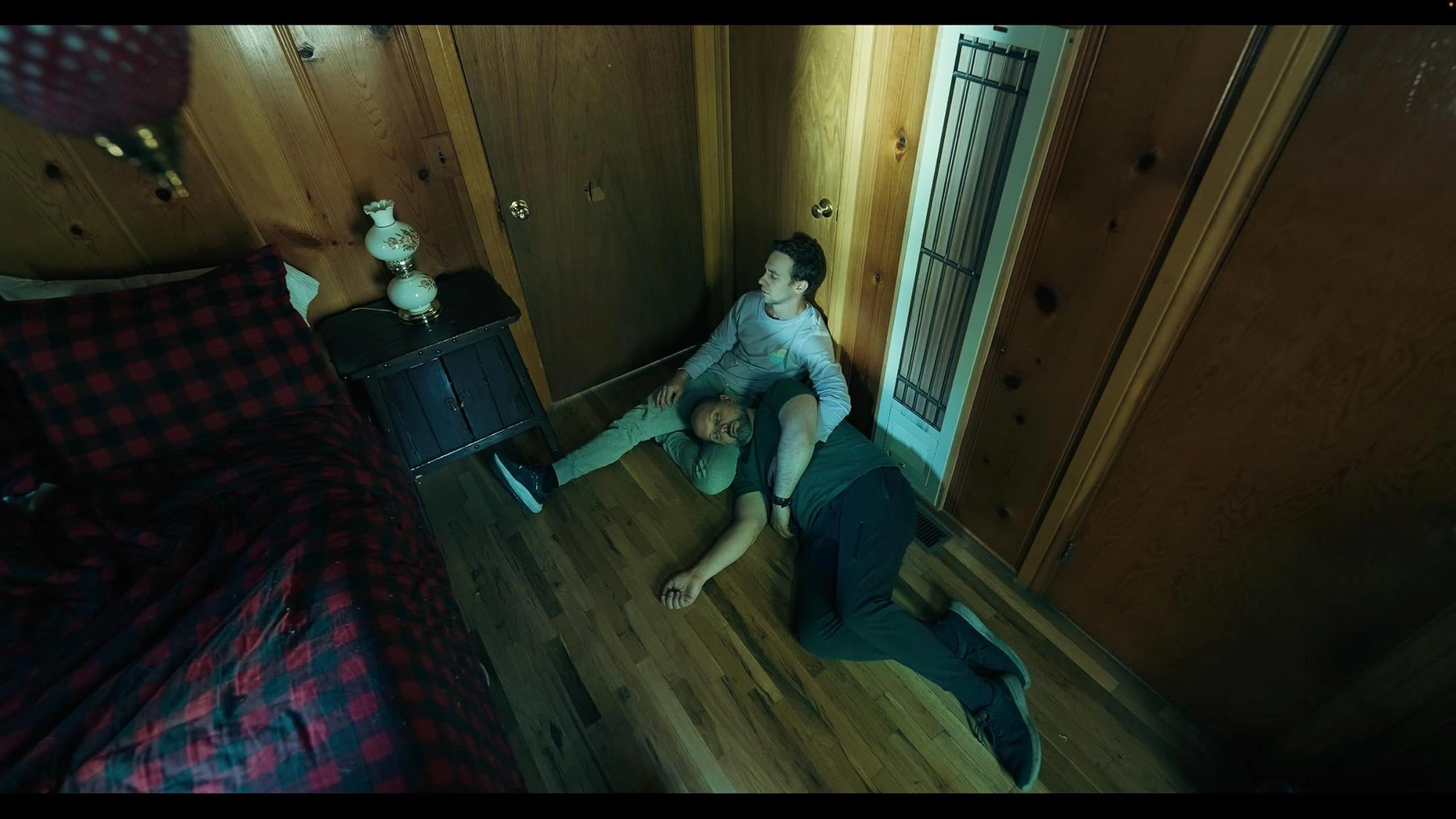
Brodsky’s Devon is a sharper, less settled creation. His anger can flare into horror-movie volume, and some of those outbursts expose the film’s uneven tonal seams. Still, Brodsky gives Devon a wounded impatience that makes sense. Devon is attracted to Albert, suspicious of him, drawn to the cabin, and furious that he has once again walked into a room where someone else controls the exits.
Their chemistry is the film’s load-bearing wall. The early awkwardness of two men translating app intimacy into physical space feels recognizable: pauses that last too long, jokes that arrive half a second late, glances that ask questions nobody wants to phrase.
The campfire scene gives the relationship its cleanest dramatic beat. Both actors lower their defenses without turning the moment into a speech contest, and for a few minutes the film trusts silence, faces, and proximity. It should do that more often. Sorry, ghosts.
The Shape Is Stronger Than the Pace
Fria knows how to use a limited setting. The cabin interiors shift with the relationship, from warm and almost inviting to pallid and unstable. Green around doorways suggests rebirth without underlining it in red ink. Torchlit night scenes keep the frame restless, and the daylight sequences are a smart deviation from horror routine. This cabin can feel unsafe at noon, which is harder to pull off than making a hallway scary at 2 a.m.
The craft has flashes of real invention. A revolving camera movement makes the cabin feel less like a location than a mechanism. An organ sequence lets sound and panic rearrange the room around the characters. Near the end, match cuts create the sense of a loop that might keep swallowing Albert, a visual idea cleaner than much of the dialogue around it.
The film’s main structural problem is duration. At 114 minutes, Shadows of Willow Cabin asks a tight two-hander to carry the weight of a larger psychological epic. Some conversations move in circles after the audience has already arrived at the point. A joke about a “sweet spot” lands with the delicacy of a dropped toolbox. A monologue about going to hell and back strains for mythic force, then gets trapped in phrasing that feels rehearsed rather than lived.
The climax has a similar issue. After so much emotional and supernatural buildup, the final stretch involving needles and fading sighs feels less like release than deflation. The film hints at a sharper ending, then chooses a quieter one without fully earning the quiet. Still, Fria’s debut has a real spine: two flawed men, one haunted space, and a story that understands repression as a structure people keep rebuilding around themselves. The editing knife needs sharpening. The foundation is there.
The independent psychological horror film Shadows of Willow Cabin celebrated its UK premiere at the 34th Raindance Film Festival in June 2026 before heading straight to home entertainment. Distributed by GrimmVision, the micro-budget feature is scheduled for a wide digital HD and premium video-on-demand rollout on June 29, 2026. The story follows Albert, a closeted middle-aged English teacher, and Devon, a younger paramedic, who retreat to an isolated mountain cabin after connecting on a dating app. Their romantic getaway rapidly devolves into a surreal survival loop as the cabin transforms into a hostile, metaphysical nightmare, forcing both men to physically confront the deeply repressed generational trauma and family secrets they have hidden away.
Where to Watch Shadows of Willow Cabin (2025) Online









Full Credits
Title: Shadows of Willow Cabin
Distributor: GrimmVision, Headcheese Films, OddDog Pictures
Release date: June 2026 (Raindance Film Festival UK Premiere), June 29, 2026 (Digital and VOD Release)
Running time: 111 minutes
Director: Joe Fria
Writers: Joe Fria
Producers and Executive Producers: Joe Fria, David Haverty, Stan Freitag, Michael Kelley
Cast: Bryan Bellomo, John Brodsky, Stan Freitag, Jimmy Ward, Keith Gruchala
Director of Photography (Cinematographer): David Haverty
Editors: Joe Fria
Composer: Michael Teoli
The Review
Shadows of Willow Cabin
Shadows of Willow Cabin has a sturdy dramatic frame: two men, one cabin, and a haunting built from secrecy rather than furniture abuse. Bryan Bellomo and John Brodsky give the film enough emotional credibility to survive its baggier stretches, while Joe Fria finds visual ideas that stretch a tight budget. The script keeps explaining wounds the structure already exposes, and the climax lands too softly after such heavy setup. Still, this is a debut with a working spine, which is rarer than a polite ghost.
PROS
- Strong two-lead chemistry
- Bellomo’s controlled, anxious performance
- Smart cabin-as-pressure-chamber setup
- Inventive match cuts and lighting
- Daylight horror used well
CONS
- Overwritten monologues
- 114-minute runtime feels baggy
- Uneven fright-night outbursts
- Soft, underpowered climax
- Themes too often explained aloud







