






















The first listeners in Ken Kwapis’ documentary do what nearly everyone does when “My Pal Foot Foot” reaches them: they search for a stable rhythm, fail to find one, then look around as if someone has altered gravity. One calls the music nightmarish. Another hears something primitive. Their faces move through amusement, irritation, and a faint panic that the song may never end.
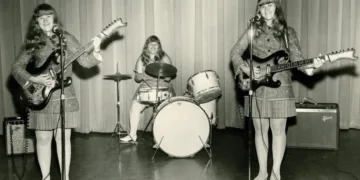
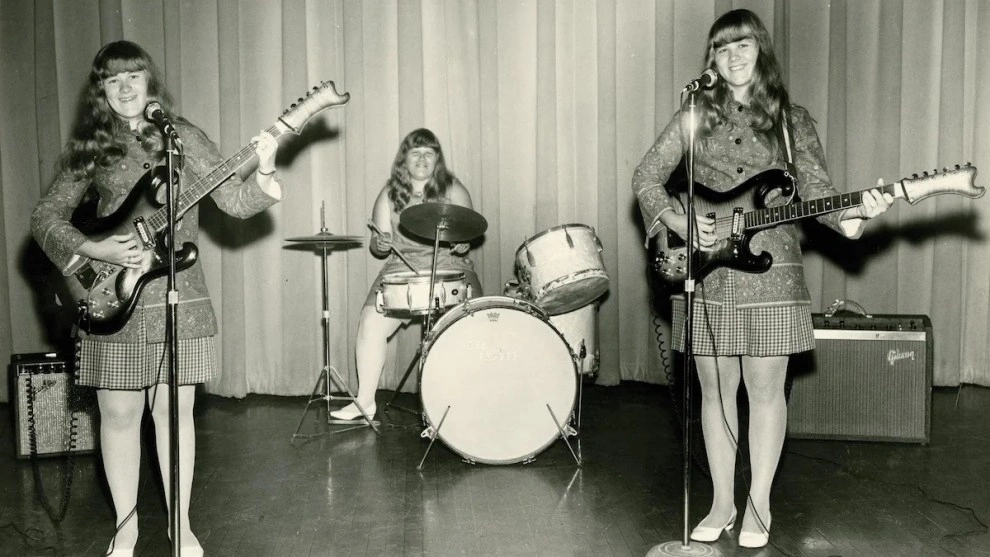
This is the right entrance to We Are the Shaggs, because explanation would only dull the initial shock. Dorothy “Dot,” Betty, and Helen Wiggin made music that seems to disobey every agreement a song usually makes with its listener. The guitars drift outside standard tuning. Helen’s drums change pace with the restless logic of weather. Dot and Betty sing together, often aligned with each other and detached from the pitch another band would choose.
Kwapis does not ask us to pretend the record is secretly polished. He asks a sadder question. What happens when years of obedience produce a sound so private that the rest of the world can hear it only as error?
The Prophecy
Austin Wiggin Jr. built the band from a prediction. His palm-reading mother told him he would marry a blonde woman, have three daughters, and watch them become a famous musical group. He fulfilled the first two parts, then treated the third as a debt his children owed fate.

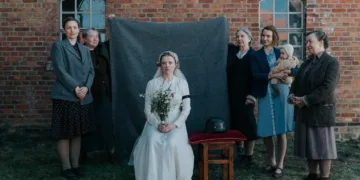
Dot, Betty, and Helen were pulled from ordinary schooling, placed under a severe rehearsal schedule, and sent to perform for local teenagers at Fremont’s tin-sided town hall. Their father’s belief became the architecture of their days. Dot found some genuine pleasure in songwriting and loved Herman’s Hermits. Betty and Helen appear to have stayed because saying no carried its own danger.
The film finds its darkest evidence in “Who Are Parents?”, a song praising the people who care for and protect their children. Heard beside the sisters’ account of forced practice and social isolation, its innocence tightens into something claustrophobic. A commentator compares it to a hostage message. The comparison is harsh, yet the lyric has the eerie calm of language learned under supervision.
Kwapis resists turning Austin into a theatrical monster. This restraint has value, but it leaves a cold space in the portrait. We understand what he did. We rarely understand the silence that allowed him to keep doing it.
A Private Grammar
The recording-room stories give the documentary its strongest pulse. Philosophy of the World was captured largely live because the sisters could not separate singing from playing. Their inexpensive guitars sat far outside conventional tuning. When someone corrected the instruments, the girls became lost and returned them to the pitches they knew.
The moment is funny until its meaning settles. Practice had taught them a closed musical language. Wrongness had become home.
That private grammar can be heard in the way Dot and Betty’s voices meet a quarter-step away from expectation, or in Helen’s sudden fills, which arrive inside verses like footsteps from another room. “My Pal Foot Foot” moves through several rhythmic shapes before the vocals appear. The songs themselves cling to simple subjects: parents, friendship, loneliness, happiness, painful memory. Their forms are unstable. Their feelings are painfully direct.
The experts gathered by Kwapis hear cubism, free jazz, punk, feminist refusal, outsider art. Tribute musicians explain that reproducing the songs requires precision because the irregularities repeat. This is persuasive up to a point. The film sometimes treats every fracture as evidence of hidden design, when repetition can preserve accident with the same faithfulness it preserves intention.
Dot and Betty quietly disturb the mythology surrounding them. Their reluctance gives the film an ache its admirers cannot explain away. The world wants the sisters to have invented a revolution. The sisters remember work.
The Afterlife of a Mistake
One thousand copies of the album were pressed. Roughly nine hundred vanished. The surviving records moved through radio stations, collectors, and musicians until Frank Zappa praised the group and NRBQ helped return the album to circulation in 1980. Mockery followed beside devotion. “Worst album” labels hardened into folklore. Kurt Cobain’s admiration later pulled the Shaggs into another generation’s idea of purity.
Kwapis uses animation and archival fragments to bridge the empty spaces, but the chronology is too slight to carry every expert summoned to defend the music. The later passages repeat the same dispute: genius or incompetence, freedom or coercion, beauty or noise. The film’s ninety minutes occasionally feel like a song refusing to locate its final beat.
Still, the repetition exposes something painful. Fame arrived after Austin’s death, after the band had dissolved, after the sisters had begun trying to live outside the prophecy. Their music became valuable once strangers could claim it as irony, rebellion, or proof that technique does not own expression.
Dot and Betty remain ordinary women standing beside an extraordinary afterlife. They do not fully embrace it. They do not need to. The sound survives anyway, crooked and lonely, carrying the pressure that made it and the innocence that escaped.
We Are the Shaggs premiered at the SXSW Film Festival in March 2026 and is currently making its way through the international festival circuit. The documentary tells the stranger-than-fiction story of three sisters from New Hampshire who were forced by their father to form an ill-fated rock band in the late 1960s.
Full Credits
Title: We Are the Shaggs
Distributor: Independent Film Festival Circuit
Release date: March 13, 2026
Running time: 98 minutes
Director: Ken Kwapis
Writers: Ken Kwapis
Producers and Executive Producers: Reynolds Anderson, Jeremy Seifert, Alex Beattie, Sandy Forman
Cast: Dorothy Wiggin, Betty Wiggin
Director of Photography (Cinematographer): Jeremy Seifert
Editors: Emily O’Brien
The Review
We Are the Shaggs
We Are the Shaggs listens patiently to music that seems to be falling apart and finds three sisters trapped inside its crooked rhythms. Ken Kwapis gives their improbable afterlife warmth, humor, and dignity, especially when Dot and Betty quietly resist the mythology built around them. The procession of admirers occasionally stretches a slender history past its natural shape, yet the recording-room stories reveal a private musical language formed through repetition, pressure, and innocence. The songs remain strange. The sadness behind them is painfully clear.
PROS
- Sensitive treatment of the Wiggin sisters
- Excellent recording-session anecdotes
- Memorable first-listen opening
- Thoughtful study of artistic value
- Strong archival and animated storytelling
CONS
- Thin material for a feature
- Repetitive expert commentary
- Occasional overpraise of accidental technique
- Austin Wiggin remains psychologically distant