





















![Kingdom Hearts Collection [I-III] Review](https://gazettely.com/wp-content/uploads/2026/10/Kingdom-Hearts-Collection-I-III-1-360x180.webp "Kingdom Hearts Collection [I-III] Review: KHII Holds Steady as Newer Entries Fluctuate 37")



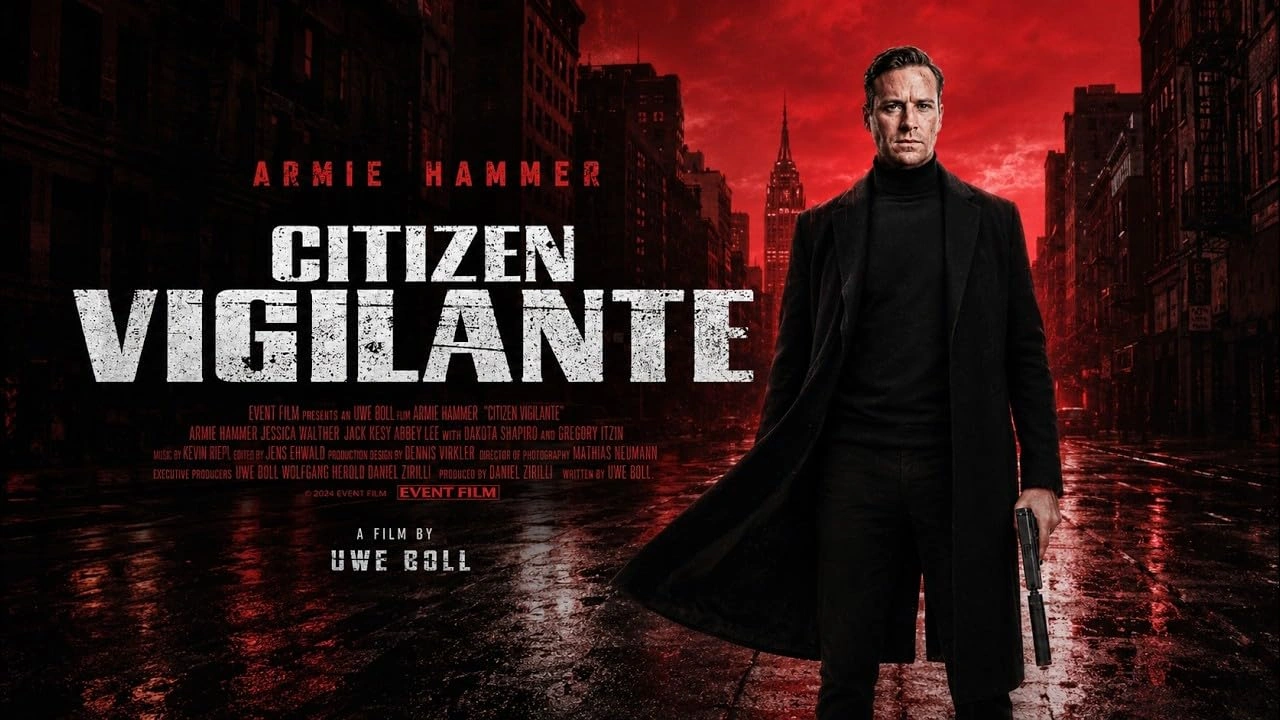

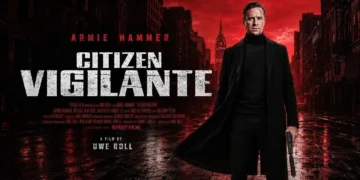
A vigilante fantasy needs doubt the way a courtroom needs evidence. Remove the doubt, and the genre becomes something uglier: a weaponized daydream with a body count. Citizen Vigilante, written and directed by Uwe Boll, does remove it. Then it reloads.
Armie Hammer plays Sanders, an American abroad who has become a viral executioner across an unnamed European setting. He targets people he believes escaped legal punishment, records blurred-face manifestos about failed institutions, and earns public support from a world that appears to have learned justice from comment sections.
Costas Mandylor plays Henry, an Interpol officer attempting to identify him, though “attempting” is doing charitable work here. Sanders leaves videos, fingerprints, patterns, property links, and enough obvious clues to make anonymity feel less like a plot device than a clerical error.
The film was once titled The Dark Knight, a choice so legally reckless and thematically revealing that the replacement title almost feels shy by comparison. Citizen Vigilante wants the moral charge of superhero myth, the grime of exploitation cinema, and the political heat of anti-immigrant panic. What it has is certainty. Deadly, tedious certainty.
Europe, Apparently
Boll begins with a title card that says “EUROPE,” as if a continent can function as a crime scene. No country, no city, no legal system, no institutional texture. Just Europe, capitalized into abstraction. This matters because the vagueness is part of the film’s argument. If the setting has no specific laws, politics, or public history, then every fear can be projected onto it. Call this Cartographic Hysteria: the act of turning geography into a panic room.
The opening wound is staged with maximum bluntness. Sanders is a child shopping with his mother. A Black man attacks her in broad daylight, killing her in front of him. The scene is shot and placed less as trauma than as thesis. Soon the film is feeding us news-style fragments about migrant crime, viral reactions praising the mystery killer, and public murmurs that someone like Sanders is needed elsewhere. The machinery is not subtle. It is not trying to be.
The choice to leave the location unnamed makes the film feel less like a thriller and closer to a feverish forwarded message. Every accent, street, police office, and social media clip is folded into the same warning siren. Migrants are framed as invading threat, courts as indulgent accomplices, citizens as helpless spectators, and Sanders as the man who finally understands the arithmetic of blood. This is not world-building. It is target selection.
Vigilante stories have always carried a dangerous temptation. Death Wish understood that temptation, even while surrendering to it in troubling ways. Dirty Harry turned procedure into masculine impatience. Taxi Driver made private violence look deranged before culture tried to canonize it. Citizen Vigilante skips the anxiety. It wants the thrill without the recoil.
The Landlord With a Gun
Sanders should be a contradiction sharp enough to cut the film open. He is a foreigner railing against foreigners. A wealthy property owner posing as tribune of the abandoned. A killer who speaks like a civics pamphlet got trapped inside a bunker. The movie sees these contradictions only by accident.
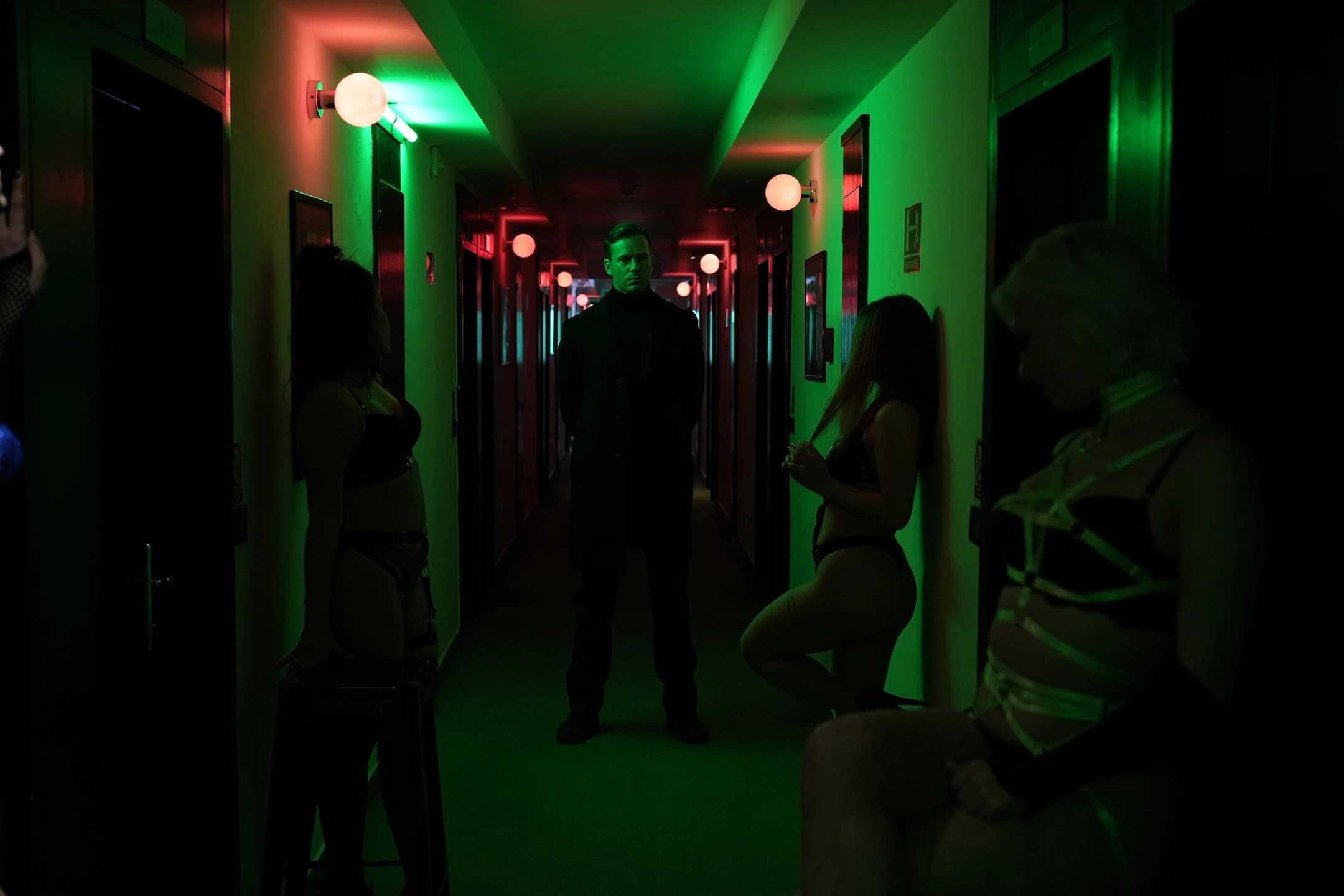
His money comes from inherited properties, which means his war on social decay is funded by rent collection. That detail could have been darkly funny, maybe even revealing. Instead, it becomes strange garnish. The funniest and most revealing scene arrives in a brothel located in one of his buildings, where Sanders interrupts sex to scold the woman about mold on the wall above the bed. For one brief second, the film almost discovers its real subject: a man who thinks ownership grants moral authority over bodies, rooms, cities, and lives.
Stay with me here: Citizen Vigilante is secretly a landlord movie. The gun is important, yes, but the key fantasy is possession. Sanders moves through Europe as if every space belongs to him by ethical foreclosure. The courts failed, so he claims jurisdiction. The tenants disappoint him, so he inspects the walls. The families offend his worldview, so he enters the house. His vigilantism is property logic with ammunition.
Hammer’s performance cannot solve that writing problem. At his best, he has had a cool, sculpted ease on screen, the kind of presence that can turn entitlement into charisma before the audience notices the trap. Here, the script gives him speeches. So many speeches. Sanders talks about crime, law, Islam, women, social collapse, and the suffering of victims in long, flat bursts of self-justification. Hammer delivers them with clenched conviction, yet the character rarely feels like a man thinking. He feels like a comment section given cheekbones.
His recent public return to acting also hangs over the film, partly because Boll gives him a role obsessed with punishment, sexual violence, and moral purification. The casting creates an echo the film seems too crude to examine. It is either unaware of the irony or thrilled by it. Neither option helps.
Victims as Ammunition
The most corrosive part of Citizen Vigilante is not that it depicts horrific crimes. Films can depict rape, murder, institutional failure, and communal rage with ethical seriousness. The issue is how Boll uses suffering. Victims here are not people with interior lives. They are ignition devices. A crime occurs, grief is invoked, Sanders speaks, someone dies. Then the film moves on to the next moral prop.
This becomes clearest in the scenes involving Muslim characters. The film links religion, migration, women’s clothing, sexual violence, and legal failure into one poisonous chain. Near the end, Sanders forces his way into a family home after a son has allegedly escaped punishment in a rape case. The family’s beliefs are treated as collective guilt. Sanders barely allows space for speech before the film turns execution into judgment.
That sequence is the ethical center of the movie, if “ethical” can be used for a scene that seems to misplace ethics under a pile of shell casings. The father, mother, son, and daughter are pulled into Sanders’ logic as if relation equals complicity. The scene could have been staged as horror, the moment a vigilante reveals himself as a mass murderer. Instead, the music and framing lean toward righteousness. Boll does not ask what happens when justice becomes tribal vengeance. He seems satisfied that vengeance has found the correct tribe.
Then comes the dedication to rape victims in Europe who were betrayed by the legal system. It arrives after the film has treated sexual violence as proof text for racial grievance. The dedication wants solemnity. It earns suspicion. There is a difference between honoring victims and conscripting them. Citizen Vigilante conscripts them.
The film’s political imagination is brutally simple: institutions are weak, outsiders are dangerous, violence is clarity. That last idea is the one that matters most. The movie’s real villain is ambiguity. It cannot stand the possibility that crime, punishment, migration, gender, trauma, and law might require thought. Thought would slow the trigger finger.
A Thriller Without Pursuit
For all its ideological noise, Citizen Vigilante is also inept as a thriller. That almost feels secondary, then the film keeps reminding you. Henry, played by Costas Mandylor, has the worn face and tired voice of a man who has seen too many bodies and too many excuses.
In another film, he could have been the moral counterweight: a procedural mind facing a public hungry for execution, a cop forced to defend a legal order he knows is imperfect. Mandylor gives the role a low, exhausted gravity. The script gives him errands.
His investigation never develops a proper rhythm. Sanders is a viral figure who records manifestos, controls a visible business, owns multiple properties, visits crime-linked locations, and leaves behind a trail that should interest anyone with Wi-Fi and a notebook. Henry still spends much of the film lagging behind the obvious. The cat-and-mouse structure has no cat, no mouse, mostly furniture.
The nonlinear editing worsens this. Fragmented chronology can sharpen a film by turning memory, guilt, and revelation into structure. Here, the jumps create clutter. Scenes appear to repeat or circle back without new meaning. Manifesto clips interrupt action. Mock news coverage gives us exposition the drama has already shouted. Influencer reactions tell us how the public sees Sanders before the film has earned that social texture. The result is less fractured psychology than broken assembly.
Boll also pads simple actions past their dramatic usefulness. Characters walk, drive, wait, watch screens, enter rooms, leave rooms. Some shots feel included because they exist. Hitchcock could turn a man following another man through a city into metaphysical dread. Boll turns movement into runtime.
There are flashes where the film nearly finds shape. A confrontation involving teenagers on a bus has a sharper public charge because Sanders’ menace enters a confined civilian space. The scene understands, for a moment, that vigilantism is theatrical. It needs witnesses. It feeds on the fear of bystanders. Then the film returns to its usual blunt-force sermon.
The Camera Picks a Side
The visual language of Citizen Vigilante is flat in the literal sense and revealing in the moral one. Interiors glow with a sickly digital yellow. Drone shots offer anonymous urban geography from above, which fits a film that sees Europe as a single contaminated surface. Gunplay is staged with militarized heaviness, yet without spatial clarity or suspense. The camera does not build dread. It waits for punishment.
The sound choices are worse. Near the final stretch, the music lends Sanders’ violence a valiant quality, as if the film is scoring civic restoration rather than home invasion. Music can complicate an image by pushing against it. Here, it salutes. That is an ethical decision, not a technical accident.
The fake media material gives the movie its most honest form. Talking heads, news clips, viral praise, anonymous declarations, public panic: Citizen Vigilante often resembles a radicalized feed pretending to be narrative cinema. This is where Boll’s lack of dramatic finesse almost becomes a method. The movie scrolls rather than unfolds. It does not develop an argument. It aggregates outrage.
That may be why the film is so unpleasant to sit with. Bad craft can be dull. Bad craft in service of hateful certainty has a different texture. It becomes sticky. Scenes do not simply fail; they leave residue. The mother’s murder in the opening, the speeches about migrant crime, the Quran-linked confrontation, the mold inspection during sex, the blurred videos, the dedication to victims: each piece reveals a film that confuses provocation with courage and brutality with moral seriousness.
There is an old fantasy hiding inside many vigilante stories: the clean act, the one violent gesture that cuts through procedure, doubt, delay, and compromise. The great danger of that fantasy is its cleanliness. Citizen Vigilante embraces it with both hands, then stains everything around it.
The action thriller film premiered on June 19, 2026, releasing simultaneously in theaters and across various video-on-demand digital streaming platforms. The story centers on an American military veteran living in Europe who launches a violent, independent crusade against criminal networks and institutional failures, turning him into a divisive online phenomenon while drawing a relentless pursuit from an Interpol regional chief.
Where to Watch Citizen Vigilante (2026) Online






Full Credits
Title: Citizen Vigilante
Distributor: Quiver Distribution
Release date: June 19, 2026
Rating: R
Running time: 1 hour 29 minutes
Director: Uwe Boll
Writers: Uwe Boll
Producers and Executive Producers: Uwe Boll, Boris Velican, Michael Roesch
Cast: Armie Hammer, Costas Mandylor, Désirée Giorgetti, Steffen Mennekes, Neb Chupin, Mukit Abdul Hamid, Fares Mongy, Hila Harush, Vjekoslav Katusin, Jenny Paris
Director of Photography (Cinematographer): Mathias Neumann
Editors: Ethan Maniquis
Composer: Rodolfo Matulich
The Review
Citizen Vigilante
Citizen Vigilante is what happens when a revenge thriller mistakes rage for thought and prejudice for moral clarity. Boll stages Sanders as a corrective force, then forgets to fear him. The film is ugly in craft and uglier in argument: scrambled editing, slack pursuit, sermon-like dialogue, and violence scored like civic hygiene. The mold-inspection sex scene nearly exposes the real movie, a landlord fantasy with a handgun. Then the sermon resumes.
PROS
- Mandylor’s weary presence
- One tense bus confrontation
- Accidental landlord satire
CONS
- Xenophobic moral framing
- Victims used as ammunition
- Chaotic nonlinear editing
- Hammer trapped in speeches
- Heroic scoring for brutality