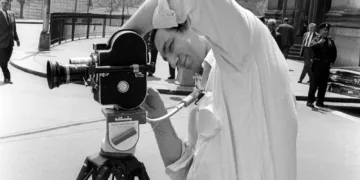




























Ken Jacobs, a central figure of American avant-garde cinema whose experiments with found footage and live projection reshaped moving-image art, has died at 92. His family confirmed he died on October 5 in Manhattan of kidney failure. The New York-born filmmaker spent seven decades probing how images work on the eye and mind, moving from 16mm collage films to performance apparatuses that created 3D illusions from ordinary prints.
Jacobs’ landmark Tom, Tom, the Piper’s Son deconstructed a 1905 short into an extended investigation of framing, motion and attention; the work was named to the National Film Registry in 2007. His nearly seven-hour Star Spangled to Death assembled archival scraps into a corrosive portrait of American mythmaking, while his “Nervous System” and later “Nervous Magic Lantern” performances used synchronized projectors and shutters to conjure parallax depth without stereoscopic cameras.
Beyond his filmography, Jacobs was a teacher and organizer whose influence radiated through classrooms and microcinemas. He taught for decades at what is now Binghamton University and toured with live shows that treated projection like an instrument, “playing” two near-identical film strips against each other to produce unstable space and time. Institutions and cooperatives that preserved and circulated his work often cite his technical curiosity and polemical energy as catalysts for new generations of makers.
He is survived by his children, including filmmaker Azazel Jacobs. His wife and frequent collaborator, Flo Jacobs, a producer and creative partner on numerous projects, died earlier this year. News of his death prompted tributes from experimental-film communities in New York and abroad, recalling a restless career that stretched from the underground 1960s to digital “eternalism” experiments in recent years.