
























![Kingdom Hearts Collection [I-III] Review](https://gazettely.com/wp-content/uploads/2026/10/Kingdom-Hearts-Collection-I-III-1-360x180.webp "Kingdom Hearts Collection [I-III] Review: KHII Holds Steady as Newer Entries Fluctuate 37")





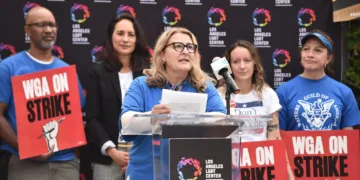
Writers Guild of America West president Michele Mulroney addressed the “No Kings” demonstrations in downtown Los Angeles on Saturday, telling thousands of attendees that “when our words are powerful, we cannot be silenced,” and urging creative workers to defend free expression amid heightened political tensions. Her remarks came as the nationwide protests drew large crowds in cities across the U.S. on Oct. 18.
Mulroney, elected this fall, framed the moment as a test of speech and labor rights, echoing priorities she outlined upon taking office, including stronger contract enforcement and guardrails around the use of artificial intelligence. The guild has pressed studios to meet obligations on copyright defense and to curb unauthorized AI training on writers’ work, positions that have shaped industry negotiations since last year’s strike settlement.
Organizers said the demonstrations spanned thousands of locations and were largely peaceful, with civic leaders and entertainment figures appearing at rallies that emphasized voting, media literacy, and nonviolence. In Southern California, street closures and rolling marches surrounded civic centers and federal buildings; local officials reported heavy but orderly turnout. Across the country, crowd estimates reached into the tens of thousands at individual sites, with images of “No Kings” banners circulating widely online.
Critics of the movement dismissed the actions as partisan theater and questioned the claims of authoritarian overreach. Conservative outlets cast the marches as coordinated by progressive groups and amplified by Hollywood unions, while federal authorities increased security around certain facilities in anticipation of large gatherings. The White House and allies argued the protests mischaracterized administration policies, even as prominent public figures continued to rally supporters throughout the day.
For writers, the moment extended a year of activism from picket lines to public squares. Mulroney’s appearance signaled that the guild views the political spotlight as intertwined with workplace concerns, including residuals in a shifting streaming economy and how emerging technologies interact with protected speech. She urged participants to keep pressure on employers and elected officials, tying creative freedom to the ability of writers to work without retaliation or unauthorized appropriation of their work.