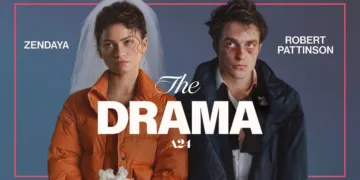









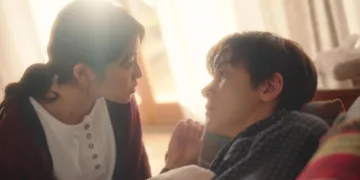








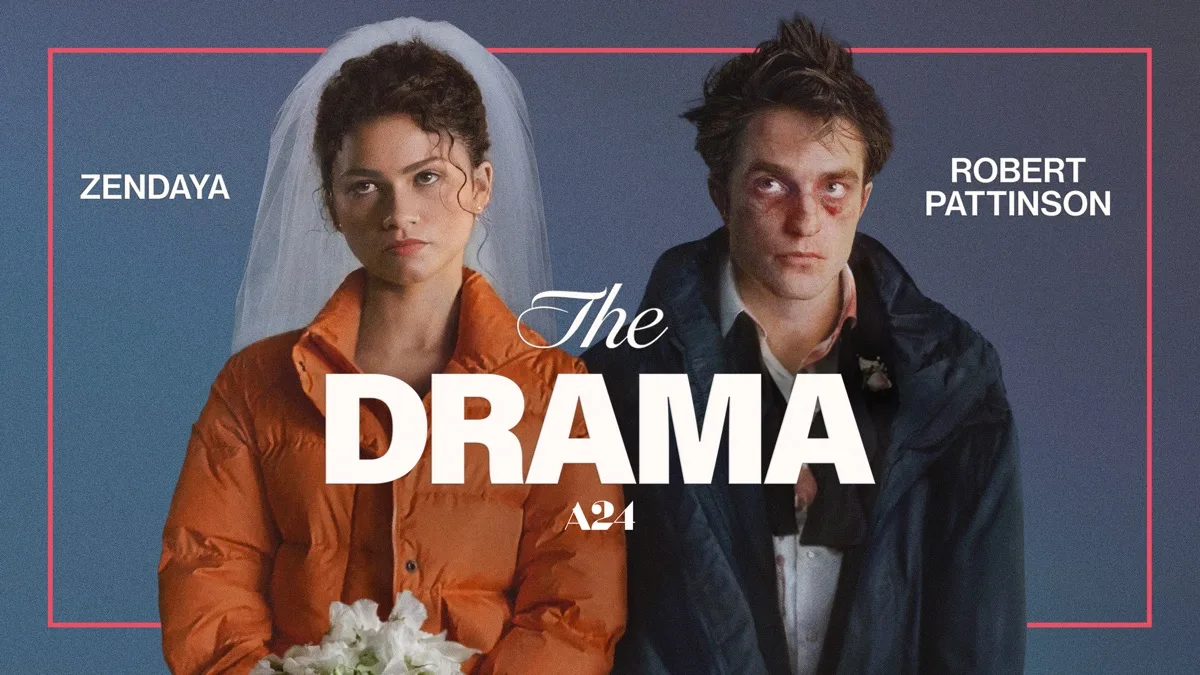

Charlie (Robert Pattinson) and Emma (Zendaya) have what looks, from every angle, like a love story. A meet-cute in a Cambridge coffee shop. A leafy apartment with a corkscrew staircase. Devoted friends. A wedding one week away. Norwegian writer-director Kristoffer Borgli, who previously upended social convention in Dream Scenario and Sick of Myself, collaborating again with producer Ari Aster, constructs this fairy tale with deliberate care. He wants you to believe it. He needs you to believe it.
Then a dinner party game called “What’s the Worst Thing You’ve Ever Done?” arrives like a lit match held to all that pretty kindling, and the film reveals itself for what it always was: a dark romantic comedy that courts the conventions of its genre precisely to dismantle them from the inside. The Drama does not shy away from the consequences of its central detonation. It leans in, unflinching, asking a question that has stalked human intimacy since before language had words for it: how well do we ever truly know the person we choose to love?
The Grenade in the Wedding Cake
Without reaching for spoilers, Emma’s confession lands at the intersection of two things America has never successfully reconciled: romantic idealism and mass violence. It is transgressive enough to earn genuine gasps, grounded enough that it cannot be dismissed as a prank or a provocation for its own sake. Borgli has found a secret that functions as a philosophical trap door. Once it opens, there is no clean way back up.
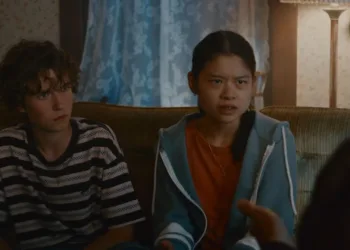
What makes the structural choices here so effective is how the film refuses to stay in one time or one emotional key. The narrative moves between the present-tense chaos of wedding preparations, charged flashbacks to teenage Emma (played with gruff, unsettling interiority by Jordyn Curet), and fantasy sequences that crack the film’s surface open to reveal what Charlie’s mind is doing when no one is watching. These sequences are among the most cinematically inventive passages in the film: reality refracted through suspicion, the person you love seen through the lens of something you cannot unfeel.
The jump cuts Borgli deploys during scenes of rising social pressure are precise instruments of discomfort. They create a stuttering, lurching rhythm that refuses the audience any comfortable footing. Scenes fit together with an angular logic, each one arriving exactly when you do not want it to and ending before anything is resolved. The film’s structural commitment to inconclusiveness is not a failure of nerve. Borgli is not interested in answers. He is interested in the particular agony of living inside a question with no satisfying resolution, and his architecture reflects that with uncommon honesty.
The flashbacks to Emma’s adolescence raise the question that propels the second act with quiet relentlessness: has she changed, or does that version of her persist somewhere beneath the woman Charlie thought he knew? The film wisely declines to answer. It leaves both Charlie and the audience sitting with the unbearable possibility that people contain multitudes their partners will never fully access.
The Weight of Other People’s Eyes
Pattinson has made a career of playing men who exist at some oblique angle to social expectation, and Charlie is his most precisely calibrated portrait of that type. A British expat museum curator with good bone structure and a conspicuous absence of backbone, Charlie has spent his adult life in America without ever truly absorbing its pathologies. His foreignness is load-bearing: the revelation that breaks him would, for a native, carry the weight of a familiar grief. For Charlie, it arrives as pure shock, as if a floor he had never thought to test has suddenly given way.
Pattinson tracks this disintegration with physical elasticity and a kind of bemused, increasingly desperate intelligence. His susceptibility to Rachel’s outrage, the way her horror gets into his head and crowds out what he actually knows and feels about Emma, is rendered with a specificity that is genuinely uncomfortable to watch. He is funny, often painfully so. He is also a portrait of a man who discovers, too late, that his self-image was built on the assumption that nothing would ever seriously test it.
Zendaya plays Emma with a wounded sweetness that makes the audience’s allegiances relatively clear, perhaps too clear for a film with genuine ambitions toward moral complexity. Her most assured work here is physical and comedic: a scene involving a kitchen knife, a tense negotiation with a wedding DJ. Where the dramatic register demands deeper interiority, the script’s decision to keep Emma deliberately opaque creates a ceiling that performance alone cannot lift. This is a meaningful design choice, but it is also a constraint, and the seams show.
Alana Haim’s Rachel is the film’s most socially precise creation: volcanic, unrelenting, her outrage operating as a kind of hegemonic force that warps every room she occupies. She is unapologetically shrill, and the film knows exactly what it is doing by making her so. Her presence transforms Emma’s secret from a private wound into a public verdict. Mamoudou Athie brings a relaxed, compassionate steadiness to Mike, the one person at the table genuinely trying to hold the social fabric together as everyone else tears at it. The peripheral characters, a dance teacher, a wedding photographer, a possibly chemically enhanced DJ, are deployed efficiently, each one a small pressure valve for the film’s accumulated tension.
The Verdicts We Render
Marriage, Borgli seems to believe, is the most honest mirror a society has ever built for itself. It is a public ceremony demanding collective approval of the most intimate possible arrangement, a ritual insisting that love be legible, presentable, and ratified by others. The Drama turns this ceremony against itself. The wedding industrial complex surrounding Charlie and Emma is the film’s primary subject: the judgment it invites, the mass approval it demands, the terrifying exposure of placing your private life before a social audience that has opinions.
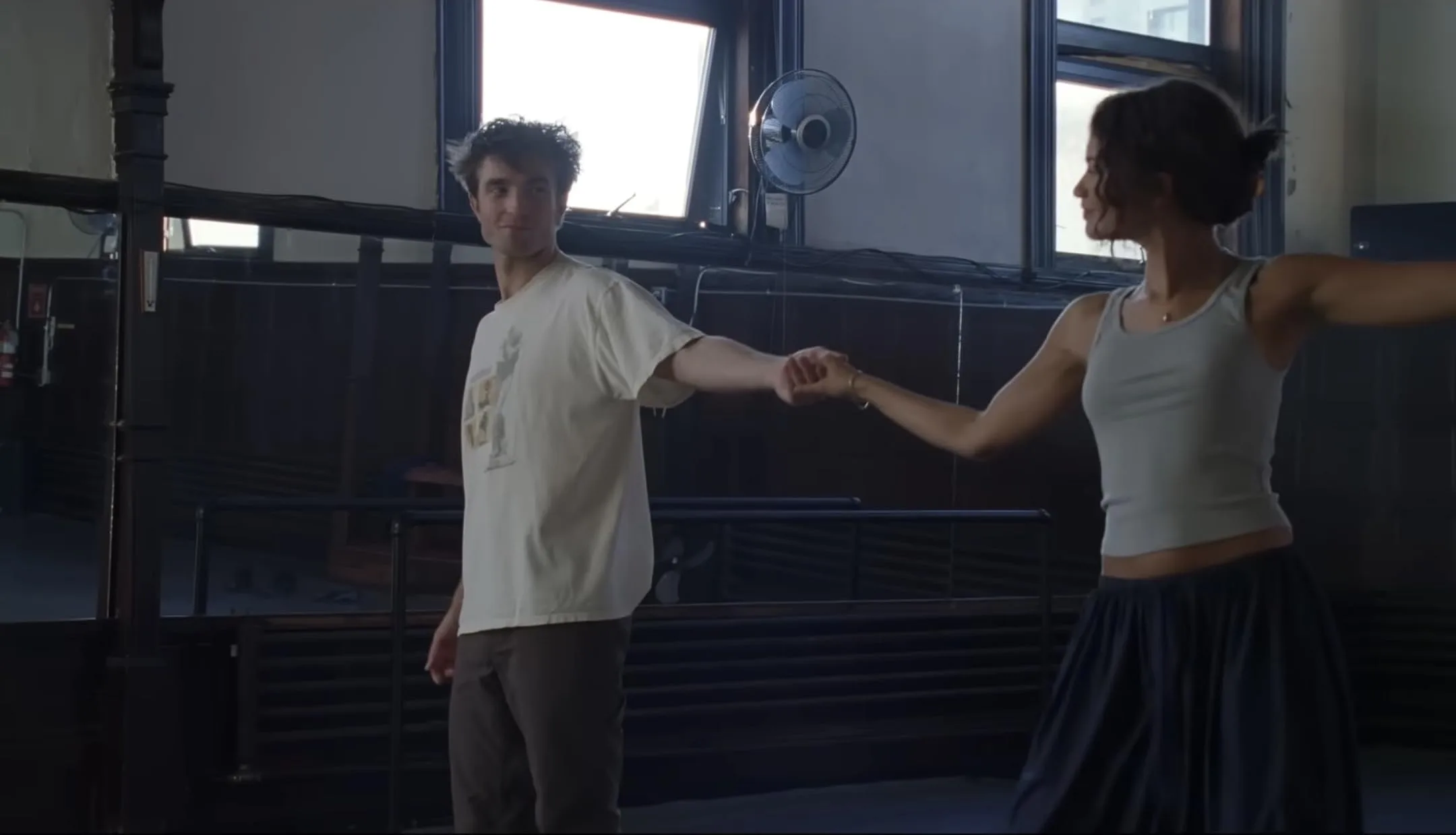
The dinner party game is the film’s most elegant structural device. Had Emma told Charlie alone, things would almost certainly have unfolded differently. Rachel’s presence does not merely complicate Charlie’s response; it colonises it. Her horror becomes the lens through which Charlie begins to see his fiancée, and the film understands something philosophically uncomfortable here: our knowledge of other people is never entirely our own. It is always partly constructed by the reactions of those around us. We do not see clearly. We see socially.
The moral slipperiness Borgli introduces is one of the film’s most rewarding ideas. Those who judge Emma most harshly, who occupy the high ground with such confidence, find themselves behaving no better once the pressure rises. Ethics, the film suggests quietly, is a performance that tends to degrade under sufficiently adverse conditions.
Charlie’s status as a British expat gives the film a proxy for Borgli’s own outsider perspective on American pathology. Once Charlie absorbs Emma’s secret, he begins to perceive its shadow everywhere, unable to comprehend how the people around him simply carry on. There is something existentially vertiginous in this: the ordinary life, suddenly exposed as a negotiation with catastrophe that everyone has tacitly agreed not to mention.
Then there is the question the film does not raise explicitly but cannot entirely suppress. Emma is a Black woman. Her being a would-be school shooter is the source of the film’s provocation, and yet Borgli leaves the racial dimension of this premise largely unexamined, neither interrogating it nor integrating it into the characters’ inner lives. This silence is the film’s most conspicuous unresolved tension, the place where its appetite for provocation and its appetite for genuine inquiry most visibly part ways.
Controlled Nausea
Borgli’s filmmaking signature is the premise that refuses to behave. He builds scenarios that are commercially appealing and philosophically corrosive in equal measure, then refuses to let either impulse fully dominate. The Drama is his most controlled exercise in this mode: close-ups that loom into faces at precisely the wrong moment, silences held a beat too long before emotional detonations, a visual grammar designed to produce a specific, carefully calibrated discomfort.
The fantasy sequences stand apart. They are the film’s most formally inventive passages, moments where the surface of realist drama cracks open to reveal what lives beneath Charlie’s increasingly fractured perception of Emma. They are unsettling in the right way: not horror, exactly, but something adjacent to it, the sensation of watching a familiar face become suddenly strange.
Daniel Pemberton’s score is a quiet achievement. Anxious, minimalist, flutey in a way that feels slightly anaesthetised, it functions as a direct extension of Charlie’s psyche. It does not push the emotional register. It holds it at a distance, contributing to the film’s disoriented, slightly sedated texture in ways that are easy to undervalue on first viewing.
The craft strains, predictably, in the third act. The climax reaches for farcical chaos and cannot find a satisfying rhythm inside it. Some plot mechanics lean on coincidence rather than earned character logic, and the film’s broadest comedic sequences occasionally suggest sketch comedy rather than the sophisticated unease that precedes them. Borgli’s instinct to prioritise productive nausea over narrative depth is an asset through the first two acts. By the third, it reveals its limits.
What Politeness Cannot Hold
The Drama succeeds most completely when it refuses its characters, and its audience, any comfortable exit. The central conceit is genuinely good, and the film wrings real tension from the space between what Charlie knows intellectually and what he feels instinctively. That gap is where the film lives, and Borgli keeps it open with considerable skill.
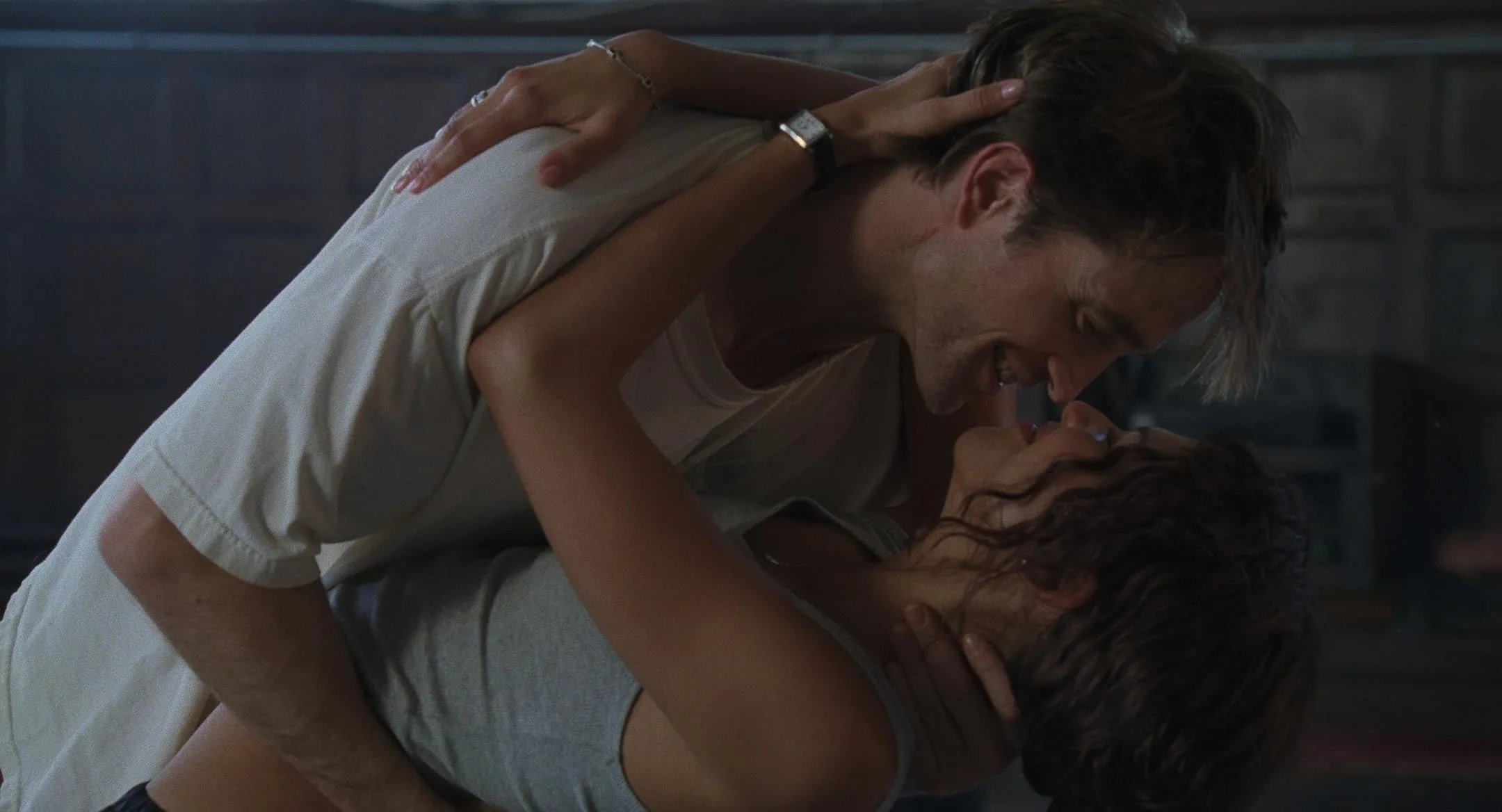
Its limitations are structural. The film is, by conscious design, thinner than its ideas deserve. It is more committed to generating discomfort than to following its characters into the places where genuine understanding might wait. Keeping Emma opaque is a meaningful choice, but it is also a choice that limits the film’s emotional range.
The racial dimension of the premise is the space where The Drama most conspicuously declines the courage it seems to be reaching for. That declination costs the film a layer of honesty the audience can feel in its absence.
The question the film circles with the most integrity is also its simplest: how do you address something that polite society has decided, collectively, not to address? The Drama does not answer this. It makes you feel the weight of not answering it.
The Drama is a 2026 American romantic comedy-drama film that explores the complexities of modern relationships through a dark, satirical lens. The story follows Emma and Charlie, a seemingly happy couple whose wedding preparations are thrown into absolute chaos when an unexpected revelation about their past surfaces just days before the ceremony. Directed by Kristoffer Borgli, known for his ability to balance cringe comedy with profound emotional tension, the film features career-defining performances from Zendaya and Robert Pattinson. Following its world premiere at the DGA Theater Complex in Los Angeles on March 17, 2026, the film was released theatrically by A24 on April 3, 2026.
Where to Watch The Drama (2026) Online








Full Credits
Title: The Drama
Distributor: A24
Release date: April 3, 2026
Rating: 15 (BBFC)
Running time: 105 minutes
Director: Kristoffer Borgli
Writers: Kristoffer Borgli
Producers and Executive Producers: Ari Aster, Lars Knudsen, Tyler Campellone
Cast: Zendaya, Robert Pattinson, Alana Haim, Mamoudou Athie, Hailey Gates, Zoë Winters, Hannah Gross, Sydney Lemmon, Anna Baryshnikov, Michael Abbott Jr., Damon Gupton, Jeremy Levick
Director of Photography (Cinematographer): Arseni Khachaturan
Editors: Kristoffer Borgli, Joshua Raymond Lee
Composer: Daniel Pemberton
The Review
The Drama
The Drama is a genuinely provocative piece of filmmaking that earns its discomfort without always earning its depth. Borgli's central conceit is sharp, his craft is precise, and Pattinson and Zendaya hold the film together with considerable skill. The third act loses its footing, and the film's racial blind spot is a real cost. Still, it lingers. A film that makes you feel the weight of unanswered questions has done something worthwhile.
PROS
- Genuinely shocking and philosophically rich central conceit
- Pattinson delivers a career-best comedic and dramatic performance
- Inventive narrative structure with effective fantasy sequences
- Sharp supporting work from Haim and Athie
- Pemberton's score is a quiet, atmospheric achievement
CONS
- Third act loses rhythmic control and narrative precision
- Emma is kept too opaque, limiting emotional payoff
- The racial dimension of the premise goes largely unexamined
- Plot mechanics occasionally rely on coincidence
- Broader comedy sequences feel tonally mismatched