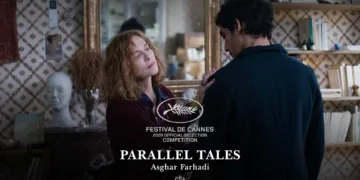













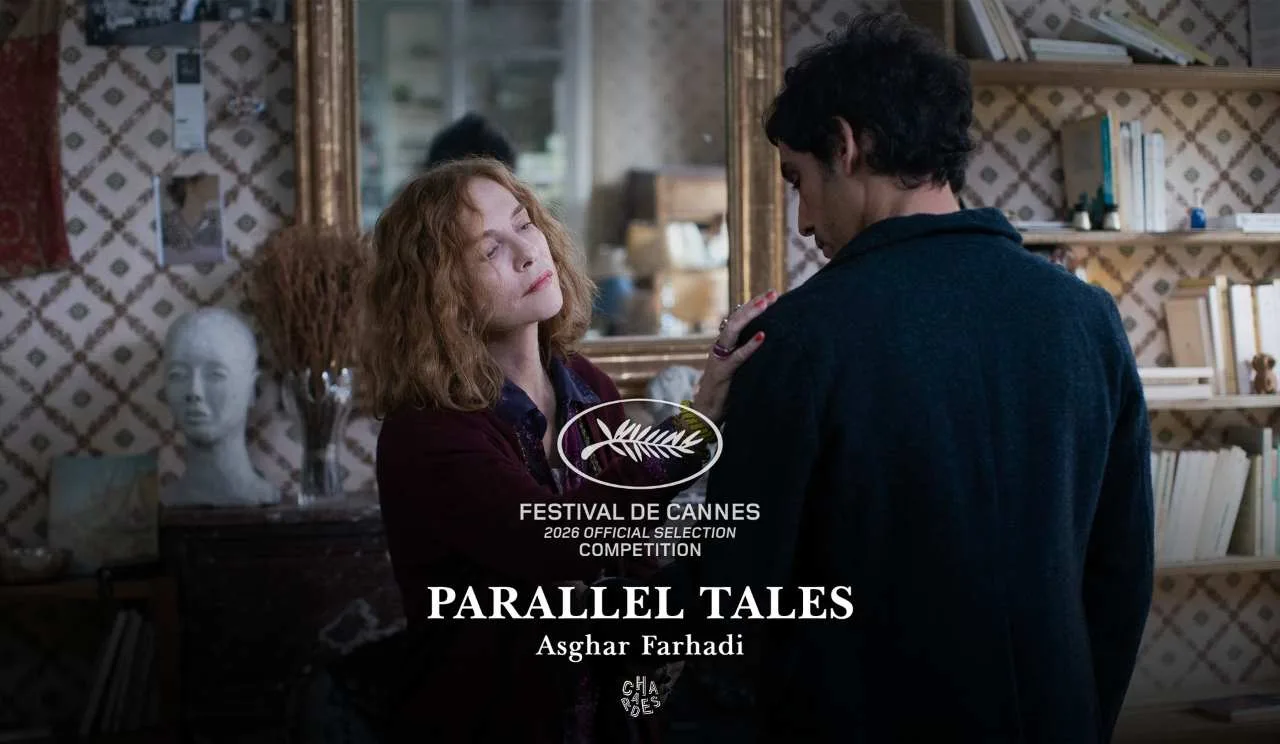

There is something philosophically vertiginous about a story that watches itself being born. Asghar Farhadi, the Iranian filmmaker whose domestic dramas A Separation and The Salesman earned him two Academy Awards, arrives at Cannes for the fifth time with Parallel Tales, a French-language meditation on voyeurism, authorship, and the uncomfortable proximity between living and inventing. Co-written with his brother Saeed and loosely drawn from the sixth chapter of Krzysztof Kieślowski’s Dekalog, the episode tied to the commandment against adultery, the film stars Isabelle Huppert as a reclusive Parisian novelist who spies on the foley artists across the street and manufactures their lives into fiction.
When a young homeless man steals her manuscript and inserts himself into the real world she has been fictionalising, reality and imagination begin their slow, uneasy convergence. Running a considerable 2 hours and 20 minutes, with Virginie Efira, Vincent Cassel, Pierre Niney, and Adam Bessa completing the principal cast, and distributed in France by Memento, Parallel Tales is a film that asks whether art can be honest about its own predatory nature. The answer it arrives at is murkier, and less satisfying, than the question deserves.
A Fiction Feeding on the Real
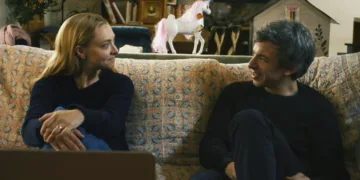
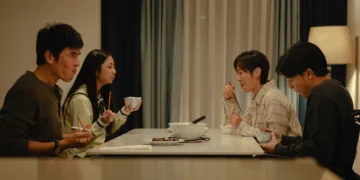
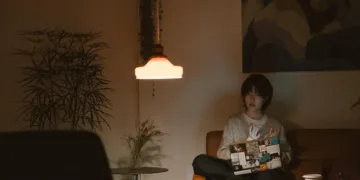
Sylvie inhabits her apartment the way the dead inhabit old houses, surrounded by the accumulated debris of a writing life, surviving on canned tuna, lighting cigarettes off a toaster. Her niece Céline, who co-owns the place, wants it sold and cleaned; Sylvie wants to keep watching the fifth-floor apartment across the Parisian avenue, where three sound designers work on nature documentaries. She cannot hear them, only observe, so she invents. In her imagining, the curly-haired Anna (Efira) is in a clandestine affair with her married superior Pierre (Cassel) while her younger colleague Christophe (Niney) pines for her. The actual trio are Nita, Nicolas, and Theo, brothers and colleague, whose real dynamics are quieter, less pulpy, only faintly gravitating toward transgression.
Efira, Cassel, and Niney play both versions of their characters, the fictional archetypes and their real-world counterparts, a structural gambit that Farhadi underscores visually. The imagined sequences carry a cooler blue palette, non-diegetic music, a stylised remove from Farhadi’s customarily naturalistic hand. The real world returns to his familiar frenetic observational mode, and for a time this contrast generates genuine tension between what is dreamed and what simply is.
The catalyst arrives in Adam (Bessa), a young former pickpocket hired as Sylvie’s assistant, who reads her discarded manuscript, picks up her telescope, and engineers a meeting with Nita at a neighbourhood café, presenting the novel as his own. The irony writes itself: a man convicted of theft steals an idea about voyeurism to pursue a woman who doesn’t know she is being watched. When Nita reads the book and recognises herself in its pages, she is unsettled enough to show it to Nicolas and Theo, seeding suspicion between them. A confrontation on a Metro platform between Adam and Theo crackles with physical menace. An unwanted advance from Christophe that Nita sharply rebuffs arrives with the clarity of a different, more focused film trying to surface.
Subplots accumulate around this central machinery. A burning light in an upstairs apartment draws Sylvie’s attention to an old man’s death, which connects, through her family history, to her mother’s affair and her father’s suicide off the balcony. These accumulations do not deepen the architecture so much as strain it.
The Art of Imitation, the Theft of Observation
Farhadi has always been drawn to the philosophical weight of human behaviour under moral pressure, and Parallel Tales carries a genuinely rich conceit at its core. Writing as surveillance. The author as predator. The foley work in the apartment across the street becomes an exquisite metaphor: Nita and her colleagues manufacture reality from artificial materials, caressing parsley leaves to imitate a butterfly’s wingbeat, dragging sand to conjure footsteps on a beach. They create, professionally, what Sylvie does obsessively, which is to make plausible fictions from limited sensory data. The silent watcher and the professional sound-makers are estranged versions of the same impulse.
Farhadi gives the sound sequences unusual and welcome attention, the foley recording offering some of the film’s most arresting moments. The contributions of sound designer Pierre Mertens, editors Paul Heymans and Mathieu Michaux, and mixer Thomas Gauder earn their place in the credits in a film where the absence of sound, from Sylvie’s end of the telescope, is as philosophically loaded as its presence. With the 100th anniversary of synchronised sound in cinema approaching in 2027, there is something quietly appropriate about a film that interrogates what we hear versus what we see, what we know versus what we invent.
Farhadi is working in his second French-language film after The Past in 2013, and doing so from a position of genuine political exile; his vow not to shoot in Iran until restrictions on depicting women without headscarves are lifted charges the geography of this project with significance. That France is historically a haven for artistic dissidents, and also a culture where infidelity carries a cultural ambiguity absent in his homeland, is a pointed choice for a film circling betrayal and fabrication.
There is also the matter of Farhadi’s own biography. Accused of plagiarism in a 2022 New Yorker article and later acquitted by an Iranian court in 2024, the director has made a film saturated with stolen manuscripts and purloined ideas. This self-referential dimension, absent from the Kieślowski source, reads as a dry, layered acknowledgment of the scandal. Worth noting, not overstating.
The tonal gamble is harder to defend. Farhadi attempts a pulpier, lighter register than he has sustained before, reaching toward Hitchcockian voyeurism, a Chabrol-tinged irony, the guilty pleasures of films like Body Double or Blow-Up. These influences flicker in the margins. But Farhadi’s instinct for moral gravity keeps interrupting the pleasures he is trying to offer, and a late-act shift into darker, more unsettling territory arrives without the structural preparation to absorb it. Kieślowski’s original, from which the premise descends, ran 86 minutes and stayed rigorously focused on the watcher and the watched. Its intimacy was its discipline. Expansion into parallel tales has not produced greater richness so much as dilution of moral charge.
A Cast Straining Against the Design
Huppert is, as always, technically formidable, and there are flashes of something genuinely possessed in her Sylvie. The character accumulates her clichés with knowing deliberateness, the ancient Olivetti electric typewriter, the stodgy spectacles, the cigarette lit from a toaster. But a veteran novelist, at work for decades, would have fingers that fly. Sylvie pecks at the keys a few letters at a time. It is a minor discrepancy and a telling one, suggesting a character assembled from idea rather than observation, the very failure the film diagnoses in lesser writers.
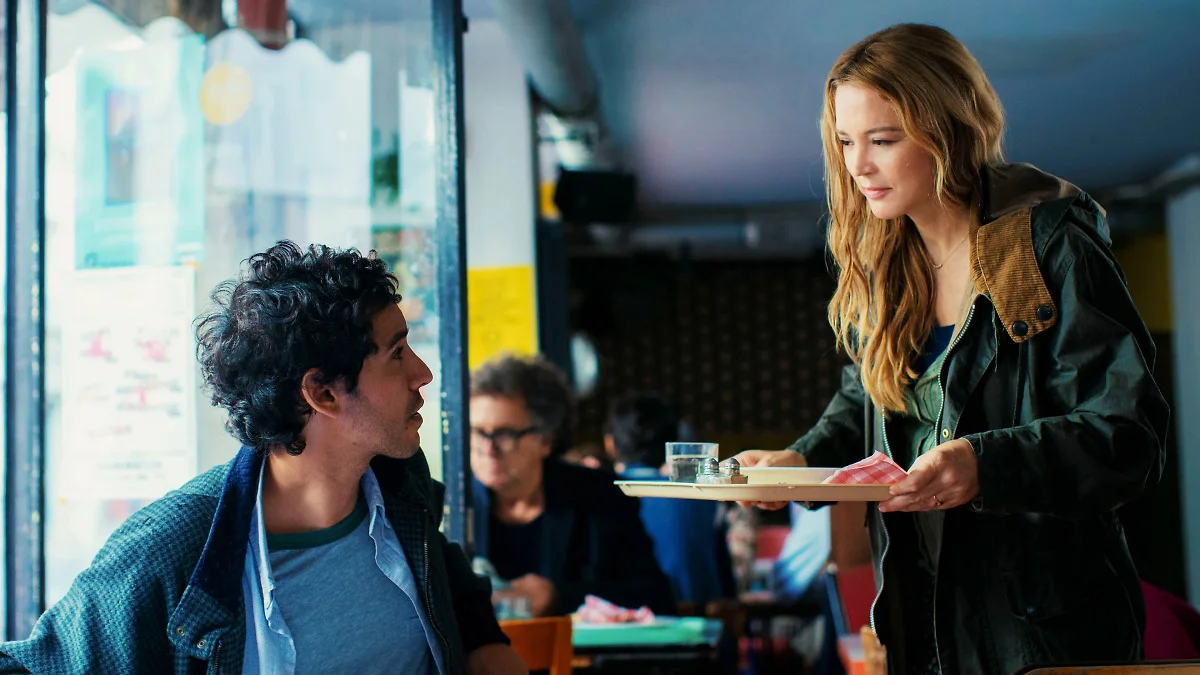
Efira navigates the dual role with intelligence and discipline. The fictional Anna is drawn in broad, deliberately archetypal strokes: languid, alluring, a function of male longing. Nita, her real counterpart, carries genuine interiority, sharpness where Anna has softness, pain where the fiction has performance. The contrast is the point, and Efira delivers it. Cassel invests both Pierre and Nicolas with a particular kind of middle-aged melancholy, a man who has outlasted his own charisma and is quietly aware of it. Niney is restless, edged, effective in both registers.
The revelation of the cast is Bessa. His Adam is a study in watchful ambiguity, a man who has learned to occupy spaces that don’t belong to him, slipping through doors left ajar by other people’s inattention. The performance is all controlled surface concealing unclear depths, and it carries the film through sequences where the plotting has grown unreliable. Catherine Deneuve appears for a single, brief scene as Sylvie’s publisher, projecting magnificent, barely-concealed boredom at the manuscript being pitched to her. The cameo is so perfectly cast in its brevity that one suspects she knew exactly what she was doing.
Guillaume Deffontaines’ cinematography is one of the film’s genuine pleasures. The rain-soaked Parisian sequences carry a particular atmospheric density, and his warm lighting in the fictional sections creates the appropriate sense of something slightly too beautiful to be true. Emmanuelle Duplay’s production design for Sylvie’s apartment achieves the rare quality of feeling genuinely inhabited rather than dressed, every surface a record of how a mind retreats into its own accumulations. Zbigniew Preisner’s score, carrying the emotional memory of his work with Kieślowski, lends the film a borrowed melancholy it has not quite earned on its own.
The Length of a Laboured Dream
A film about parallel tales ought to trust its audience to hold multiple threads simultaneously. Parallel Tales asks this trust and then tests it to exhaustion. At two hours and twenty minutes, the film runs roughly twice as long as the source work that inspired its central conceit, and the additional time is not spent in depth so much as in accumulation.
The mid-section sags once the manuscript has exchanged hands and the fiction-versus-reality mechanism begins repeating its gestures. Coincidences pile up. Ironic reversals arrive on schedule. The subplot involving the dead neighbour and Sylvie’s family history introduces a genuine melancholy but lands in a film already overfull of competing registers.
The deepest problem is structural. Farhadi cannot commit to a primary perspective, and so access to any one character remains fractured and partial. The metafictional architecture, which should generate a productive unease about how we consume and manufacture stories, produces instead a kind of flatness, the sense that cleverness has been mistaken for insight. Individual sequences retain their power: the Metro confrontation between Adam and Theo, Nita’s sharp rejection of workplace harassment, the foley artists coaxing animal sounds from domestic objects. These moments contain the sharper, more disciplined film that Parallel Tales could have been.
The craft is evident. The ambition is real. But a film about the gap between imagination and reality has, paradoxically, imagined itself as better than it is.
Parallel Tales is a psychological drama film directed by acclaimed Iranian filmmaker Asghar Farhadi, making it his second French-language feature. Loosely based on Krzysztof Kieślowski’s Dekalog: Six, the movie follows a reclusive novelist who begins spying on her neighbors across the street for artistic inspiration, only for the lines between her fictional manuscript and real life to dangerously blur. The film celebrated its world premiere in official competition at the Cannes Film Festival on May 14, 2026, and was simultaneously released theatrically in France. Viewers can currently watch it in French cinemas, with international streaming and theatrical platforms expected to distribute it globally following its festival run.
Where to Watch Parallel Tales (2026) Online
Full Credits
Title: Parallel Tales (French: Histoires Parallèles)
Distributor: Memento Films
Release date: May 14, 2026
Rating: Not Rated / Censorship Pending
Running time: 140 minutes
Director: Asghar Farhadi
Writers: Asghar Farhadi, Massoumeh Lahidji, Saeed Farhadi, Krzysztof Kieślowski, Krzysztof Piesiewicz
Producers and Executive Producers: Gaëtan David, Asghar Farhadi, David Levine, André Logie, Alexandre Mallet-Guy, Andrea Occhipinti, Maciej Musiał
Cast: Isabelle Huppert, Virginie Efira, Vincent Cassel, Pierre Niney, Adam Bessa, Catherine Deneuve, India Hair
Director of Photography (Cinematographer): Guillaume Deffontaines
Editors: Hayedeh Safiyari
Composer: Zbigniew Preisner
The Review
Parallel Tales
Parallel Tales carries the DNA of a genuinely provocative film about art's predatory relationship with life. Farhadi's ambition is visible in every frame, and his cast delivers committed work within a structure that repeatedly undercuts them. The foley sequences and Adam Bessa's watchful performance suggest what sharpness the film might have sustained. Instead, a distended runtime, fractured perspective, and surface-level metafiction leave the film circling its own ideas without landing. Technically accomplished, intellectually gesturing, emotionally undernourished.
PROS
- Strong ensemble cast, particularly Bessa and Efira
- Inventive foley/sound design conceptual layer
- Atmospheric cinematography by Deffontaines
- Distinctive visual separation between fiction and reality
- Rich central conceit about authorship and observation
CONS
- Bloated 2hr 20min runtime
- Overstuffed, coincidence-heavy plotting
- Huppert's character leans on cliché
- Tonal shifts feel unearned
- Metafictional cleverness rarely deepens into genuine insight