


























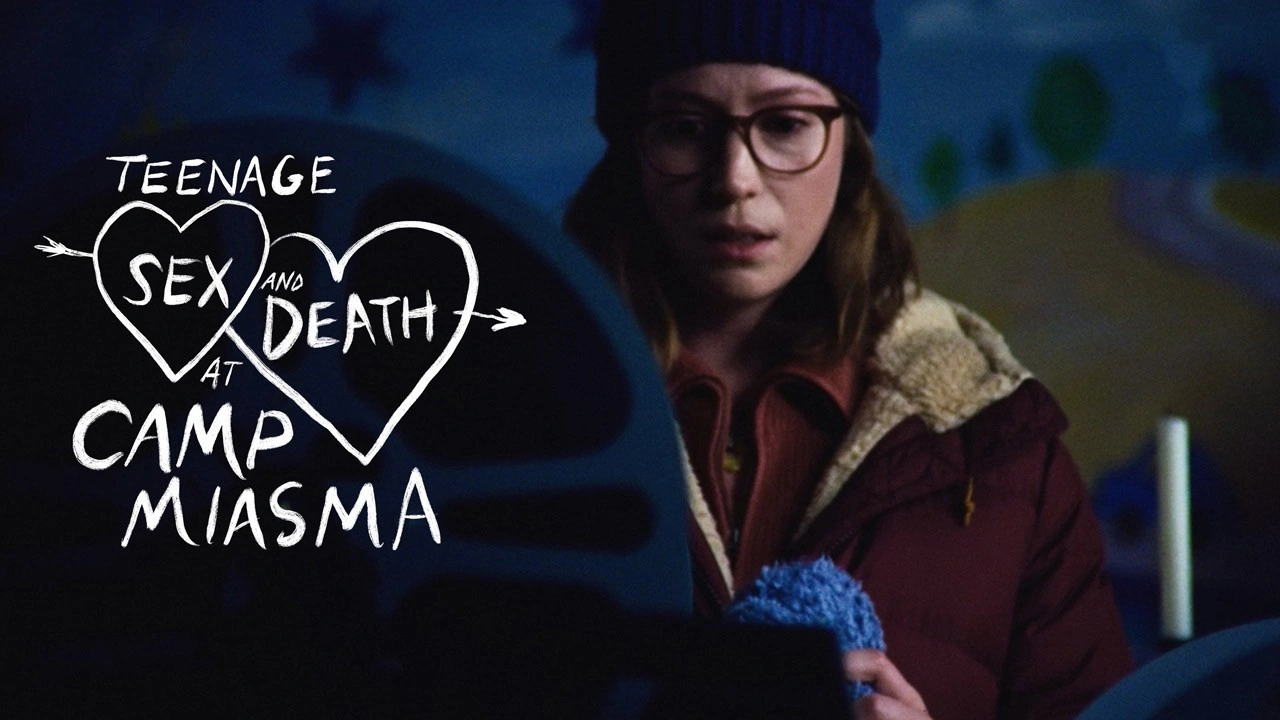

Kris, an ascending filmmaker played by Hannah Einbinder, accepts a high-stakes assignment: bring a dormant horror franchise back to life. The property, Teenage Sex and Death at Camp Miasma, carries the residue of its eighties slasher origins. Its mythos turns around Little Death, a killer born from the tragic bullying of a gender-fluid teenager at a summer camp. The vengeful spirit stalks Camp Tivoli with a spear and an HVAC vent fitted into a mask, a grotesque emblem of industrial menace and adolescent cruelty.
Kris tries to move beyond the franchise’s poor sequels by recruiting Billy Presley, the original star. Gillian Anderson plays Billy as a recluse living in a remote cabin near the Washington border. Their meeting alters the film’s pressure system. Kris begins with an industry task, then drifts into a charged inquiry into identity, embodiment, and inheritance.
The story starts with the grammar of horror, then opens into a surreal terrain where film and reality lose their clean separation. Media memory presses against the physical experience of self. The director evades the stale mechanics of the remake by fixing attention on the creator’s inner life. Camp Tivoli becomes a living presence, a haunted archive with cabins, snow, and old wounds.
The Iconography of the Final Girl
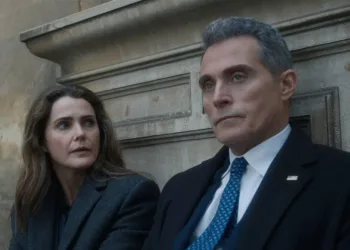
The relationship between Kris and Billy Presley gives the film its governing axis. Billy recalls the Norma Desmond archetype, shaped here without the usual tragic fog of faded stardom. She lives inside quiet assurance. Anderson plays her with a thick Southern accent, velvet, fedoras, and a composure that turns the snowy Pacific Northwest into her private stage. She commands the frame with the serenity of someone who survived the image made of her.
The first professional friction between Kris and Billy soon thickens into erotic charge. That shift exposes the visual and emotional distance between them. Billy carries a classic feminine silhouette. Kris, played by Hannah Einbinder, moves with diffidence and androgynized reserve.
Their conversations reveal a deeper disagreement over the Camp Miasma legacy. Kris treats the material with academic distance. Billy refuses that frame. For her, horror and genre desire live in flesh and fluids, in the crude truth of the body before interpretation files it down.
This argument gives the film its sharpest cultural pulse. The body, here, resists becoming a thesis. The snowy campground gives the heat between Kris and Billy a sterile, almost surgical backdrop. Their connection anchors the surreal shifts that follow, turning genre homage into a meditation on recognition. The film studies how identity can be refracted through those who arrived earlier, those who carried the archetype before it had language. Some lessons resist the lens. Some knowledge begins where analysis loses its grip.
The Mechanics of the Slasher
Eric Yue’s cinematography leans into saturated color and the tactile grain of low-budget horror memory. Matte paintings create a dreamlike field, suggesting a world partly built by imagination and partly by damaged recollection. The film captures the sensation of watching an old movie on a flickering basement screen, where cheap artifice can feel strangely intimate.

Alex G’s score, paired with tracks from REM and Counting Crows, establishes a precise emotional frequency. Inside this frame, the movie within the movie embraces exaggerated gore. Little Death’s HVAC helmet remains a wonderfully odd image of industrial horror, absurd and threatening in the same breath. The franchise’s visual identity has the blunt force of a nightmare assembled from scraps.
That artistic vision collides with the machinery of present-day filmmaking. Sarah Sherman plays a hyperactive agent who embodies commercial pressure with manic clarity. A meltdown during an executive Zoom call crystallizes the conflict. Kris is caught between her private vision and a studio system hungry for a safe product. The satire lands because the film understands how easily language about creativity can become a cage.
The technical design mirrors the film’s friction between artifice and reality. The artificial space often feels truer than the polished professional world surrounding it. Saturated images reflect a media culture swollen with references, remakes, and recycled icons. The slasher apparatus becomes a tool for examining authorship, commerce, and the strange emotional afterlife of images that refuse to stay buried.
The Physical Awakening
The film moves toward physical reality and away from intellectual distance. Kris has built a life around watching herself as if seated in a theater, observing the gestures of existence without fully entering them. This detachment leaves her estranged from her own body. Her sexual hesitation grows from a history of using media as protection against the pain of social rejection.
Little Death becomes her symbolic mirror. The character’s origin, rooted in the bullying of a gender-fluid teenager, speaks to a shared exile. Through that connection, the narrative studies the unsettled period after the destruction of gender dysphoria, when the body finally fits and the question becomes what to do with that fit. The film gives those anxieties a physical shape without turning them into a lecture.
The final moments arrive with a needle drop that signals release from mental cages. Kris reaches a clear understanding of existence. Life refuses the scripted rules of a slasher movie. Experience can be written from within the body, through touch, breath, desire, and presence. That realization loosens the grip of inherited patterns. The film shifts from mind to skin, from explanation to sensation.
The ending becomes a quiet celebration of the present tense. Kris no longer needs to treat herself as footage awaiting interpretation. The deepest discovery appears outside the script, in the breath, in the body, in the strange freedom of being alive without turning every feeling into evidence.
Teenage Sex and Death at Camp Miasma had its world premiere today, May 13, 2026, as the opening film of the Un Certain Regard section at the Cannes Film Festival. The film received significant attention for its bold approach to the slasher genre and its focus on queer identity. Audiences in the United States can watch the film when it arrives in theaters on August 7, 2026. Mubi handles the distribution for the project, which was produced in collaboration with Plan B Entertainment.
Where to Watch Teenage Sex and Death at Camp Miasma (2026) Online





Full Credits
Title: Teenage Sex and Death at Camp Miasma
Distributor: Mubi
Release date: May 13, 2026 (Cannes Premiere), August 7, 2026 (United States)
Running time: 112 minutes
Director: Jane Schoenbrun
Writers: Jane Schoenbrun
Producers and Executive Producers: Dede Gardner, Jeremy Kleiner, Brad Pitt, Efe Çakarel, Daniel Bekerman, Caddy Vanasirikul, Amanda Verhagen
Cast: Hannah Einbinder, Gillian Anderson, Amanda Fix, Arthur Conti, Eva Victor, Zach Cherry, Sarah Sherman, Patrick Fischler, Dylan Baker, Jasmin Savoy Brown, Kevin McDonald, Quintessa Swindell, Jack Haven
Director of Photography (Cinematographer): Eric Yue
Editors: Graham Mason
Composer: Alex G
The Review
Teenage Sex and Death at Camp Miasma
This film provides a powerful exploration of the physical self and the transition from observation to existence. It rejects the standard tropes of the slasher genre to find a profound sense of liberation. The performances are grounded and the visual style effectively captures a specific era of horror. It demands patience from the viewer but rewards that investment with an honest look at identity. This work stands as a bold step in the director’s filmography. It is a vital piece of cinema for those interested in the connection between media memory and reality.
PROS
- Exceptional performances from Hannah Einbinder and Gillian Anderson.
- Evocative and dreamlike cinematography that establishes a distinct mood.
- Sharp and effective satire of the modern film industry.
- A sincere and moving exploration of physical identity.
CONS
- The pacing slows during the extended sequences at the cabin.
- The meta-narrative structure might feel distant to some viewers.
- Some industry-specific satirical elements are quite niche.