

















The festive lights of horror cinema feel sharpest and most disorienting once Santa Claus shifts from mythic guardian to instrument of punishment. The 1984 Christmas slasher Silent Night, Deadly Night marked a key point in this holiday horror niche, a cult artifact whose early reputation grew out of public anger at its very premise. Director and writer Mike P. Nelson’s new take treats that premise as a frame for gore and as a structure for examining contemporary fears around trauma and justice.
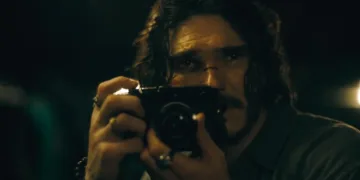
The film follows Billy Chapman (Rohan Campbell), a young man permanently splintered by the memory of his parents’ brutal killing at the hands of someone in a red suit that children across the world recognize. As an adult drifter, Billy drifts into a heavily decorated small American town that feels pulled from seasonal programming.
There he slips into the role of a holiday vigilante, driven by an internal push to seek out and violently punish those he labels “naughty.” The film threads ferocious, imaginative violence through moments of camp and a tender romantic subplot that arrives as a surprise. The result reads as a cultural hybrid, taking a familiar North American horror setup and remixing it with a contemporary sensibility aimed at viewers steeped in global media flows.
Trauma, Tradition, and the Digital Vigilante
Nelson’s revision of the story concentrates on reconfiguring the vigilante figure for a modern worldwide audience, shifting the killer’s motivation from a local, psychologically framed trauma toward an abstract directive that feels almost supernatural. The opening sequence lays out the traumatic core with clean, economical staging. Young Billy witnesses the senseless murder of his parents by a Santa-clad attacker. This act serves as the origin point of a killer and establishes a repeating shock that fuses the holiday figure with unfiltered malice.
That single night defines Billy’s adult life, pushing him into a wandering existence where he keeps moving to stay ahead of memory and impulse. His rootless path echoes a contemporary global narrative pattern familiar from international cinema, in which isolation and voluntary exile function as responses to damage that cannot be repaired.
Billy’s drive to kill revolves around the idea of “punishing the naughty.” The film presents this moral system as something sharper than a clinical diagnosis. It taps into a present-day hunger for absolute moral clarity and reflects the swift demands for accountability that shape digital culture and online discourse. Billy personifies this urge. He takes a festive rule set about rewarding the good and shaming the bad and turns it into an intensely personal, blood-soaked code of action. The film positions its slasher figure as an agent of justice, a familiar role from crime storytelling, and layers it with an unusually direct holiday frame.
The most striking structural change from the 1984 film is the introduction of the “voice” inside Billy’s mind. The film presents this voice as a supernatural presence, hinting at the transfer of a compulsion, or a Christmas-justice spirit, from an earlier killer to Billy. That choice shifts the work from a strictly psychoanalytic horror, built around childhood abuse and the making of a monster, toward a slasher shaped by supernatural influence. The voice carries a definite personality and functions both as a companion and as an instruction system for killing. It operates like a constant passenger that detects “bad people” and refines Billy’s sense of mission and his selection of targets.
This shift in framing becomes central to the film’s global appeal. The earlier version grew out of specific American fears, including religious trauma tied to harsh discipline in a Christian orphanage. Nelson’s film removes that tightly local framework and replaces it with a more widely legible supernatural lore in which morality receives enforcement from a force beyond the human. That approach connects to transnational anxieties about inherited trauma and spiritual influence, ideas that appear across storytelling traditions in many regions.
Billy occupies a distinct place in this configuration, a vigilante whose mission flows from an inner directive that feels imposed from outside, which sets him apart from other masked killers whose behavior reads as pure psychosis. Nelson keeps the tempo brisk. Scenes rarely linger beyond their impact. Flashbacks appear sparingly, laying out Billy’s trauma clearly while avoiding repetition. This method keeps the momentum high and sustains a forward drive that mirrors the relentless pull of the voice that controls him.
The Performance of Identity and the Hallmark-Slasher Hybrid
The film’s ambitious mix of modes rests on the believability of its leads, whose chemistry and attention to emotional detail hold together the sharp turns between seasonal romance and savage horror. Rohan Campbell’s interpretation of Billy Chapman provides the anchor for Nelson’s redesign. Campbell steps away from a familiar, theatrical version of the psychotic killer and grounds Billy in quiet hurt and disorientation. This choice matters for the film’s emotional texture. It frames Billy as a figure who invites sympathy at the same time that he commits acts of extreme violence.

Campbell captures a striking dual presence that the review names a “murderous cutie” persona. He plays gentle, open moments, such as helping decorate a Christmas tree, then shifts into a focused, efficient killer swinging an axe. The role requires precision, with a constant tension between the softness of a young man seeking connection and the lethal pull of his compulsion. Billy’s inner war, between a real desire for an ordinary life and the pressure to kill, produces the emotional stake that lifts the film above more routine slashers. Campbell keeps viewers tied to Billy’s humanity, so his decline or possible rescue feels gripping instead of abstract.
Ruby Modine’s work as Pamela extends and deepens that emotional framework. Pamela functions as the romantic partner and the anchor for Billy’s attempt at stability. She stands for the possibility of a life untouched by violence and carries the warmth and acceptance that Billy has never received. The film presents her as one of the rare people who recognize the possibility of genuine goodness beneath his surface.
Modine gives the character a confident, arresting presence, providing a partner who can match Billy’s intensity. She combines a caring impulse with a protective drive, which turns Pamela into a force inside the story rather than a simple accessory. The supporting ensemble mainly supplies a roster of “naughty” victims, which directs attention back to the charged interplay between Billy and Pam and keeps their relationship as the emotional core.
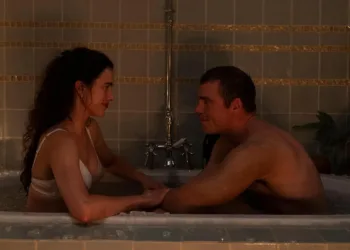
The romantic line in Nelson’s version feels like the boldest move. The tangible connection between Campbell and Modine makes the relationship feel convincing and emotionally sharp. Folding a gentle, sincere romance into a graphic slasher framework functions as a clear act of media remix. The motif of love developing amid chaos appears across many international film traditions, where romance gains intensity against settings shaped by war or upheaval. Here the film channels that structure through the lens of a holiday killing spree.
This device supports the film’s unusual Hallmark-slasher tone and injects emotional sincerity into a form that often stays purely cynical or mechanical. The image of a serial killer curled up on a couch to watch a true-crime documentary with his girlfriend, only to receive a call to murder from within his own mind, becomes a sharp portrait of fractured modern identity, split between everyday intimacy and algorithmic violence.
Visual Storytelling, Media Remix, and Cultural Aesthetics
The film’s ability to sustain its unusual pitch depends on a deliberate visual plan and careful handling of its clashing tones. Silent Night, Deadly Night operates in a state of designed ambiguity, pairing gushy, high-gloss holiday visuals with bursts of intense physical violence. This combination acts as a form of genre satire. The film constantly recognizes and bends the rules of the cheerful, consumption-driven holiday media it visually echoes.

A clear self-aware humor runs through the project, as if it shares the audience’s laughter at the extremity of its own premise. The risk of sudden tonal shifts is high, yet Nelson’s full commitment to this heightened aesthetic helps the emotional and stylistic complexity cohere. The result feels like an energetic piece of crafted camp, a cultural object that understands contemporary viewers’ appetite for works that acknowledge their own absurdity while still delivering impact.
Action design and practical effects play a key role in meeting expectations for a slasher while shaping this sensibility. The kill scenes earn praise within the review for their invention, brutality, and stylish staging. The strong reliance on practical effects, including cracked skulls and dismembered limbs, answers the demand for visceral horror. At the same time, the staging and lighting temper the heaviness, adding streaks of camp that keep the imagery from sinking into grim monotony.
The film’s use of Christmas ornaments and seasonal tools in the violence, including impalements on festive objects, becomes its signature visual move. That approach heightens the unsettling collision between holidays and death and aligns the film with a visual language common in contemporary horror, where familiar symbols acquire a corrupted charge. The review connects this to practices in international filmmaking, where recognizable cultural icons receive similar treatment to provoke unease.
The constant Christmas setting functions as a key visual engine rather than a simple backdrop. Decorations, lights, and snowfall shape nearly every frame and build an identity for the film that depends on saturation. The intensity of the seasonal color palette sharpens each instance of bloodshed and makes the violence feel more transgressive. The film’s aesthetic leans into a kind of gleeful visual chaos, in which holiday cheer heightens the sense of violation each time Billy acts on the voice in his head.
The score by Blitz//Berlin reinforces this design. It combines familiar holiday textures and carols with pulsing horror motifs, keeping the viewer inside a field of tension between comfort and dread. The close alignment of sound and image defines the film as a thoughtful yet unabashedly brutal remix of a horror property. The review frames this strategy as evidence of how visual and sonic storytelling can transform a straightforward premise into commentary on consumer Christmas culture and the violence that often lies buried beneath rituals of celebration.
Silent Night, Deadly Night (2025) is a horror film and a modern reimagining of the controversial 1984 slasher cult classic. The movie centers on Billy Chapman, a troubled young man who, after witnessing his parents’ brutal murder by a killer in a Santa suit, goes on an annual spree of holiday violence. The film premiered at Fantastic Fest on September 21, 2025, and is scheduled for a wide theatrical release in the United States by Cineverse on December 12, 2025. Outside of North America, it is being distributed by StudioCanal. As it is receiving an unrated release, it is marketed toward an adult audience anticipating intense horror content.
Full Credits
Title: Silent Night, Deadly Night
Distributor: Cineverse (United States), StudioCanal (U.K., Ireland, France, Germany, Australia, New Zealand, the Benelux, Poland)
Release date: December 12, 2025 (United States theatrical release)
Running time: 97 minutes
Director: Mike P. Nelson
Writers: Mike P. Nelson
Producers and Executive Producers: Jeremy Torrie, Tanya Brunel, Scott Schneid, Dennis Whitehead, Jamie R. Thompson, Erik Bernard, Yolanda Macias, Erick Opeka, Steven Schneider, Jed Benedict, Brad Miska, Brandon Hill, Anthony Masi, Victor Zimmerman, Sarah Eilts, Matthew Helderman, Luke Taylor, Grady Craig
Cast: Rohan Campbell, Ruby Modine, David Lawrence Brown, David Tomlinson, Mark Acheson, Sharon Bajer, Erik Athavale, Toni Reimer
Director of Photography (Cinematographer): Nick Junkersfeld
Editors: Geoff Klein
Composer: Blitz//Berlin
The Review
Silent Night, Deadly Night
Silent Night, Deadly Night succeeds as a high-energy, self-aware reinvention that honors the controversial spirit of the original while forging a distinct new path. By merging brutal, inventive slasher action with a genuinely sweet, central romance and a supernatural vigilante twist, the film creates a unique tone. Rohan Campbell and Ruby Modine's compelling chemistry grounds the deliberate camp, making the film feel both fiercely transgressive and surprisingly heartfelt. It is a highly effective, modern Christmas horror hybrid.
PROS
- Inventive blend of slasher, romance, and camp.
- Rohan Campbell's sympathetic dual-nature performance.
- Excellent use of practical effects and gore.
- Maintains a tight, energetic pace throughout.
- Bold update that successfully redefines the killer's motivation.
CONS
- Supporting characters are often thinly sketched.
- The rapid tonal shifts may not appeal to all horror fans.
- The revised, supernatural lore takes some adjustment.
- The film's overall predictability in its genre structure.