




























Thirty seconds sounds generous until a corridor fills with robots, automated weapons begin firing in every direction, and the mission marker remains several rooms away. That initial restriction defines Ascend to ZERO, an action roguelite from Flyway Games that turns the clock into currency, health, progression, and pressure.
The year is 2225, intelligent machines have devastated civilization, and humanity’s remaining hope is the Chrono Child. She repeatedly travels into the past to rescue her colleagues before the catastrophe claims them. Each return begins with a tiny allowance of time, forcing the player to push through enemy-filled laboratories before being dragged back to the bunker.
The auto-attacking arsenal places the game near Vampire Survivors, while its room-by-room progression and permanent upgrades recall the structure popularized by Hades. Its defining idea comes closer to Superhot: Mind Control Delete: time can be stopped with one button, allowing the player to move through frozen bullets, gather dropped items, and choose a safer position before combat resumes. The difference is that Ascend to ZERO makes every second part of the build.
Freezing the Fight
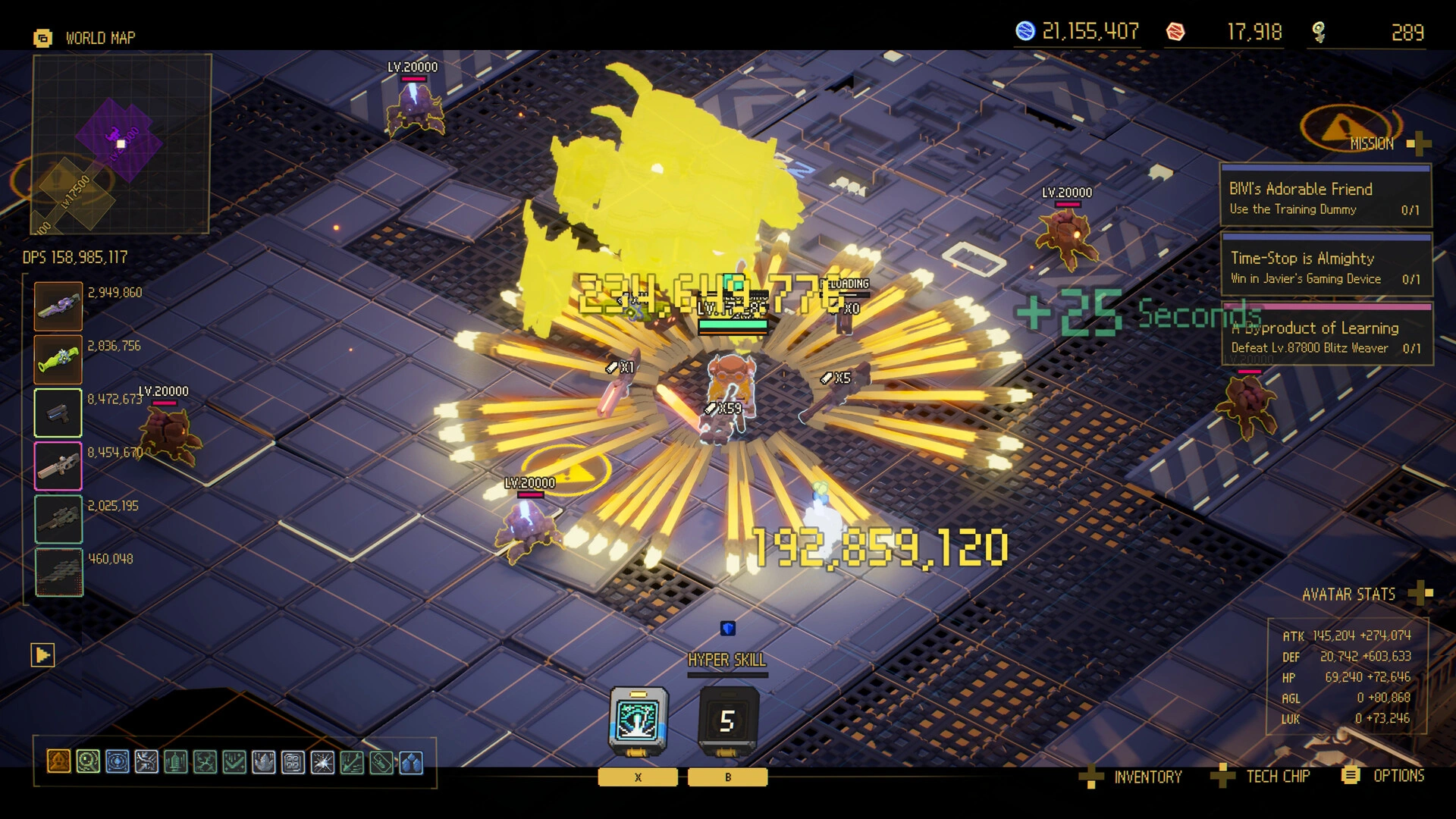
Movement is controlled directly, yet weapons attack automatically on cooldowns. Swords, cannons, guns, drones, and stranger improvisations orbit the chosen avatar, gradually transforming each room into a storm of explosions and projectiles. Dashing consumes stamina while the clock is running, but frozen time removes that limitation, letting the player cross dangerous spaces without wasting precious seconds.
Restarting the clock triggers the avatar’s signature move. The Chrono Child damages nearby enemies, creating an incentive to freeze time while surrounded and restart it from an aggressive position. Blade Blossom converts the same action into a fast katana strike capable of cutting through a crowded room. Upgraded avatars later gain Hyper Skills, stronger forms of these attacks that can erase enemies when the surrounding build supports them.
That distinction matters because mechanical skill alone cannot rescue a weak setup. A player can dodge cleanly and position carefully, yet low damage will allow the timer to expire during a boss fight. Tech Chips, temporary enhancements, equipment bonuses, and weapon combinations decide how quickly each room collapses. Elite enemies known as Unbeatables can restore small amounts of time, turning their health bars into calculated risks. Spending ten seconds killing one may earn enough time to continue, or consume the run.
The closest comparison is still Vampire Survivors, but the emotional rhythm is different. Survival there comes from holding ground until the clock completes its work. Here, remaining still feels like surrender.
The Bunker Grows
Every failed run returns the Chrono Child to a damaged bunker outside normal time. Rescuing colleagues gradually repopulates this space and opens new systems. Gabriela improves permanent abilities. Seis sells equipment, weapons, and heavier tools such as a bazooka. Other survivors expand inventory capacity, starting modifiers, gadgets, armor choices, and avatar development.

This structure gives the rescue missions mechanical weight. A colleague is rarely a decorative addition to the hub. Saving one often provides the exact upgrade category needed to overcome the next progression wall. The game creates a reliable rhythm: reach an apparently impossible room, complete a rescue objective elsewhere, unlock another system, and return stronger.
The numerical growth is intentionally excessive. Levels and damage values that appear absurd during the opening hours soon become routine, drawing from Japanese inflation RPGs and the escalating power fantasies of games such as Disgaea. Gear rises through familiar rarity tiers, with red unique equipment forming six-piece sets that can reshape an entire run. A coordinated set may improve time recovery, raise damage multipliers, or turn an underperforming avatar into a room-clearing machine.
Avatars provide another reason to experiment. The Golden Gunslinger favors ranged attacks, Blade Blossom excels at close-range clearing, and the Chrono Child offers a balanced introduction to time manipulation. Each receives separate skills, Hyper Skills, and Tech Chips. The range of combinations supports careful specialization, including builds that sacrifice Time Stop for bonuses elsewhere.
The story supporting these systems is less developed. Anime-style portraits give the survivors distinct personalities, yet predictable twists and awkwardly translated lines keep their relationships from carrying much emotional force. Optional bunker conversations frequently offer chatter without changing the mission or character arc.
Running the Same Hallways
Flyway Games uses preset rooms rather than relying entirely on procedural layouts. Familiar spaces make experimentation readable. Returning to the same laboratory with a new avatar or equipment set provides a clear demonstration of how much stronger the character has become. A room that once consumed twenty seconds may disappear in two.
That clarity eventually turns into repetition. Runs revisit the same corridors, enemy formations, and objectives often enough that exploration loses its pull. Shortcuts help players reach advanced areas faster, yet later runs can still drag, especially when a defensive build survives everything while lacking the damage required to kill a boss. Being unable to die is less impressive after twenty minutes of stalemate.
The visual presentation creates a similar split. Blocky voxel environments work well during Time Stop, when bullets, debris, and shattered machines hang motionless beneath the cyberpunk lighting. Character portraits shown during dialogue are sharper and richer than the large-headed in-game models, making the difference between the two styles difficult to ignore.
Enemy variety relies heavily on robots, with spiders and other creatures providing occasional interruptions. Dense effects can obscure incoming attacks and cause brief performance drops during larger boss fights. Small equipment text, a crowded interface, and inconsistent menu inputs create extra friction on handheld screens.
The clock remains persuasive long after the corridors stop surprising. Every desperate revival, elite encounter, and final-second boss kill proves that Flyway Games found a sharp mechanical identity inside a crowded genre, even when the rooms surrounding that idea begin to repeat themselves.
The Review
Ascend to ZERO
Ascend to ZERO earns its place beside Vampire Survivors and Hades by making time a genuine build resource rather than a decorative gimmick. Freezing bullets, repositioning freely, and restarting the clock through avatar-specific attacks gives each run a tactical identity, while rescued colleagues and gear sets keep failure productive. Repeated rooms, thin character writing, mismatched visual styles, and crowded menus keep it from joining the genre’s strongest entries. The clock, however, is persuasive enough to make another run difficult to resist.
PROS
- Excellent Time Stop mechanic
- Deep build experimentation
- Distinct avatars and Hyper Skills
- Rewarding bunker progression
- Satisfying power growth
CONS
- Preset rooms become repetitive
- Thin, predictable story
- Conflicting character-art styles
- Crowded interface and small text