
















![Kingdom Hearts Collection [I-III] Review](https://gazettely.com/wp-content/uploads/2026/10/Kingdom-Hearts-Collection-I-III-1-360x180.webp "Kingdom Hearts Collection [I-III] Review: KHII Holds Steady as Newer Entries Fluctuate 33")







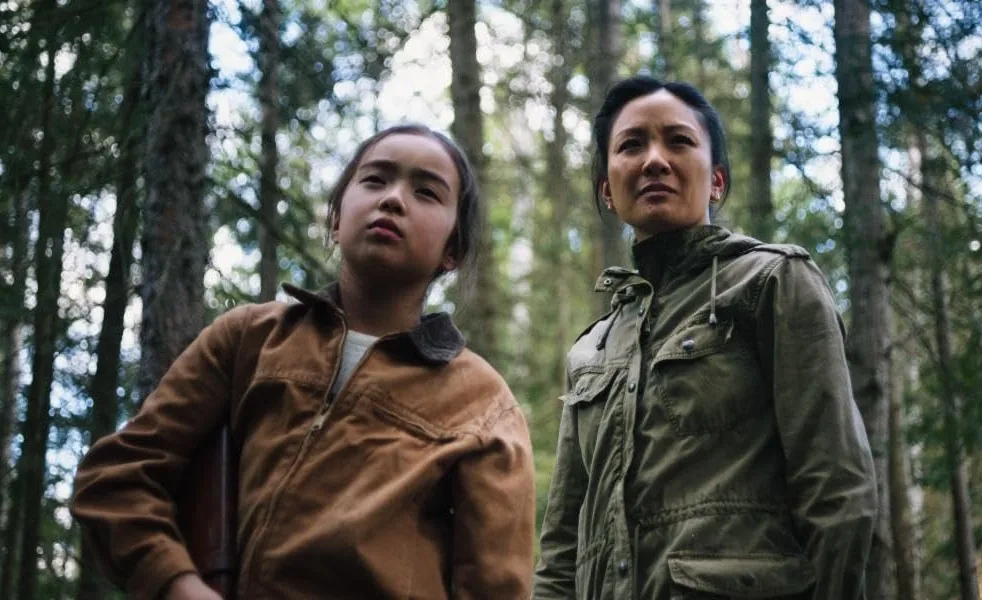

Daniel Ashford keeps his telescope controls in a bunker beneath the family property, a fitting arrangement for a man whose ambitions have gone underground without ever going away. He lives with Michelle and their children, Frankie and Maddie, in rural isolation, yet every room carries evidence that his attention is still pointed elsewhere. Mark O’Brien plays Daniel with the distracted intensity of someone who hears cosmic possibility louder than his own household.
The discovery finally rewards that obsession. A signal from a planet capable of using Dyson sphere structures suggests an intelligence far beyond humanity’s technological reach. Daniel’s supervisor, Teddy, dismisses the data, while Michelle and her estranged father, Ming, confirm it. William Woods stages these exchanges with little spectacle. Screens glow in dark rooms, faces hover near monitors, and the apparent enormity of the finding is compressed into cautious voices and withheld reactions.
That restraint suits the material. The signal is frightening because it remains abstract, an intelligence inferred from patterns rather than presented through a ship or body. The film places the unknown behind glass and beneath soil. Its menace is architectural.
A Marriage Under Observation
Michelle understands the discovery faster than Daniel understands its consequences. Constance Wu gives her a measured severity that can turn into alarm with a slight pause. When she studies the data beside Daniel, their shared excitement briefly restores the partnership they had before parenthood, resentment, and professional abandonment redrew the household. Their chemistry is strongest in that temporary return to intellectual intimacy.
The ethical split follows quickly. Daniel sees confirmation of extraterrestrial life as a gift owed to civilization. Michelle sees a destabilizing fact that institutions will weaponize and frightened people will misunderstand. His decision to email the report to Teddy without her consent turns a scientific debate into a domestic betrayal. He has chosen recognition over trust again.
Woods ties this choice to Michelle’s estrangement from Ming, another scientist whose work displaced his family. Daniel risks becoming the same silhouette. The parallel is stated plainly, but Wu and O’Brien give it texture. Her anger carries old exhaustion. His remorse arrives late and remains mixed with pride.
When drones descend and Daniel is briefly separated from the others, Michelle’s relieved sigh exposes the bond beneath the argument. The film does not pretend that affection corrects selfishness. It simply lets both occupy the frame.
Empty Roads, Watching Machines
The blackout arrives with sharp economy. Power dies, mobile service collapses, radio signals vanish, and drones gather above the property. Woods avoids crowds and burning skylines, using abandoned roads, handwritten fuel notices, silent buildings, and the mechanical buzz overhead. Ben Fox’s score presses hard on several of these moments, sometimes warning us before the image has earned the fear.
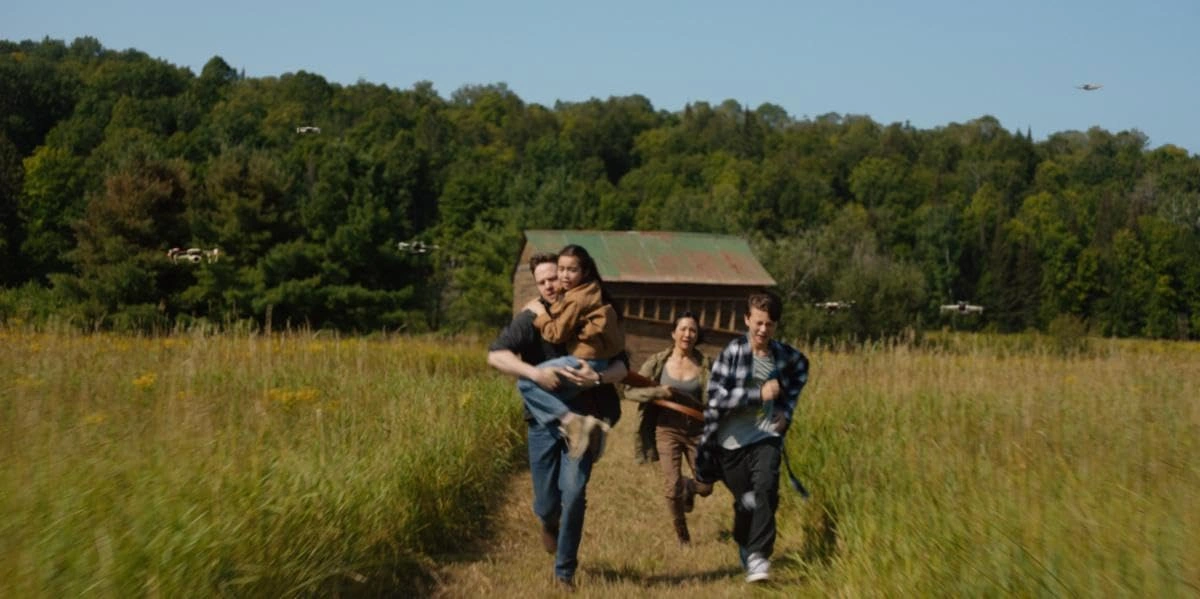
The family’s escape offers the film its clearest visual grammar. Wide rural frames make their vehicle look exposed, while tighter interiors place four intelligent people inside a shrinking box. Observation balloons hang above the landscape like pale, patient eyes. The camera rarely adopts the pursuer’s viewpoint, which keeps the threat uncertain. Surveillance exists everywhere without acquiring a face.
That uncertainty weakens once the scale of the crisis demands explanation. Soldiers are said to be ordering people indoors, fuel is scarce, and infrastructure appears to be failing across a large region. Little of that collapse reaches the screen. The road-trip geography stays vague, and the family moves through spaces that feel abandoned for production convenience rather than emptied by social panic.
Their competence creates another problem. Michelle’s survival training, the children’s practical intelligence, and Daniel’s technical skill let them solve obstacles with remarkable speed. Frankie and Maddie are refreshing because they never become reckless plot devices, yet the family begins to resemble a prepared unit operating inside a crisis designed for them. The shadows promise chaos. The screenplay keeps handing out flashlights.
The Stranger at the Diner
The stop at Sam’s diner supplies the human danger missing from the wider collapse. William Fichtner’s presence immediately alters the temperature of the room. Sam offers food and shelter, but his guarded posture and deliberate speech make hospitality feel conditional. Woods uses the audience’s suspicion of Fichtner’s screen persona as part of the scene’s tension, a slightly unfair trick that works.
His conversation with Michelle turns toward distrust, racism, and the speed with which crisis strips civility from social contact. Their exchange carries a threat that remains difficult to classify. Sam may be warning her, confessing something, or testing the limits of her gratitude. The lighting keeps faces partially shadowed, refusing the moral clarity the dialogue appears to seek.
The scene also reveals what the film lacks elsewhere. Human fear is immediate when it has a body, a voice, and a room with one visible exit. The drones remain ominous, but Sam can change his mind.
Once the mystery behind the pursuit begins to resolve, the film shifts toward family adventure. Daniel becomes present, the children contribute to each solution, and Michelle’s argument about humanity is tested by the people they meet. The eventual explanation connects technology, curiosity, and control, yet its mechanics feel smaller than the dread built around them. Woods answers the question of who is watching. The disturbing question is why this family is so easy to save.
The independent science-fiction thriller The Outer Threat debuted globally on digital video-on-demand networks on July 7, 2026. Viewers can rent or buy the film on streaming platforms including Apple TV and Amazon Vudu. The story focuses on an astrophysicist whose sudden alien discovery forces him to quickly pack up his family and run, setting off a tense escape from a mysterious pursuer that strains the boundary between reality and extreme paranoia.
Where to Watch The Outer Threat (2026) Online






Full Credits
Title: The Outer Threat
Distributor: Quiver Distribution, Apple TV, Amazon Vudu
Release date: July 7, 2026
Running time: 95 minutes
Director: William Woods
Writers: William Woods
Producers and Executive Producers: Maddy Falle, Albert Shin, Allison White
Cast: Constance Wu, Mark O’Brien, William Fichtner, Callista Crowe, Isaac Smelcer-Zhang, Oscar Hsu, Murray Furrow, Stephanie Aubertin
The Review
The Outer Threat
The Outer Threat finds its sharpest menace in restraint: empty roads, dead signals, and drones watching a family whose intelligence often protects them too efficiently. William Woods gives the science credible weight, while Constance Wu and Mark O’Brien turn an extraterrestrial discovery into a dispute about trust, parenthood, and consent. Yet the unseen collapse remains too abstract, and the final reveal shrinks the dread rather than deepening it. The film’s shadows imply a harsher moral universe than its screenplay can fully enter.
PROS
- Strong central performances
- Credible speculative science
- Economical visual tension
- Thoughtful ethical conflict
- Effective drone sound design
CONS
- Unclear crisis geography
- Limited sense of public collapse
- Overly capable protagonists
- Underused diner encounter
- Deflating final reveal