


















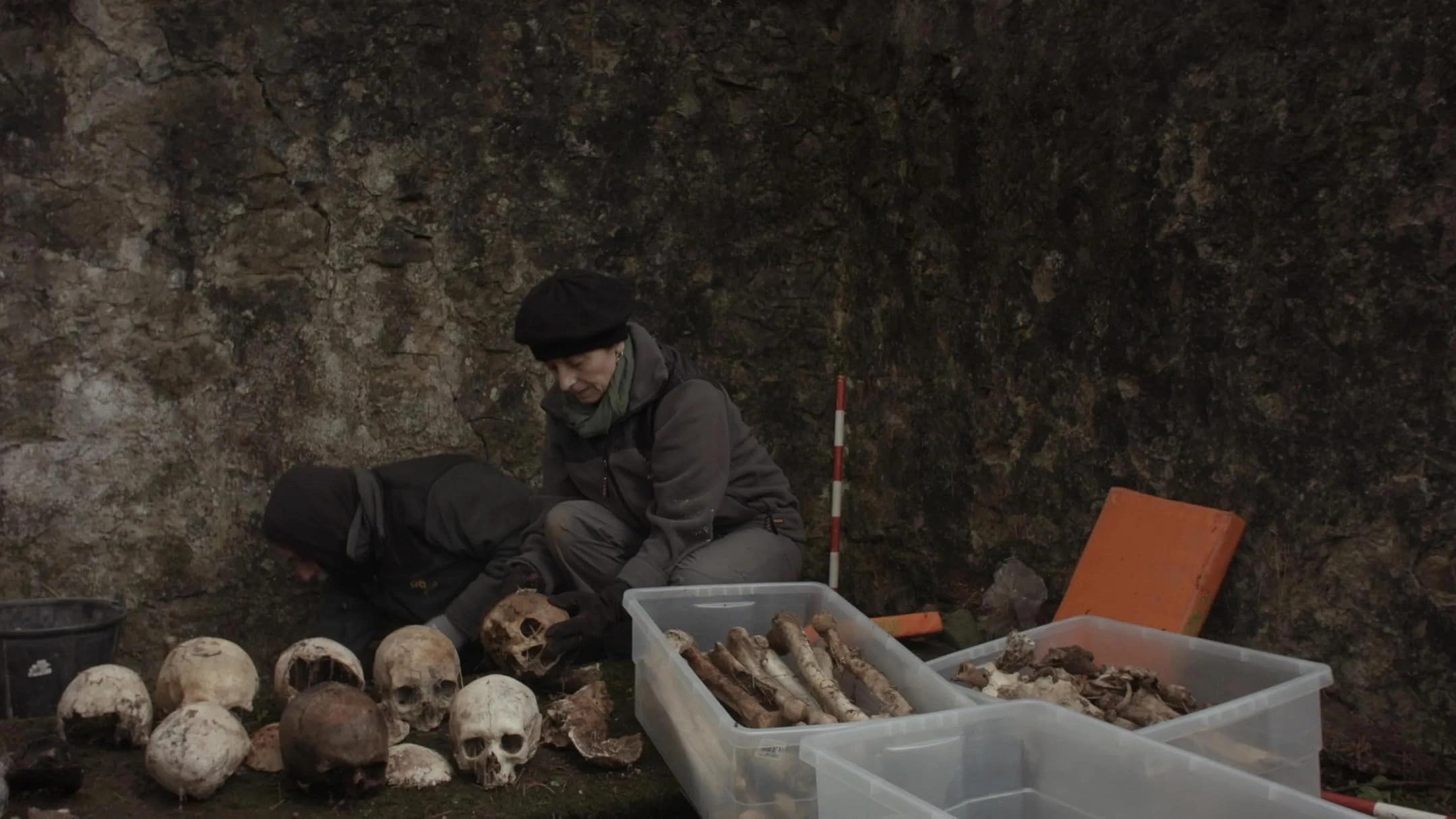

The dead beneath the Valle de los Caídos have addresses, numbers, boxes, and walls. They have almost everything except the right to return home. Manuel Correa’s Atlas of Disappearance studies the colossal memorial outside Madrid as a machine built to convert human remains into silence. Beneath its 150-meter cross lie 33,849 bodies, over 13,000 recorded as unknown.
Many belong to Republicans executed during the Francoist terror, removed from mass graves and transferred without the permission, or sometimes the knowledge, of their families. They were carried into a monument that claimed reconciliation while preserving the authority of the regime that killed them.
Correa refuses the comforting explanation that this situation survives through negligence. The blueprints tell a colder story. Ossuaries were placed behind chapels, packed with wooden crates, then sealed behind walls. Corridors restrict movement. Chambers resist entry. The architecture does not merely contain the dead. It prevents contact between the living and those they mourn. A burial can become a place. A wall permits only distance.
That distinction gives the documentary its moral gravity. The monument has held these remains in a state somewhere between presence and disappearance. Families know where their relatives may be, yet cannot touch them, verify them, hold a vigil, or carry them to a family grave. The body exists, hidden under the stone of the executioner’s memorial, and still remains absent.
Inventory of the Dead
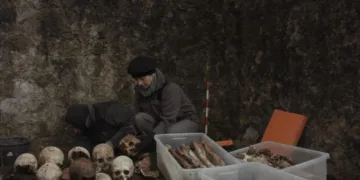
The film traces the transfer operation that began in 1959, when remains from mass graves across Spain were packed into crates and transported to the Valley. The process appears in surviving registers as a nightmare of bureaucratic language: municipalities, dates, numbers, misspelled names, confused origins. Some boxes contain several people. Some records contradict one another. Individual lives dissolve into poor handwriting and administrative shorthand. This disorder was not innocent. It completed the violence.
Killing takes a life. Erasing the route back to the body attacks everyone who survives it. Correa’s archival footage shows the machinery of Francoist power, while present-day testimony reveals the long duration of its damage. The dictatorship ended, yet the grief it organized continued through locked doors, missing documents, delayed permissions, and polite institutional deferrals.
One daughter speaks of her father, Republican soldier Rafael Abril. She promised her mother, who lived to 101, that she would continue searching for his remains. The promise has passed through years that the state allowed to accumulate. Her words carry no theatrical flourish. Their force comes from repetition: another request, another delay, another generation asked to wait.
The inscription at the entrance, “Fallen for God, from 1936 to 1939,” exposes the cruelty of imposed language. It gathers victims and executioners beneath one sacred phrase, dissolving the history of how each person died. The regime took possession of their bodies, then attempted to take possession of their meaning. The families refuse that second death.
Maps Against Silence
Correa responds to this architecture of concealment with another kind of architecture. Through the Office of Documentary Research, architects, geographers, activists, and forensic specialists digitize the Burial Register Book, map the 506 mass graves connected to the Valley, reconstruct transfer routes, and create three-dimensional models of the crypts.
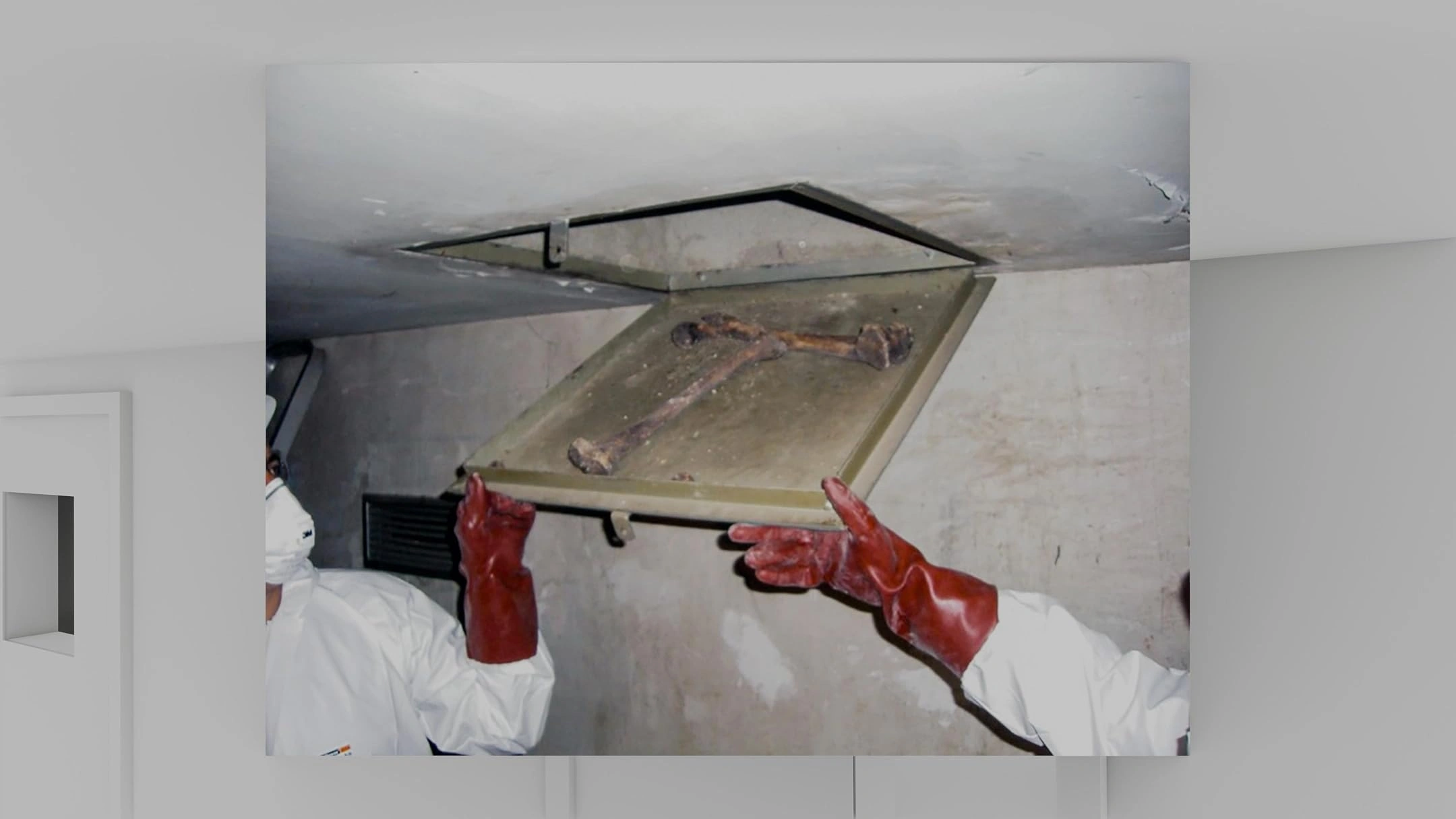
The work is clinical. Screens fill with coordinates, spatial hypotheses, architectural layers, and possible box locations. Mathematical topology assigns several potential positions to remains that cannot be located through surviving records alone.
The precision feels almost merciless beside the families’ testimonies, yet the contrast defines the film’s deepest tension. Emotion knows who is missing. Data must prove where the missing person went. A name becomes a line in a register. The line becomes a route. The route enters a wall.
This process reverses the dictatorship’s design one fragment at a time. Francoism gathered scattered remains into an indistinct mass. The Atlas separates them again through names, dates, origins, and probable locations. Technology does not replace mourning here. It gives mourning a direction.
Correa avoids presenting the forensic work as an easy rescue. Some chambers were sealed after being filled. Water has damaged parts of the structure. Crates may have collapsed, and remains from several people may have merged. Every recovered fact reveals another uncertainty. The specialists can map the shape of disappearance, yet identification still depends on entering spaces built to deny entry. The closer the map comes to completion, the darker the unknown spaces appear.
Water in the Walls
The documentary’s form mirrors its investigation. Archival images, transport records, blueprints, digital renderings, and contemporary interviews do not sit beside one another as separate forms of evidence. Correa edits them into a chain. A number leads to a box. A box leads to an ossuary. An ossuary leads to a family that has waited decades for a door to open.
Near the end, photographs of the disappeared restore faces to people reduced by the state to quantities. They look back from another Spain, unaware of the monument that will one day contain them. The images deny the anonymity imposed by the registers. Each face interrupts the mass. Then water appears, seeping through cracks inside the Valley.
It is tempting to read the leaking structure as history taking revenge on stone. Correa permits no such comfort. Water threatens the evidence, the remains, and the fragile possibility of identification. The monument is decaying, yet its collapse would not free the dead. It might bury them again. This is the terrible urgency of Atlas of Disappearance. Time weakens the prison and its prisoners together. Walls fracture. Records fade. Bones deteriorate. Families age. Still, the names are spoken.
Atlas of Disappearance premiered at the CPH:DOX film festival on March 11, 2026, and is available through international festival circuits and specialized documentary distributors. The documentary follows families searching for the remains of loved ones who vanished during the Franco regime, utilizing modern forensic architecture and digital archives to investigate state violence.
Full Credits
Title: Atlas of Disappearance
Distributor: Agencia Audiovisual Freak, Artefacto Films
Release date: March 11, 2026
Running time: 84 minutes
Director: Manuel Correa
Writers: Manuel Correa
Producers and Executive Producers: Anna Giralt Gris, Jorge Caballero Ramos, Emil Olsen
Director of Photography (Cinematographer): Manuel Correa
Editors: Ivan Guarnizo, Manuel Correa
Composer: Simón Mesa Giraldo
The Review
Atlas of Disappearance
Atlas of Disappearance turns architecture into evidence and absence into a physical prison. Manuel Correa’s maps, blueprints, and digital models reveal how Francoism extended its violence beyond death, sealing bodies inside a monument built to outlast the families seeking them. The documentary’s restraint gives the testimonies room to ache, especially when Rafael Abril’s daughter carries a promise across generations. Its forensic passages can feel dense, yet their cold precision serves the horror. The stone is failing. Memory remains awake.
PROS
- Powerful family testimonies
- Rigorous architectural investigation
- Haunting archival contrasts
- Precise political argument
- Unforgettable final imagery
CONS
- Dense technical passages
- Limited access to the crypt
- Some historical details move quickly