




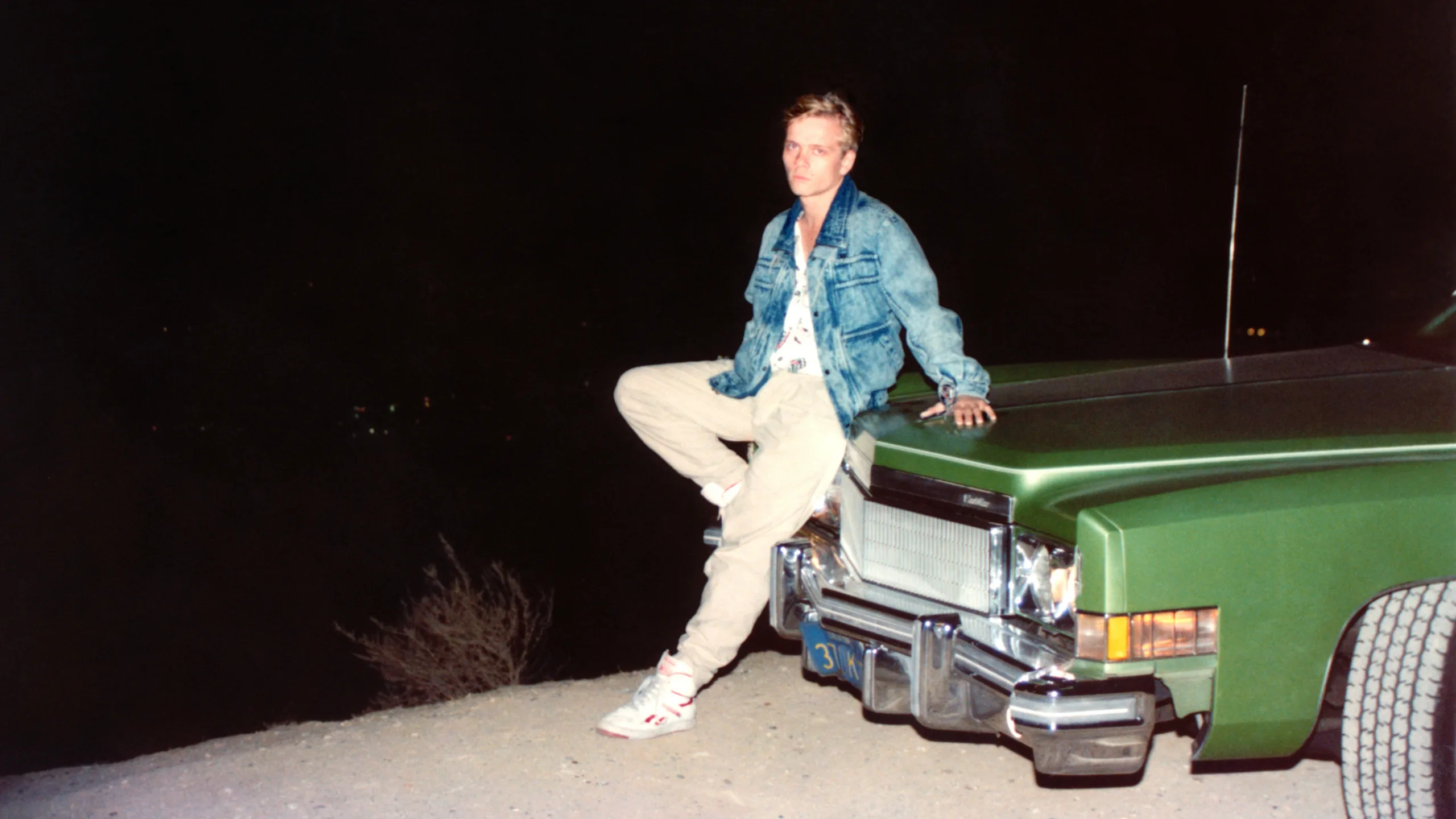
Rachel Mason builds her cold-case documentary around an inconvenience to the standard true-crime script: the LAPD detectives did not simply forget William Arnold Newton. Newton, a 25-year-old occasional gay porn performer known as Billy London, vanished in October 1990 after telling his flatmates he was going to rent a movie. Witnesses later placed him at Rage, a West Hollywood nightclub, where he had been using methamphetamine. His severed head and feet were soon found in a dumpster near La Brea and Santa Monica Boulevard. His torso never surfaced.
That discovery gives My Brother’s Killer an immediate hook, but Mason resists arranging every institution into the usual lineup of villains. Detectives Wendi Berndt and John Lamberti remained troubled by the case, and Lamberti eventually reopened it. The system failed to solve the murder for decades, yet the film finds individual officers who kept carrying it. True crime likes clean moral assignments. Mason keeps returning the paperwork.
Her link to the case comes through Circus of Books, her earlier film about the adult bookstore run by her parents. That connection gives her access to West Hollywood’s surviving witnesses without turning her into the lead investigator of her own movie. She appears when the search needs a guide, then steps aside when someone else has the better evidence.
A Life Recovered in Fragments
The film reconstructs Newton through scattered testimony, clips from films such as Imperfect Strangers and Head of the Class, and his poem “A Piece of Me.” He grew up amid instability in the Midwest, changed homes and schools repeatedly, dropped out, and headed west after rejection from a homophobic father. In Los Angeles, pornography offered work and a place inside a community, though Newton reportedly preferred hair, makeup, painting, and poetry to performing.
 Mason’s archival footage gives the district a clear physical identity. Bars, adult businesses, crowded pavements, and neon signs form a refuge with danger built into its street plan. Gay men were living through AIDS, routine harassment, violent attacks, addiction, and the risks attached to cruising. When Newton disappeared, the assumption that he had entered the wrong car was grimly plausible.
The documentary is less successful when it tries to turn those facts into a full character. Chi Chi LaRue, Phil Tarley, former partner Marc Rabins, and surviving relatives supply pieces, but Newton’s temperament remains hard to locate. The poem offers intimacy that the interviews rarely match. The structure can identify where he went, what work he did, and whom he knew. It has far less access to how he occupied a room.
Suspects, Spreadsheets, and a Working Spine
The investigation gains shape through a sequence of plausible leads. Rabins, who performed as David Rey, becomes an obvious suspect because of his turbulent relationship with Newton. Jeffrey Dahmer briefly enters the case because the dismemberment resembles his crimes, until geography kills that theory. Each branch is given enough time to register without swallowing the film.
Podcasters Christopher Rice and Eric Shaw Quinn help return attention to the murder, while social worker Clark Williams becomes the documentary’s sharpest investigator. Williams grew up in the same Wisconsin region as Newton and uses that connection to reconstruct the victim’s early life. His research links names, places, and histories that had remained separate for years. Mason lets interviews produce documents, documents produce names, and names reopen old questions.
The method is conventional: archival footage, talking heads, suspense cues, delayed information, and carefully timed reversals. The editing keeps those tools under control. A spreadsheet listing men from Newton’s circle who died young from AIDS, overdoses, or violence changes the scale without interrupting the case. One murder remains the narrative spine, but the document around it is crowded with absences.
The Answer and Its Missing Depth
The final identification works because the film has quietly built a parallel between Newton and the man who killed him. Both carried formative trauma, sexual shame, and links to pornography. The killer’s life split in a lethal direction: he moved among white-supremacist skinheads and attacked gay men while concealing his own desires. When Mason interviews him in prison, the scene refuses theatrical confrontation. His presence supplies legal clarity and very little human clarity.
A murderer need not receive a polished psychological profile simply because the camera has reached him. The problem is that the film has raised internalized homophobia as its strongest explanatory idea, then gives the subject only brief treatment. Author David McConnell appears to discuss men whose self-hatred turns outward, but the documentary moves on before that framework can reshape the earlier material. The adult-film world receives similarly light examination after witnesses hint at exploitation, drugs, unstable work, and dangerous personalities.
The title creates another structural wobble. Newton’s half-sister Michele Oliver matters to the search for closure, yet she does not provide the film’s governing viewpoint. The investigation belongs to Mason, the detectives, the podcasters, and Williams in shifting proportions. That collaborative design keeps the case moving, though it leaves the promised family perspective at the edge of the frame.
Mason returns to Newton’s poem after the killer has been exposed. His words briefly restore the interior voice that the interviews struggled to recover. Then the old absence takes over again: the murderer has a name, Newton’s torso is still missing, and the person who wrote the poem remains scattered across other people’s memories.
My Brother’s Killer premiered at the South by Southwest Film & TV Festival on March 13, 2026, and can be found through festival screenings and independent distribution channels. The documentary explores the decades-old cold case homicide of a gay adult film performer in West Hollywood and the community’s relentless efforts to uncover the truth.
Full Credits
Title: My Brother’s Killer
Distributor: FutureClown Productions, Submarine Entertainment, UTA
Release date: March 13, 2026
Running time: 95 minutes
Director: Rachel Mason
Writers: Rachel Mason, Dion Labriola, James Cude
Producers and Executive Producers: Dion Labriola, Rachel Mason, Julee Metz, Penelope Spheeris, Josh Braun, Ben Braun, James Cude
Cast: Christopher Rice, Eric Shaw Quinn, Clark Williams, ChiChi LaRue, Wendi Berndt, Krystal DeLight, Phil St. John, Sabin Grey
Director of Photography (Cinematographer): Michael Pessah
Editors: Dion Labriola
Composer: Bruno Coviello
The Review
My Brother’s Killer
My Brother’s Killer works best once its investigation stops circling suspects and begins connecting William Newton’s death to the violence surrounding gay life in 1990. Rachel Mason handles the case with restraint, while detectives, podcasters, and Clark Williams give the search a clear dramatic spine. The killer’s exposure carries real force, yet the documentary leaves Newton himself underwritten and treats internalized homophobia, pornography, and the era’s wider losses too briefly. It solves the crime with greater precision than it reconstructs the person.
PROS
- Strong investigative structure
- Startling late revelation
- Respectful true-crime approach
- Valuable queer historical context
CONS
- Newton remains indistinct
- Thin industry examination
- Themes lack depth
- Misleading title