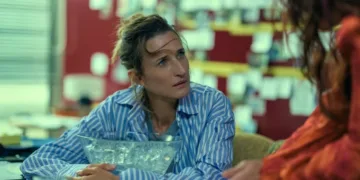














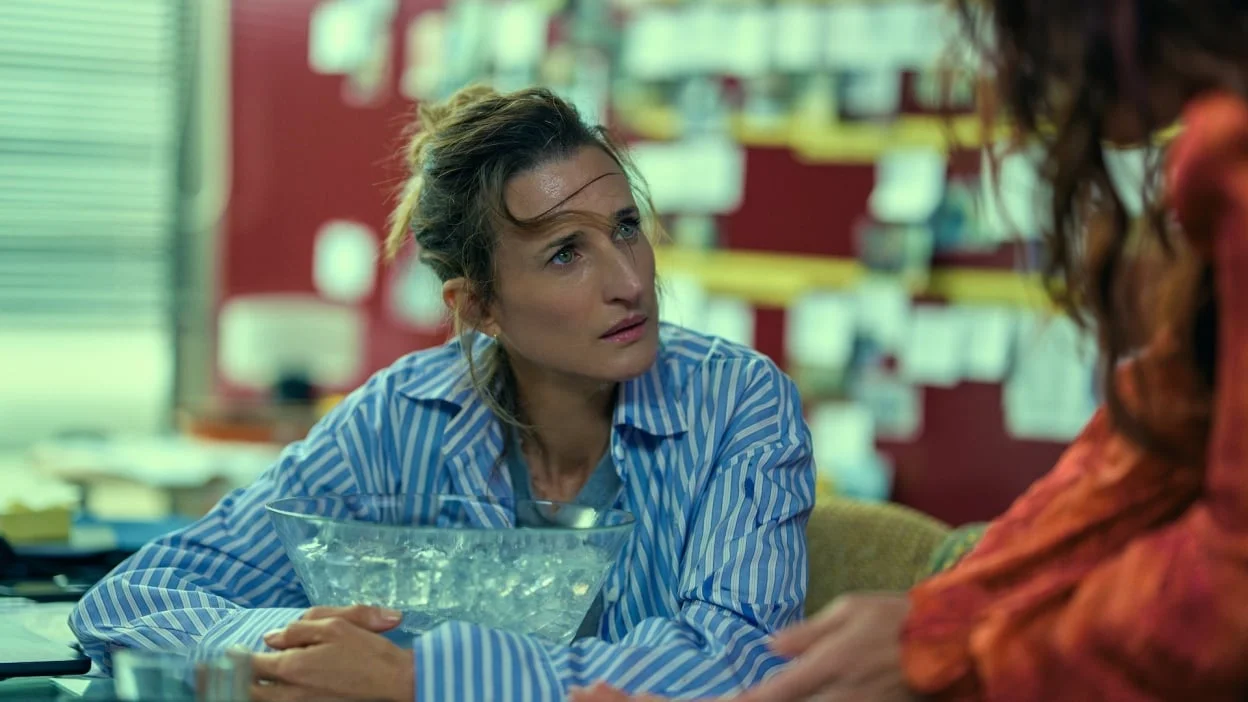

Andréa Martel used to spend her days cleaning up other people’s disasters. Directing her first feature teaches her how pleasant it was to stand on the safe side of the fire. That reversal gives Call My Agent! The Movie its strongest idea. Six years after Agence Samuel Kerry collapsed, the former ASK staff have scattered across the French entertainment industry.
Mathias has founded another agency with his daughter Camille. Noémie, once his assistant, has become a successful television producer and his wife. Gabriel remains stuck at Starmédia. Hervé, now acting, supplies a direct-to-camera recap that efficiently reconnects the pieces, even if the device has all the elegance of somebody explaining a family tree at dinner.
Andréa has made the most dramatic change. She has exchanged representation for writing and directing, preparing a revenge thriller called The Fugitive with Laetitia Casta. Yet Émilie Noblet’s film quickly restores the old comic equation: entertainment work means controlling egos, money, schedules, grudges, and people convinced their emergency is civilization’s emergency.
French comedy has a long appetite for professional farce, where bureaucracy becomes theater and social status becomes ammunition. The original series translated that tradition into modern celebrity culture. The movie keeps the machinery intact, even after removing the agency itself.
The Director Needs an Agent
Andréa’s production deteriorates through exactly the kinds of crises she once handled for clients. Laurent Lafitte, playing himself, is meant to star, but Mathias represents him and still carries enough resentment toward Andréa to make cooperation difficult. Their feud turns casting and scheduling into extensions of an old workplace war.
The smartest decision is refusing to rebuild ASK. Putting everyone behind identical desks again would have reduced six years of change to nostalgia. Instead, their new positions alter their old relationships. Noémie entering the production as a producer is especially effective because her newfound authority changes how she interacts with Andréa and Mathias.
Her meeting with George Clooney provides the broadest demonstration. Clooney initially seems like the dream solution until Noémie casually insults The Monuments Men, unaware that she is criticizing the direction of the man sitting opposite her. Laure Calamy plays the resulting collapse with terrific escalating panic. Clooney’s participation works because the joke depends on his identity instead of simply displaying it.
Eva Longoria gets another good industry gag when she suggests transforming Andréa’s grim survival revenge story into a romantic Parisian fantasy. Wes Anderson disrupts events without appearing. Gérard Depardieu becomes material for a pointed throwaway jab. The script by Fanny Herrero and Lison Daniel treats international celebrity as part of French cinema’s increasingly global ecosystem, where prestige, financing, streaming, and American recognition continually rub against local artistic ambitions.
Fame Moves Faster Than the Jokes
Herrero’s writing still thrives on speed. Conversations become small power struggles, with characters interrupting, withholding information, correcting each other, then changing strategy halfway through a sentence. Camille Cottin remains ideal for this rhythm. Andréa’s irritation often arrives through a tightened expression before the dialogue catches up.
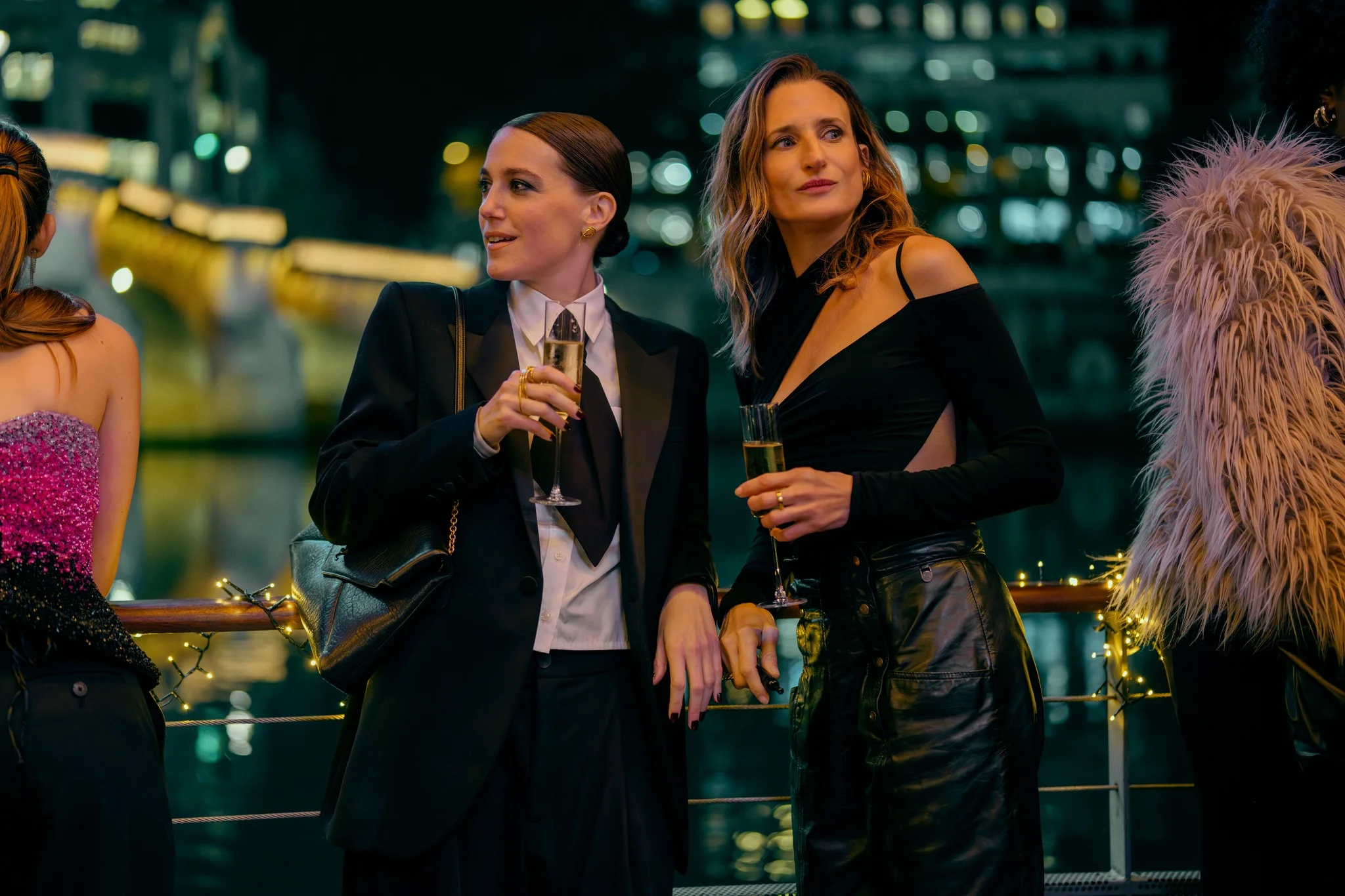
Calamy attacks scenes differently. Noémie operates through nervous momentum, and pairing her with Cottin creates a comic mismatch between Andréa’s attempt at control and Noémie’s instinct to fill every silence. Vincent Macaigne, Laurent Lafitte, and Fanny Sidney also understand the required register. They play absurd situations with enough sincerity that the joke can emerge without being announced. The film sometimes announces it anyway.
Music appears so frequently that scenes can feel accompanied by emotional instructions. Comic cues underline jokes, tense cues prepare conflict, and sentimental passages receive corresponding signals. The editing creates a similar problem. Rapid cutting suits the characters’ frantic professional lives, yet Noblet occasionally rushes through reactions that needed another second to become funny.
That pressure reflects contemporary streaming aesthetics far less gracefully than the series’ dialogue does. French verbal comedy depends heavily on rhythm, embarrassment, and the discomfort of a pause. Cutting too quickly can erase the very social awkwardness the writing has constructed.
French Television in Movie Clothes
Aurélien Marra shoots the film in glossy widescreen, giving Andréa’s production and Parisian locations a finish far removed from ASK’s crowded offices. The images are clean, bright, and expensive-looking. They can also feel strangely anonymous.
This matters because Call My Agent! always derived part of its identity from proximity. Agents squeezed into offices, corridors, restaurants, cars, and dressing rooms while attempting to keep private disasters from becoming public ones. The movie gives them wider frames, yet its best scenes still involve people cornering one another in rooms and negotiating through barely concealed hostility.
The feature format cannot give every returning character equal space. Gabriel receives less development than Andréa, Mathias, or Noémie, and several familiar faces function primarily as pieces in the eventual effort to rescue Andréa’s collapsing shoot. Still, the catastrophe succeeds as a reunion mechanism because the characters arrive carrying lives that continued while the audience was away.
That distinction separates this French return from many international franchise revivals built around restoring an old arrangement. Here, time has altered status, loyalties, and careers. The glossy Netflix surface may smooth away some of the series’ local texture, but the arguments remain unmistakably its own: actors want attention, agents want leverage, directors want control, producers want the day to finish, and everyone thinks somebody else is being unreasonable.
Call My Agent! The Movie premieres on Netflix on September 10, 2026. The comedy film follows the beloved Parisian talent agents as they reunite to tackle a fresh wave of high-stakes celebrity crises and agency chaos.
Where to Watch Call My Agent! The Movie (2026) Online


Full Credits
Title: Call My Agent! The Movie
Distributor: Netflix
Release date: September 10, 2026
Running time: 1 hour 57 minutes
Director: Émilie Noblet
Cast: Camille Cottin, Laure Calamy, Thibault de Montalembert, Grégory Montel, Nicolas Maury, Fanny Sidney, Liliane Rovere
Director of Photography (Cinematographer): Aurélien Marra
Editors: Clemence Carre
The Review
Call My Agent! The Movie
Call My Agent! The Movie understands that its French show-business satire travels best through character rather than celebrity spectacle. Andréa’s disastrous transition from agent to director gives the reunion a sharp comic reversal, while Camille Cottin and Laure Calamy make every strained exchange feel lived-in. The glossy photography, insistent score, and frantic editing occasionally flatten the distinctly Parisian personality that once gave the series its texture. George Clooney supplies an amusing detour, yet the former ASK crew remain the real attraction. For longtime viewers, the film feels like a welcome return with a slightly shinier, less intimate surface.
PROS
- Cottin and Calamy’s comic chemistry
- Andréa’s smart role reversal
- Strong workplace satire
- Believable character progression
- Effective ensemble reunion
CONS
- Overly polished visual style
- Intrusive musical cues
- Uneven celebrity cameos
- Some underused returning characters