


















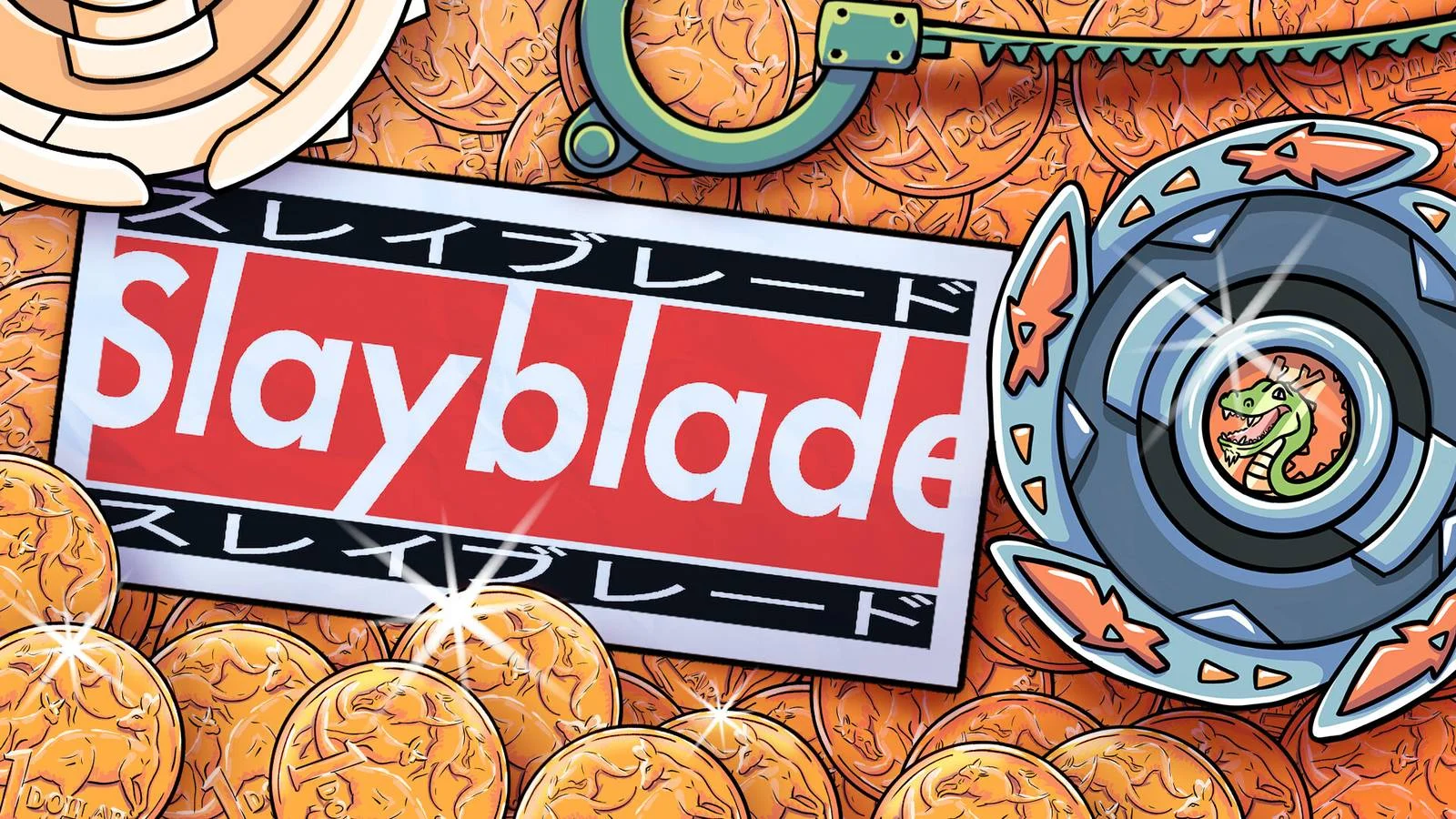

Beyblade turned an ordinary toy into miniature combat mythology, and Slayblade understands why that fantasy travelled so easily across countries in the early 2000s. Australian developers Rob Gross and Oscar Brittain, working as Henry’s House, translate that Japanese pop-cultural phenomenon into a compact roguelite where spinning tops collide in suburban arenas while electronic music rattles underneath.
The framing is intentionally thin. There is a championship to win, a small city to roam, money to earn, and a Slayblade to improve before tournament day. A slight story concerning a missing father and experiments with perpetual rotation gives the campaign some texture, yet the game treats narrative like packaging around its mechanical ritual. That choice suits its arcade instincts. The trouble arrives when the ritual stops changing.
Betting on the Spin
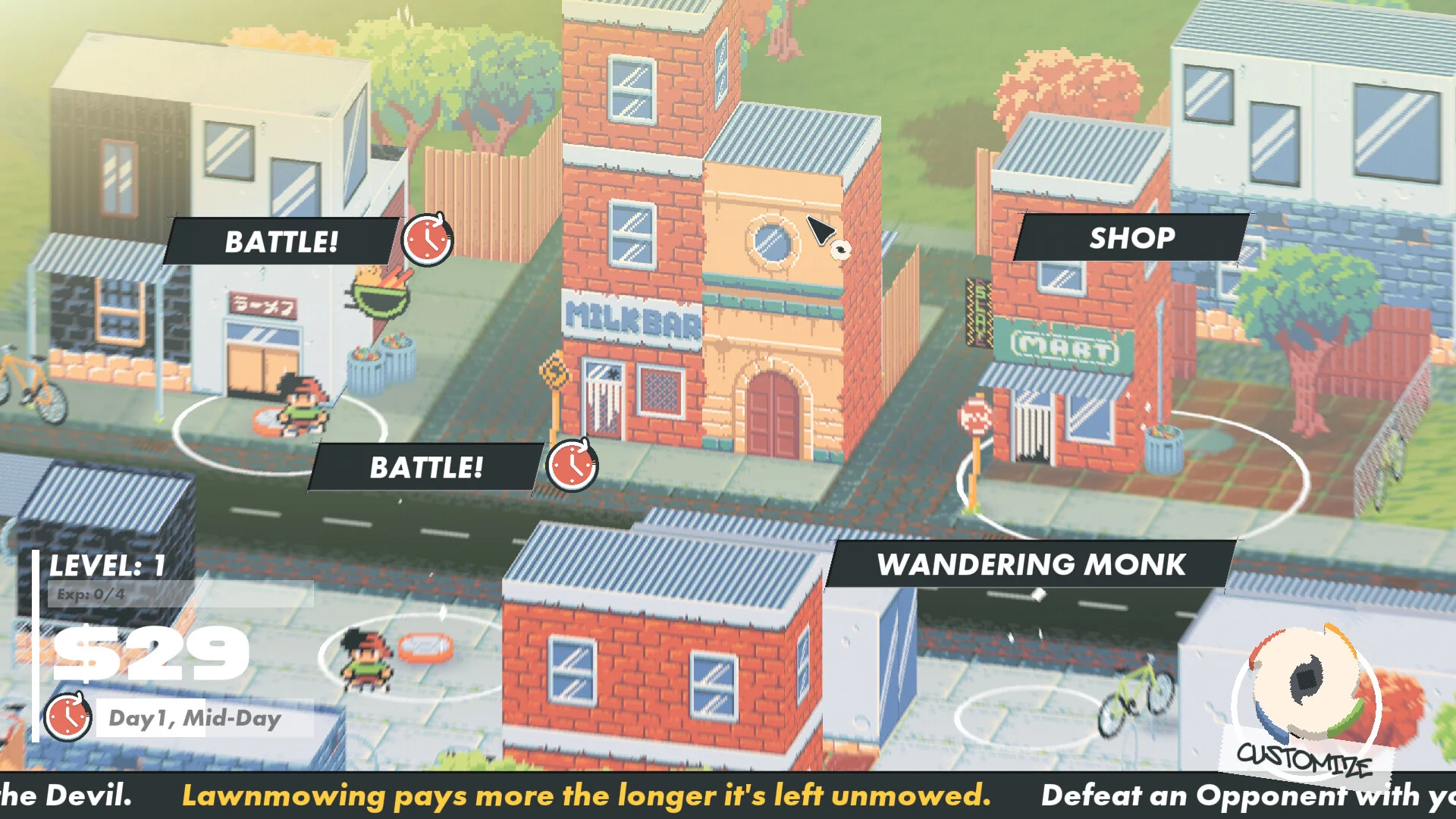
Each run divides preparation into a limited number of days. Moving around the circular town reveals fights, shops, loose cash, and odd jobs such as mowing somebody’s lawn with a weaponized spinning top. Activities consume time, while tournament entry demands that enough money survives the shopping and gambling along the way.
That economy gives Slayblade its sharpest roguelite idea. Every fight requires a wager, so losing early damages the future of the run. Cash that could have bought a stronger component disappears, leaving the next opponent harder to face. Success creates the reverse effect. One good build can generate a winning streak that quickly turns a vulnerable beginner into the local menace.
The tops themselves are assembled from interchangeable sections such as heads, bodies, and tips. Heavier components sacrifice RPM for impact, while lighter configurations favor endurance and mobility. Active abilities expand those choices further. One component can summon ghosts that slow an opponent. Another launches missiles. Some restore RPM, while particular combinations can turn a single power-up pickup into a devastating attack.
This is where Slayblade captures something the licensed Beyblade games often struggled with: the pleasure of designing a ridiculous object and then watching its physical behavior validate the idea. A high-impact build slamming an opponent across the bowl communicates its strength instantly. Numbers become movement.
Chaos Inside the Bowl
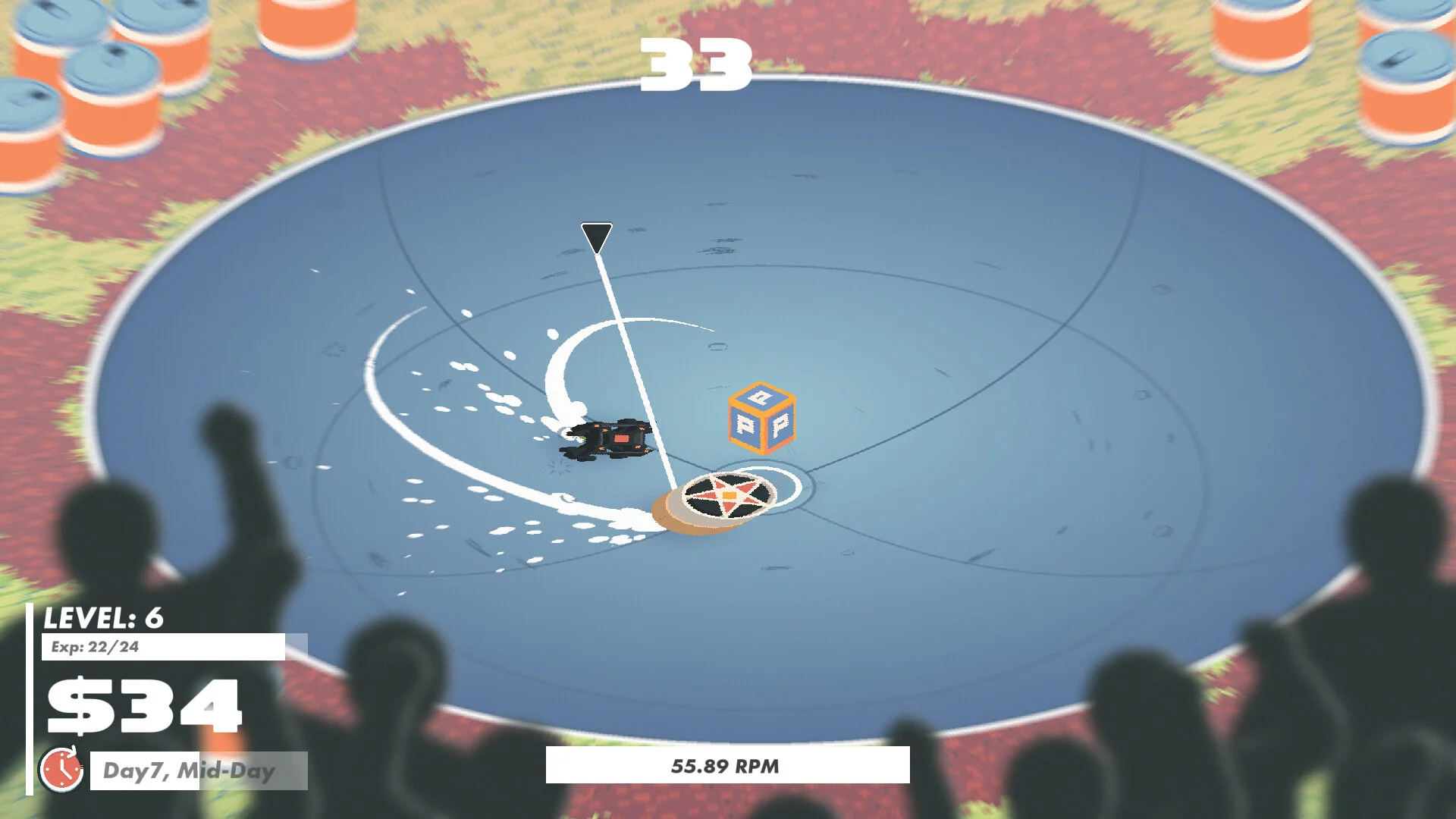
Control is extremely simple. Build speed around the arena wall, angle toward the rival top, crash into it, recover, and repeat. Power-up boxes periodically appear, activating the abilities attached to equipped parts.
Simplicity should make these encounters readable. Instead, some fights end before their systems become clear. One opponent collapses almost immediately, while another strips away RPM in seconds. Power-up placement can decide too much when a box appears beside one competitor, and arena-edge damage is communicated poorly enough that an unexpected defeat may feel arbitrary rather than instructional.
The city interface carries a similar friction. Mouse movement handles both traversal and rotation of the circular map, making tiny activity markers unnecessarily awkward to reach. The problem sounds minor until every run asks the player to repeat those movements.
Episodes add universal modifiers that introduce stranger variables. The giant dog that occasionally stomps into an arena is the funniest example and one of the cruelest. Its impact can erase most of a top’s RPM, while the disruption can send the victim flying toward the arena edge. It produces slapstick worthy of a playground argument, yet it also exposes how readily spectacle can overwhelm player control.
When the Rotation Repeats
Many roguelites create continuity by allowing failure to feed the next attempt. Slayblade takes a leaner approach. Ranking up unlocks Episodes and modifiers, while the important equipment decisions largely vanish with each run. The persistent improvement comes from understanding the system rather than accumulating permanent power.
That philosophy has respectable precedents in older arcade design, where mastery lived in the player rather than the save file. Here, however, the small number of activities and repeated tournament structure make mastery arrive quickly. Once a dependable combination is discovered, shops and the gachapon machine can often recreate something close to it. Later attempts begin resembling rehearsals.
The brevity prevents repetition from becoming exhausting. A championship can be pursued over a compact session, and matches are short enough to suit handheld play. That modest scale feels closer to a lost portable game from the Nintendo DS era than to the sprawling progression structures now associated with roguelites.
Presentation makes that comparison feel intentional. Fake Wii-era safety screens and DS-style startup imagery immediately locate the game in a specific moment of consumer technology. Pixel suburbs, bicycles, basketball courts, illustrated character portraits, and exaggerated Slayblade designs recreate the visual language of a generation that experienced Japanese anime, Western skate culture, handheld consoles, and internet-era coolness all at once.
Yoppi’s soundtrack completes the period illusion through electronic beats, drum and bass, and lo-fi textures that accelerate during combat. Even after the mechanical loop has become familiar, the music and visual identity keep the city feeling like a tiny preserved artifact from a very particular global childhood.
The Review
Slayblade
Slayblade filters Beyblade-era nostalgia through an Australian indie sensibility, replacing collectible toys with a brisk roguelite economy of bets, upgrades, and violent little collisions. The strongest moments come when a carefully weighted build meets the right power-up and an opponent’s RPM disappears in seconds. That pleasure survives clumsy navigation, poorly explained systems, severe difficulty spikes, and progression that rarely changes later runs. Its pixel suburb, playful console-era references, and Yoppi’s energetic soundtrack give the game personality long after its mechanical surprises have started repeating.
PROS
- Satisfying spinning-top combat
- Flexible part combinations
- Strong early-2000s aesthetic
- Energetic electronic soundtrack
- Compact, accessible runs
CONS
- Shallow long-term progression
- Uneven difficulty spikes
- Imprecise navigation and controls
- Repetitive run structure
- Mechanics need clearer explanations