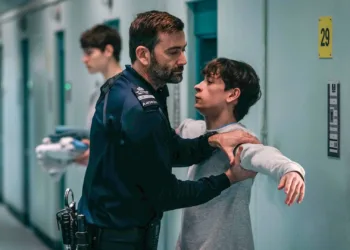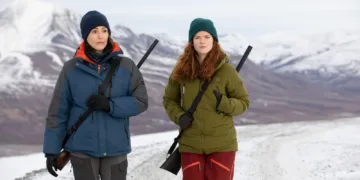












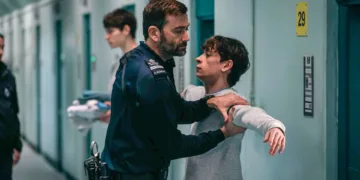










Four British operatives moving through Svalbard to extract a Chinese scientist already creates the sort of political fiction Vigil likes best: governments publicly observing rules while privately preparing to break them. The operation takes place in territory presented as demilitarised, yet both British and Russian forces are armed, covert and entirely willing to shoot at each other over Shen Jia, a researcher whose ice-core discovery appears valuable enough to reshape national energy interests.
Daniel Hodge survives the initial confrontation only to turn up dead inside the Russian enclave of Baltegrad, shot after apparently hiding in a wardrobe. The absurd detail helps. Global conflict in Vigil often depends on governments speaking in grave strategic language while individual bodies end up in painfully ordinary positions.
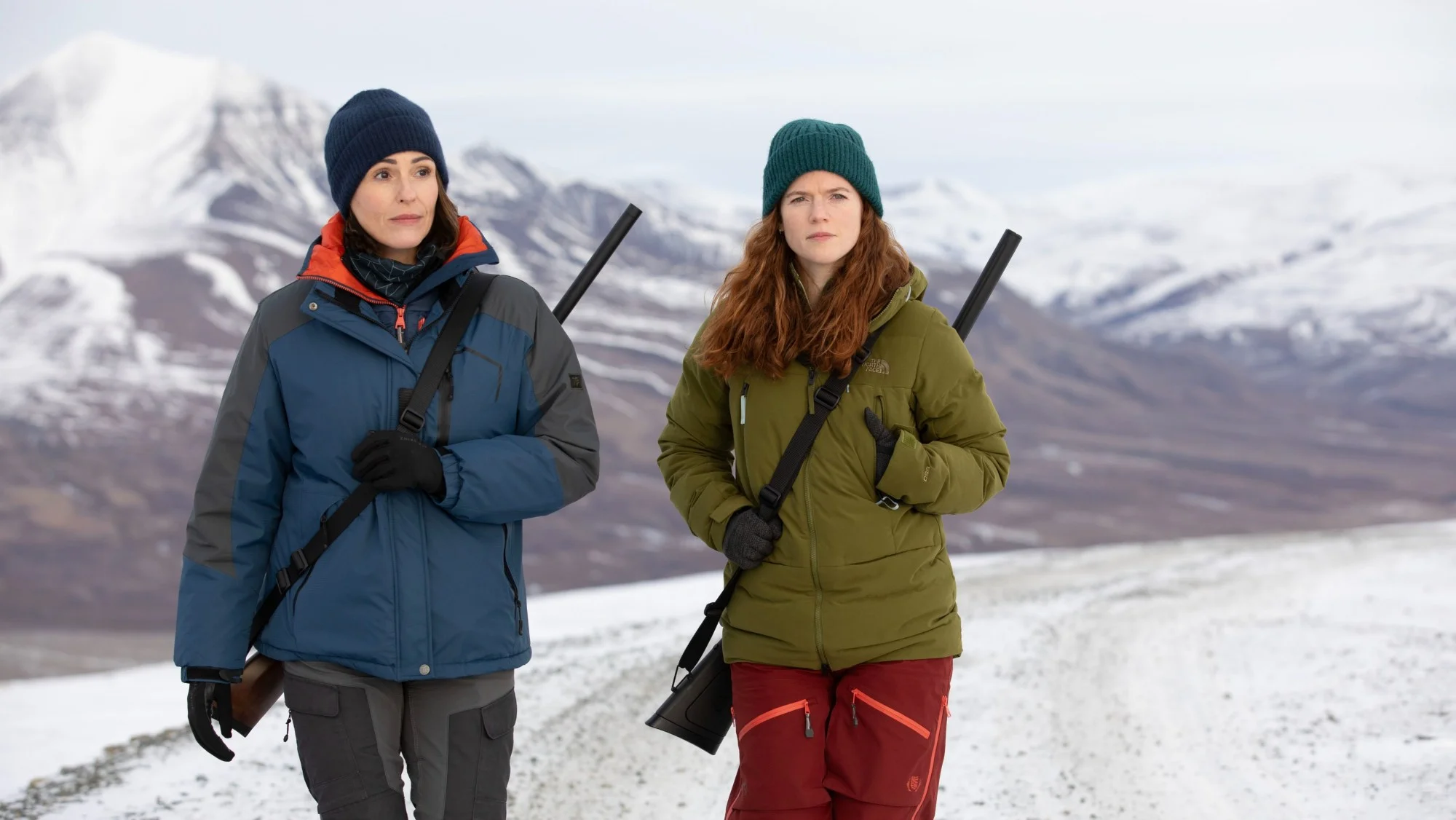
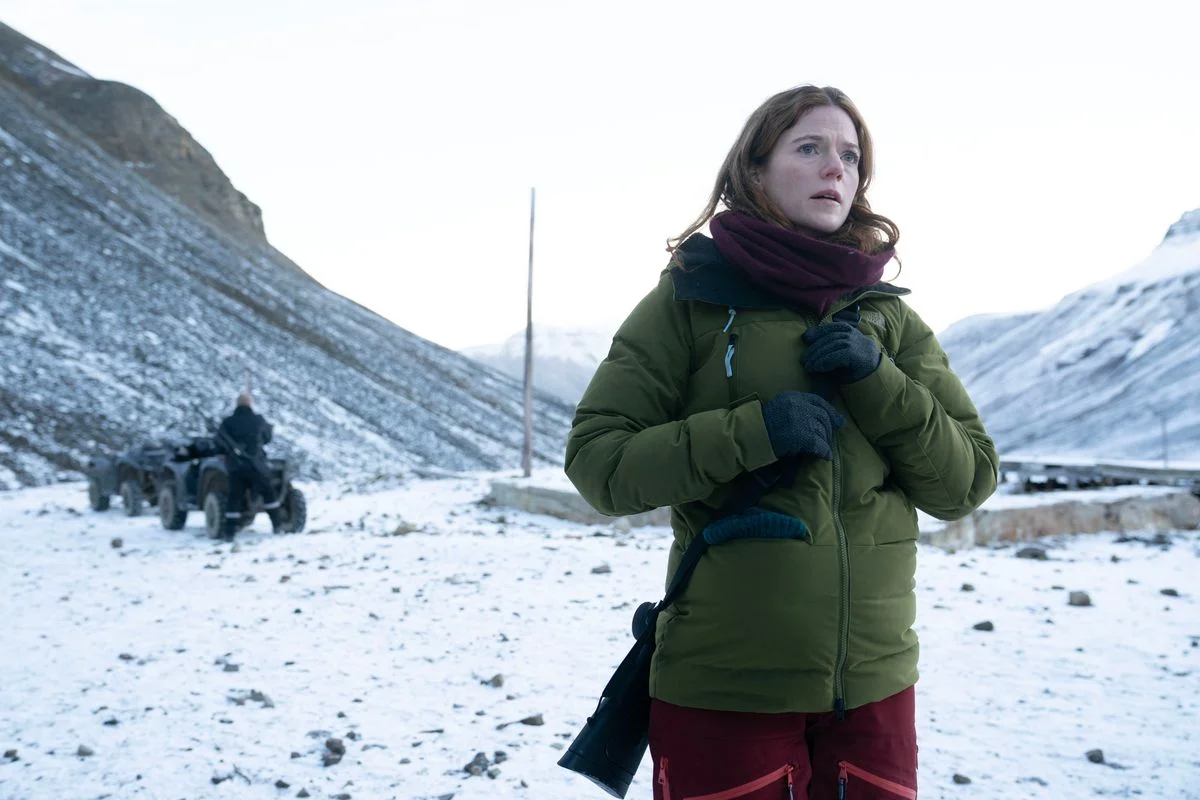
Season 3 relocates the series from the enclosed submarine of its first run and the drone-war terrain of its second to the Arctic Circle, recovering some of the geographical pressure that made its earliest episodes so effective. Svalbard offers remoteness without complete isolation. Russians, Norwegians, Britons and Chinese scientists occupy the same landscape while carrying incompatible versions of what that landscape is for. The ice, meanwhile, is disappearing beneath them.
Two Detectives, Two Political Realities
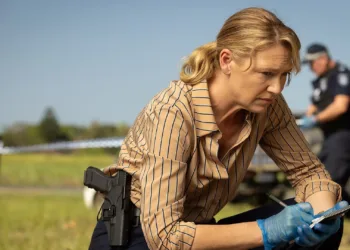
Amy Silva and Kirsten Longacre are married now, raising their family in Glasgow and briefly allowed the sort of domestic calm television usually grants detectives approximately three minutes before somebody phones about a corpse. This season separates them almost immediately. Kirsten is sent north to investigate Hodge’s death while Amy remains in Scotland.
The decision finally gives Rose Leslie’s Kirsten room to function outside Amy’s investigative shadow. In Svalbard, she enters a system where procedure is inseparable from diplomacy. Norwegian police chief Becken must treat British and Russian interests with carefully maintained equality, so Russian investigator Fyodor Zamorin joins the case.
That arrangement exposes one of the season’s sharpest ideas. Institutions perform neutrality through rules that cannot remove power from the room. Kirsten can question witnesses, examine evidence and follow Hodge’s movements, yet every step risks becoming a diplomatic statement. A bullet wound is evidence. Who fired the bullet may become foreign policy.
Zamorin is useful because the series refuses to leave him as a familiar Russian antagonist. His suspicion of his own side gives Kirsten an uneasy partner, and Tornike Gogrichiani plays his cooperation with enough reserve that trust never becomes simple. The tension sits in small exchanges rather than theatrical declarations of loyalty.
Amy’s supposedly safer assignment in Glasgow proves less peaceful. Her investigation leads to a scientist who has returned abruptly from Svalbard during a climate conference. Soon after Amy confronts him at his university, his laboratory explodes and climate activist Jason Collier runs from the scene.
The editing between Amy’s investigation and Kirsten’s Arctic inquiry lets the same political problem appear in two forms. Kirsten deals with governments trying to control information. Amy confronts public anger at the environmental consequences those institutions have spent years managing through speeches, targets and promises. One side has secure communications. The other has a bomb.
Who Owns a Melting Arctic?
Svalbard is especially effective terrain for Vigil because the season treats geography as property under negotiation. The land may belong to Norway, but Britain wants Shen Jia, Russia maintains Baltegrad, Chinese scientific interests are present, and every major actor seems interested in what lies beneath ice that is becoming less permanent each year.
Tom Edge builds the conspiracy around climate change, rare-earth resources and energy security. Shen’s samples matter because scientific knowledge has economic consequences. If Arctic resources can transform Britain’s energy supply, environmental policy immediately becomes entangled with extraction, ownership and national competition.
This is where the season’s political argument becomes stronger than its murder mystery. The climate crisis is routinely described by governments as a shared human emergency. Vigil imagines what happens when the possible solutions acquire strategic value. Cooperation quickly gives way to possession. Saving the planet remains admirable right up until somebody discovers something another state can monopolise.
The British covert mission makes that hypocrisy visible from the opening sequence. Officials can condemn hostile Russian activity while authorising their own clandestine operation inside demilitarised territory. Russia can invoke sovereignty while applying pressure of its own. Scientific research sits between both camps, valuable precisely because nobody is willing to leave it as science.
Shen Jia consequently carries a difficult symbolic burden. She is a scientist, a missing person and an object of state competition. The season is strongest when it recognises the discomfort in that position rather than turning her into a simple container for secret information.
The Russian material follows a similar path. Early armed confrontations flirt with the easiest contemporary espionage shorthand, complete with secretive forces and an enclave run by the formidable Mayor Korotayev. Zamorin disrupts that arrangement.
His presence allows suspicion to move through institutions rather than nationalities. That distinction matters in a political thriller made during a period when television can turn international conflict into moral colour coding with remarkable speed.
The Conspiracy Problem
Vigil wants viewers to distrust institutions, which is sensible. It also wants viewers to distrust nearly every individual produced by those institutions, which creates a structural problem.
Hodge’s murder leads to covert operations. Those operations lead to Shen Jia. Her research points toward energy interests. Amy’s investigation introduces environmental activism, a murdered scientist and the possibility of terrorism. Svalbard adds Russian political pressure, British secrecy and competing intelligence agendas. Each new disclosure is designed to rearrange the previous one.
For a while, that produces momentum. Kirsten cannot accept the obvious explanation for Hodge’s death because too many people benefit from closing the case quickly. Amy cannot treat Collier running from the laboratory as proof of guilt because the explosion arrives inside a much larger web of interests.
The difficulty appears once deception becomes the default state of every relationship. A suspicious official is no longer suspicious when every official is suspicious. A hidden allegiance loses force once the viewer has been trained to expect another one shortly afterward.
Season 1 had an elegant solution to this problem. Its submarine physically contained suspicion. Every lie made the same corridors feel tighter. Season 3 tries to recreate that sensation through Arctic remoteness, but Svalbard contains states, corporations, activists, soldiers, scientists and police forces rather than one crew. The scale gives the writers richer politics and messier drama.
There is also an unavoidable credibility strain in Kirsten’s role. Hodge’s death potentially exposes illegal military activity involving major powers, yet a civilian Scottish detective becomes one of the central figures handling the case.
The series acknowledges diplomatic interference, Russian participation and British pressure, but Kirsten still receives freedom that real intelligence machinery would probably suffocate under classification stamps. Television needs somebody who can enter the room and ask the impolite question. Apparently MI6 has outsourced this function to Glasgow.
Amy and Kirsten Against the Machinery
The relationship between Amy and Kirsten gives Season 3 something its conspiracies cannot manufacture: people whose motives remain legible. Suranne Jones plays Amy with the restraint of someone accustomed to performing authority while protecting vulnerability. Her university investigation shows that control physically.
She approaches a scientist expecting answers, then finds herself dealing with an explosion and a fleeing suspect. The sequence turns her local assignment into immediate danger without requiring Amy to suddenly behave like an action hero.
Rose Leslie receives the season’s larger shift. Kirsten enters Svalbard without Amy beside her and has to establish authority among Becken, Zamorin and representatives whose cooperation depends on political convenience. Leslie keeps Kirsten assured without making her invulnerable. Her conversations with Zamorin work because she neither embraces him as an ally nor performs constant hostility for dramatic effect.
Their marriage is similarly restrained. The series gives them domestic responsibilities, a young child and the strain of separation, yet avoids turning professional danger into manufactured romantic conflict. Television still has a habit of treating stable relationships as narrative emergencies requiring sabotage. Vigil lets two women remain married while the story finds its chaos elsewhere.
That choice also exposes a weakness. Amy and Kirsten are so functional together that the season sometimes gives their private life less dramatic texture than the institutions surrounding them. Their disagreements rarely threaten the relationship, and their competence can make them feel calmer than the world they inhabit.
Still, their stability has political meaning inside this particular story. Governments conceal operations. Military units disappear behind official denials. Scientific discoveries become bargaining chips. Police authority bends around international sensitivities. Amy and Kirsten remain comparatively transparent with each other because the series places intimacy on the opposite side of secrecy.
The most revealing contrast arrives every time the investigation pulls them away from home. Their family exists through ordinary commitments: childcare, work, trust, returning safely. Around them, states discuss survival through resources, borders and strategic advantage. One model of security requires possession. The other requires somebody to come home.
Vigil third season premiered on BBC One and BBC iPlayer on August 30, 2026. Detectives Amy Silva and Kirsten Longacre head to a remote Arctic research station on Svalbard to investigate the mysterious death of a British special forces soldier.
Where to Watch Vigil Season 3 Online


Full Credits
Title: Vigil Season 3
Distributor: BBC One, BBC iPlayer, Peacock
Release date: August 30, 2026
Rating: TV-MA
Running time: 60 minutes
Writers: Tom Edge
Producers and Executive Producers: World Productions, Simon Heath, Jake Lushington
Cast: Suranne Jones, Rose Leslie, Gary Lewis, Romola Garai, Dougray Scott, Amir El-Masry, Chris Jenks
The Review
Vigil Season 3
Vigil Season 3 finds fertile political territory in Svalbard, where melting ice, energy interests and covert military games turn environmental crisis into another arena for state power. Its best move is refusing to make national allegiance a moral shortcut, particularly through Kirsten's wary cooperation with Zamorin. Yet the season keeps burying those ideas beneath fresh conspiracies, until secrecy becomes routine rather than destabilising. Suranne Jones and Rose Leslie provide the steadiness the plot rarely permits itself, while the Arctic landscape gives the series back some of its lost sense of isolation.
PROS
- Striking Arctic setting
- Rich climate and energy politics
- Strong Jones and Leslie performances
- Zamorin complicates easy political binaries
- Effective parallel investigations
CONS
- Excessive conspiracy layering
- Twists lose their force
- Several geopolitical threads compete for space
- Investigative setup strains credibility