


























The most affecting choice Luchina Fisher makes is to let fear arrive through logistics. Stephen Chukumba worries about which dorm his son Hobbes will choose. Ed Diaz studies the reality of sending his daughter and her mother to Canada while he stays behind in Texas to settle family matters. Christoph Heizner faces a similar rupture in Arizona. The political threat is vast, but The Dads keeps bringing it back to forms, housing, passports, tuition, and the question of where a child can sleep without attracting danger.
That focus gives Fisher’s 72-minute documentary its emotional force. Policy becomes a bedroom left empty. A court ruling becomes a family divided across a border. The film understands that public hostility hurts through private rearrangement, one ordinary decision at a time.
Men Learning to Speak
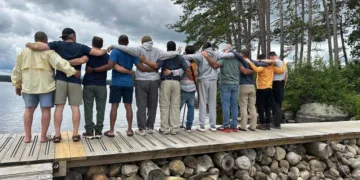
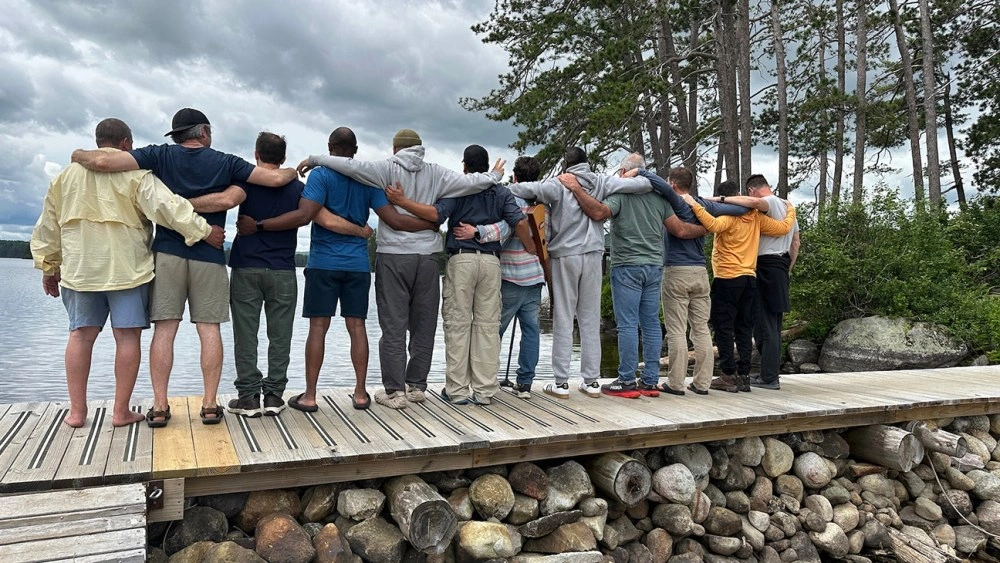
Fisher gathers the fathers in a setting built from familiar American masculinity: a lakeside retreat, fishing rods in hand, conversation moving at the pace of the water. The image could have been played as a neat joke about dads being dads. Instead, the activity gives these men somewhere to place their hands while they say things that still feel difficult.
Wayne Maines embodies that tension clearly. He has the reserve and outdoorsman comfort of someone who could disappear into a standard portrait of stoic fatherhood. His history with daughter Nicole changed that role. After hostility pushed the family out of Maine, protection stopped meaning quiet endurance and became public advocacy. Fisher watches him fish, listen, and speak with the measured caution of a man who learned that silence can leave a child exposed.
The retreat scenes carry the film’s warmest rhythm. Fathers admit confusion, describe the assumptions they had to unlearn, and give one another room to finish a thought. Some reached acceptance quickly. Others arrived through mistakes, fear, and correction. The variation matters because viewers may recognize themselves at different points along that path.
Vulnerability appears through pauses, lowered eyes, and the relief of hearing another father describe the same panic. Fisher’s camera stays close enough to catch the discomfort without punishing it. The emotion comes from watching men discover that listening is an action.
Home Starts Moving
Stephen and Hobbes provide the film with its gentlest relationship. Hobbes is calm about entering university and choosing a regular men’s dorm rather than LGBTQ+ housing. Stephen is less calm. His concern is visible in the way he circles the decision, trying to respect his son’s confidence while mentally scanning every possible risk.
Nothing disastrous happens at the dorm. That absence becomes quietly important. Hobbes’ peers may be kinder, or simply less interested in policing him, than the institutions shaping his father’s fears. Fisher finds hope here through uneventfulness. A young man goes to college. For once, ordinary life gets to remain ordinary.
Ed Diaz’s story moves in the opposite direction. His family’s plan to leave Texas for Canada turns safety into separation. Ed may have to remain in San Antonio while his daughter and her mother relocate, which means protecting his child requires surrendering daily proximity to her. His practical explanations already carry the wound.
Christoph Heizner’s situation in Arizona widens the pattern. Families are preparing to leave homes, jobs, schools, and support networks because the legal climate has made staying feel reckless. References to asylum and moves toward Canada, Australia, and Spain make the crisis feel dispersed across maps, yet Fisher keeps the pain anchored in individual households.
The strongest passages connect these decisions to footage recorded before and after the 2024 election. Earlier retreat conversations contain cautious faith that the political situation might stabilize. Later scenes are shaped by calculation. The fathers do not become different people. The country changes around them, and love is forced to become an exit plan.
Seventy-Two Minutes, Too Much Weight
The film’s urgency creates its main weakness. Fisher is carrying the retreat, several family histories, protests, legal developments, a college transition, and international relocation inside 72 minutes. The compression keeps the documentary direct, but it also cuts away from some of its richest material too soon.
The retreat could have supported a longer observational stretch. More time around the dining table or on the dock might have shown how trust forms between the men. The trans and gender-expansive children also remain secondary by design. That choice protects the father-centered perspective, yet it limits the film’s ability to show differences between the children’s experiences or the ways they interpret their parents’ fear.
Fisher avoids turning the documentary into a policy debate, which keeps the emotional line clear. Difficult medical and social questions remain outside the frame. The film is less interested in litigating identity than in showing what persecution does to families who have already answered the question that matters to them: this is our child, and we will protect them.
What stays with you is Stephen trying to let Hobbes walk into a normal dorm, Ed preparing to send his family across a border, and a group of fathers sitting beside a lake while learning how to say fear aloud.
The Dads premiered at the South by Southwest Film Festival on March 11, 2023, and is available for streaming on Netflix. The short documentary follows five fathers of transgender and LGBTQ+ children as they gather for a weekend fishing trip in rural Oklahoma alongside Dennis Shepard, exploring unconditional love and solidarity amid rising anti-trans legislation.
Where to Watch The Dads (2023) Online


Full Credits
Title: The Dads
Distributor: Netflix
Release date: March 11, 2023
Running time: 12 minutes
Director: Luchina Fisher
Producers and Executive Producers: Stephen Chukumba, Luchina Fisher, Dwyane Wade, Jon Marcus
Cast: Dennis Shepard, Stephen Chukumba, Frank Gonzales, Jose Trujillo, Peter Betz, Wayne Maines
Director of Photography (Cinematographer): andy robinson
The Review
The Dads
The Dads draws its deepest emotion from familiar acts: fishing beside another father, worrying over a college dorm, or packing up a family because home no longer feels safe. Luchina Fisher occasionally compresses too many lives and political developments into 72 minutes, leaving the retreat and the trans children themselves less room than they deserve. Still, the film turns parental fear into tenderness, solidarity, and determined action. Its hope feels fragile, which makes it honest.
PROS
- Vulnerable, candid fathers
- Strong retreat conversations
- Hobbes’ calm, affecting presence
- Personalizes political danger
- Hope grounded in solidarity
CONS
- Overloaded brief runtime
- Retreat footage feels rushed
- Children receive limited focus
- Some identity differences are flattened