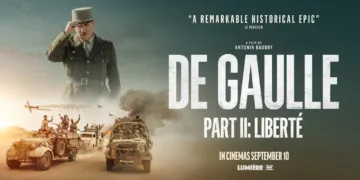


















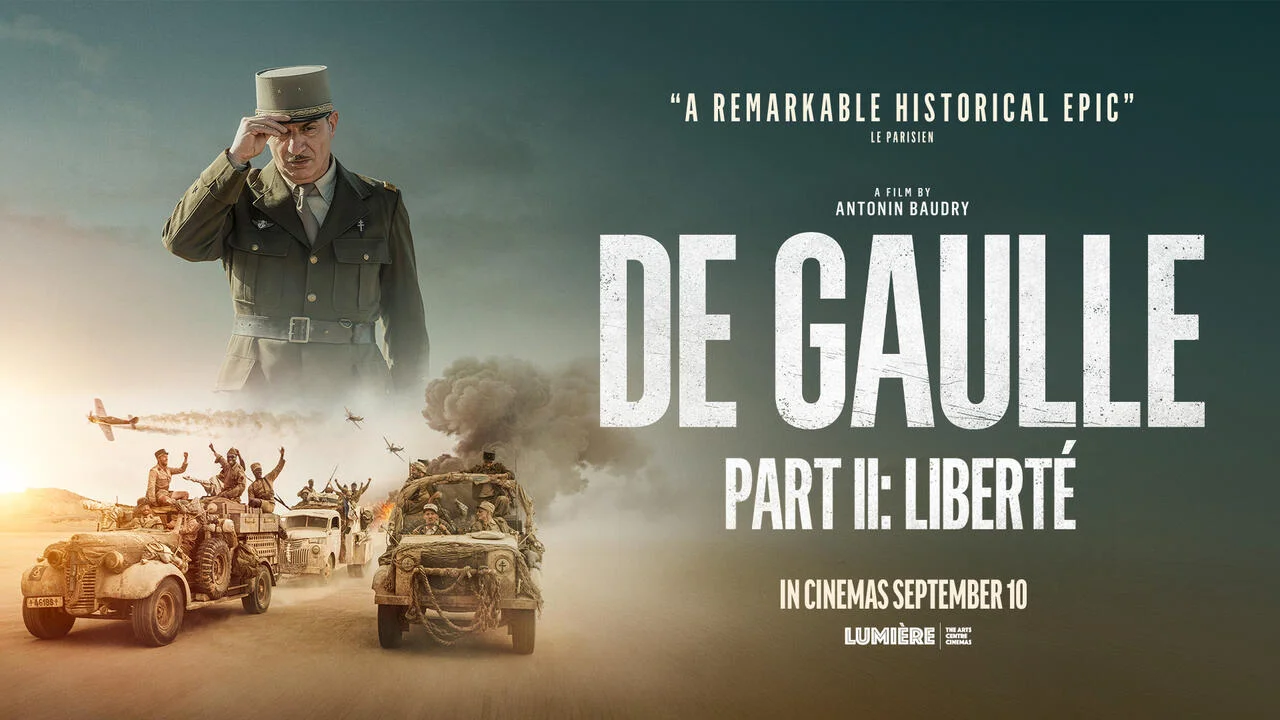

Roosevelt wants France managed. De Gaulle wants France recognized. Somewhere between those two positions, De Gaulle: Liberté discovers the war film it actually wants to be. Antonin Baudry’s second half of his Charles de Gaulle epic spends surprisingly little time treating German occupation as its central dramatic problem.
The Nazis remain the physical enemy, obviously, and people are still being arrested, shot at, hunted, and sent into battles they may not survive. Yet the film’s sharper conflict concerns legitimacy. Who gets to speak for France? Who gets to decide what France will look like after liberation? Can a country be rescued by allies who do not fully trust it to govern itself? This is sovereignty theater, and Simon Abkarian turns it into something close to political comedy.
His De Gaulle cannot enter a hotel room, conference hall, or military reception without first measuring the temperature of the insult awaiting him. A seating arrangement becomes strategy. A delayed invitation becomes evidence. An eavesdropping device in Casablanca confirms that even hospitality has terms attached. I initially took this hypersensitivity as one of the film’s comic exaggerations.
Then it becomes clear that De Gaulle has collapsed the distinction between his personal status and France’s national status. Offend him and, in his mind, you have downgraded France itself. That is absurd. It is also occasionally persuasive.
Baudry benefits from letting both ideas survive. Abkarian never smooths De Gaulle into a noble monument. He makes him prickly, manipulative, suspicious, vain, funny, and shrewd enough to understand that symbolism is political infrastructure. Thierry Lhermitte’s General Giraud learns this painfully.
De Gaulle appears willing to share authority with the American-backed rival, then works the arrangement until Giraud is politically displaced. The maneuver tells us far more about this version of De Gaulle than another battlefield speech could. He understands that power sometimes arrives disguised as etiquette.
The film enlarges that political struggle by cutting among three different forms of resistance. De Gaulle negotiates for legitimacy, Jean Moulin organizes the internal Resistance, and Philippe Leclerc fights across North Africa. The structure could have turned the film into three competing biographies stapled together by history. Baudry instead gives each strand its own physical grammar.
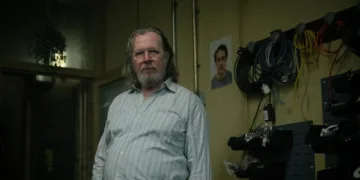
Moulin, known here as Rex, works through secrecy, persuasion, and the constant possibility of betrayal. Livia handles communications while danger closes around her. Their world is compressed, furtive, suspicious. Leclerc’s world runs in the opposite direction. It is open desert, moving vehicles, exposed bodies, tanks, distance. His battles cannot hide.
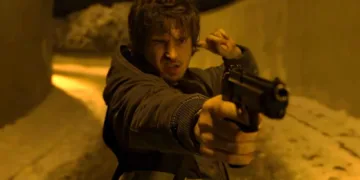
Niels Schneider thrives in that exposure. Leclerc emerges as the film’s great action figure because his conviction is expressed through movement rather than rhetoric. One of the defining images has him holding his cane aloft while explosions tear through the battlefield, waiting for the precise moment to order fire. It is blatantly heroic filmmaking, almost boyishly so, yet Schneider gives the gesture enough concentration that it registers as decision rather than pose.
Baudry clearly enjoys this mode. The desert campaign has the momentum of an old studio war picture, with military history converted into movement, danger, anticipation, and release. The sequel loses some of the intimate intrigue that made Résistance feel unpredictable, but it gains a sense of physical scale. Simon Russell Beale’s Churchill helps bridge those modes. His exchanges with De Gaulle bring the political scenes back down from marble-statue seriousness, usually through the mild British miracle of insulting someone while appearing to offer them tea.
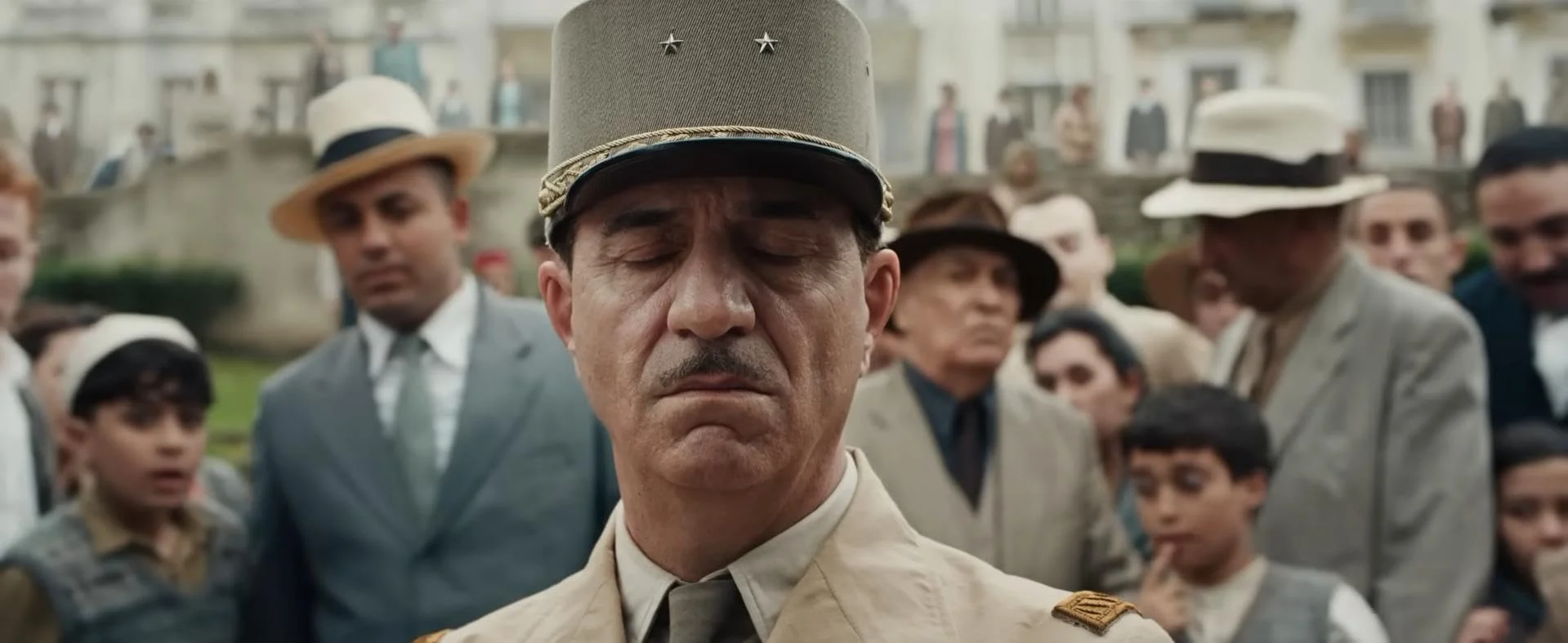
The film’s strongest idea, however, contains its most uncomfortable contradiction. Everything here is built around the sacred importance of French sovereignty. France must govern France. France must speak for itself. France cannot emerge from occupation only to become subordinate to another power. Baudry treats this principle with tremendous seriousness, and the American plans for postwar administration become evidence that military liberation and political freedom are not identical things.
Then the camera turns toward Leclerc’s forces and reveals African soldiers helping to liberate the country. The film acknowledges them, and their presence matters. It also gestures toward racism inside the Allied system. Yet acknowledgment is not perspective. The colonial troops are largely absorbed into the film’s idea of heroic France, serving a story about national self-determination without receiving comparable space for their own relationship to French rule.
I found myself resisting this criticism at first because the film is already carrying an enormous historical load. De Gaulle, Giraud, Roosevelt, Churchill, Moulin, Leclerc, the Resistance, North Africa, Paris. Asking one film to contain every contradiction of French political history can become a convenient way of reviewing a film that does not exist. But this contradiction is already inside the one Baudry made.
A film that argues so forcefully that domination remains domination when practiced by an ally invites the question back onto France. That does not invalidate its argument about American pressure. It makes the argument harder to contain. “Free France” becomes a phrase with unstable borders, especially once men from French colonies are asked to bleed for it.
The treatment of the internal Resistance creates a related compression. Moulin’s efforts to unite competing factions give the film another version of sovereignty politics, this time at home, but ideological differences are often converted into obstacles for the narrative to overcome rather than political struggles deserving equal weight. Unity makes terrific drama because it points toward liberation. Disagreement is messier. History usually is.
Paris is where all these lines are supposed to converge. Leclerc advances, Livia takes up arms, De Gaulle’s political campaign acquires visible meaning, and the long argument over who represents France finally reaches the city itself. Baudry makes an interesting choice by folding archival footage into the liberation rather than staging every beat as blockbuster spectacle. I admire the instinct. It gives history a texture the recreation cannot manufacture. I am less certain it gives the film the climax it has spent two and a half hours promising.
The street fighting feels comparatively brief, and the archival material introduces a strange friction between cinematic momentum and historical record. Perhaps that friction is appropriate. Liberté has spent its running time converting history into narrative certainty, then real images arrive and remind us that history is stubbornly less obedient.
That may be why the later Churchill-De Gaulle coda feels unnecessary. Their volatile affection has already supplied some of the film’s best comedy and political tension, but the liberation itself offers the cleaner break. Extending the relationship afterward softens an ending that had already reached its emotional pressure point.
Still, the larger unresolved question survives that extra scene. De Gaulle spends the film insisting that no outside power has the right to decide what France is, and Baudry believes him. What the film is less comfortable asking is who, inside France’s own story, was allowed to make the same demand.
De Gaulle: Liberté was released in theaters in June 2026 and is distributed by Pathé. As the second installment of the biographical war epic, the film follows Charles de Gaulle as he navigates high-stakes political maneuvers, Allied diplomacy, and the path toward the Liberation of France.
Where to Watch De Gaulle: Liberté (2026) Online
Full Credits
Title: De Gaulle: Liberté
Distributor: Pathé Films
Release date: June 26, 2026 (France)
Running time: 2 hours 39 minutes (159 minutes)
Director: Antonin Baudry
Writers: Antonin Baudry, Bérénice Vila
Producers and Executive Producers: Jérôme Seydoux, Ardavan Safaee, Axelle Boucaï
Cast: Simon Abkarian, Anamaria Vartolomei, Niels Schneider, Mathieu Kassovitz, Thierry Lhermitte, Félix Kysyl, Simon Russell Beale
The Review
De Gaulle: Liberté
De Gaulle: Liberté turns diplomacy, battlefield action, and resistance politics into a muscular historical epic without sanding De Gaulle into a saint. Simon Abkarian’s prickly performance and Niels Schneider’s commanding Leclerc give the film much of its force, while Baudry’s cross-cutting keeps its huge canvas moving. Its defense of French sovereignty becomes less comfortable once colonial troops enter the frame, a contradiction the film sees without fully confronting. The liberation of Paris also lands with less force than the buildup promises.
PROS
- Abkarian’s sharp, difficult De Gaulle
- Schneider’s forceful Leclerc
- Strong political and military cross-cutting
- Energetic desert action
- Smart use of Churchill for comic relief
CONS
- Colonial perspective remains limited
- Internal Resistance politics feel compressed
- Paris climax is comparatively muted
- Final coda weakens the ending