

























![Kingdom Hearts Collection [I-III] Review](https://gazettely.com/wp-content/uploads/2026/10/Kingdom-Hearts-Collection-I-III-1-360x180.webp "Kingdom Hearts Collection [I-III] Review: KHII Holds Steady as Newer Entries Fluctuate 37")





A woman can reject marriage, demand a profession, defend another woman’s right to practice medicine, and still believe that a wealthy merchant remains beneath her because he was born into the wrong class. The Doll understands this contradiction better than almost anything else. Izabela Łęcka’s rebellion has boundaries, and those boundaries make her far richer than the straightforward feminist heroine the series could easily have produced.
Izabela wants to write, travel to Paris, and escape the marriage market that treats her future as another family asset. Sandra Drzymalska gives that resistance a brittle energy. Izabela can confront her father over the fortune he has squandered, challenge relatives eager to arrange her life, and involve herself in Dr Zofia Dobska’s fight for professional legitimacy.
Yet she remains perfectly capable of reproducing the hierarchy that limits her. When Stanisław Wokulski’s money brings him closer to her social circle, she reminds him that wealth cannot make him equal to the aristocracy. When she realizes his feelings make him financially useful, she encourages her father to borrow from him. Marianna, meanwhile, becomes a potential spy. Freedom, apparently, is easier to demand than to distribute.
That tension gives this new adaptation of Bolesław Prus’s novel its strongest cultural argument. Izabela can recognize the absurdity of a social order that restricts women without recognizing how deeply she has internalized its assumptions about class. The Zofia storyline makes the distinction especially sharp. After Stasia dies following the emergency delivery at the debutante ball, Zofia faces arrest despite her practical medical experience.
Izabela uses noble connections to help secure her release, then seeks assistance at the Russian embassy, where Aleksandr mocks the idea of a woman practicing medicine. Wokulski later pays him to obtain the necessary diploma. Zofia gains her credential, but the mechanism granting it is hardly liberating: aristocratic influence decides who receives recognition, while money can quietly purchase what principle cannot secure.
Wokulski repeatedly occupies that uncomfortable space between progress and purchase. Tomasz Schuchardt plays him as a man whose confidence evaporates at precisely the wrong moments. Around business, gambling, investment, and negotiation, Wokulski can dominate a room.
Around Izabela, he studies women’s publications, practices English, questions Marianna about her tastes, changes his furniture, and has clothing prepared for a social meeting. These gestures are tender until their cumulative effect becomes unsettling. He does not merely want Izabela to like him. He tries to engineer the conditions under which liking him might become possible.
The irony is that Wokulski represents a social order far better equipped for the future than the aristocracy he idolizes. He returns to Warsaw with substantial wealth, defeats Baron Krzeszowski at cards, entertains Julian Ochocki’s interest in aircraft, and opens a department store illuminated by electricity. Around him, noble families pawn silverware, conceal debts, fail to pay servants, and gamble away resources they can no longer replace. He can help modernize Warsaw, yet he keeps asking a decaying elite for permission to belong.
The Doll becomes most persuasive when those ideas emerge from action. Tomasz Łęcki returning home drunk with a horse while his household slips into insolvency says plenty about aristocratic decline without a lecture. The servants demanding unpaid wages make the same point from below.
Izabela watching her father squander the proceeds from pawned silverware turns economic collapse into familial humiliation. Wokulski’s glittering new department store supplies the counterimage: capital, technology, commerce, and invention are moving forward while hereditary prestige keeps insisting that birth remains the only credential that counts.
The series occasionally loses confidence in that material and begins explaining itself. Conversations about women’s rights, Western medicine, class position, and scientific progress sometimes articulate tensions the characters have already demonstrated through behavior. The production has enough dramatic machinery to trust those contradictions without translating all of them into argument.
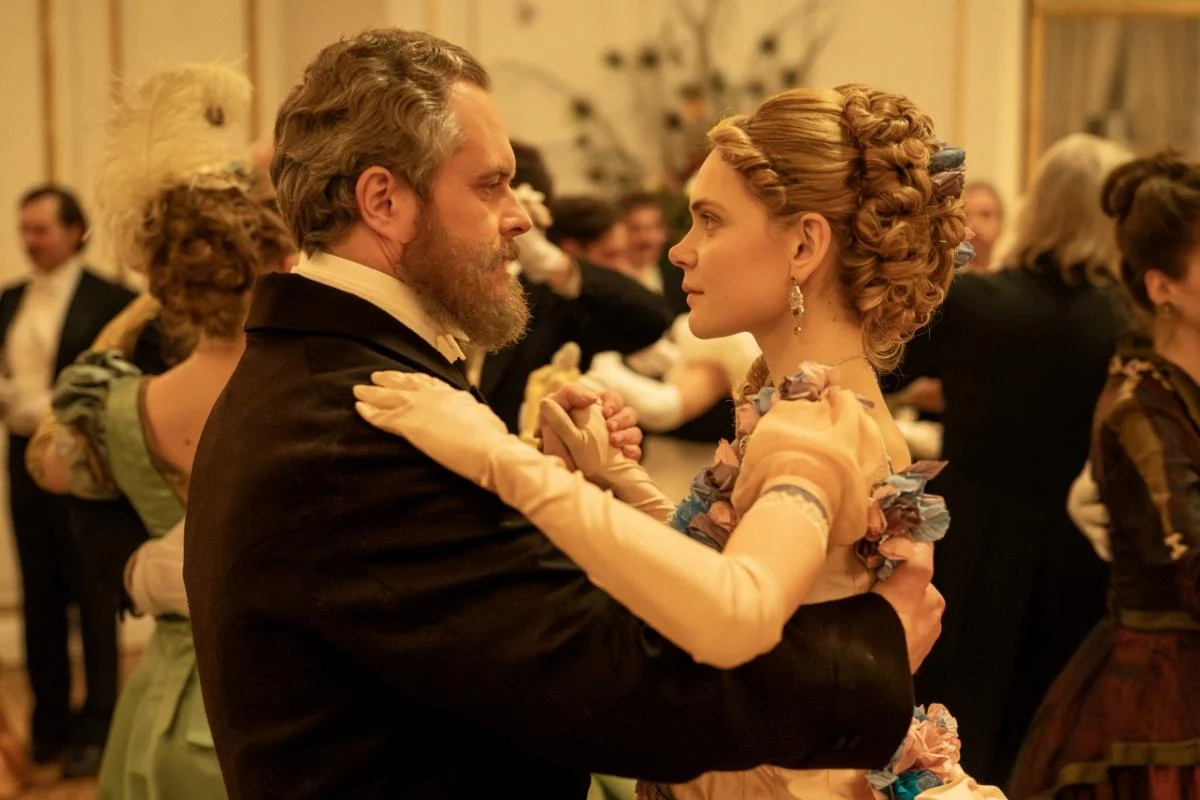
Paweł Maślona’s direction works best when it does. The aristocratic interiors, elaborate gatherings, department store, and divisions between noble and servant life give Warsaw a hierarchy that can be seen as well as discussed. Dreamlike passages loosen that rigid surface, particularly Izabela’s erotic dream about Wokulski, which admits an attraction her conscious behavior keeps trying to discipline.
Drzymalska makes those reversals readable without smoothing them out. Izabela can move from interest to contempt with startling speed because both reactions are genuine. She wants what Wokulski represents and recoils from what his presence threatens to reveal about her own values.
Schuchardt gives the relationship its complementary discomfort. Wokulski’s devotion never becomes cleanly heroic because he keeps translating feeling into acquisition. He buys the Łęcki silverware, enters Tomasz’s financial affairs, gathers information through Marianna, and spends freely to resolve problems surrounding Izabela. His generosity has consequences, but so does his conviction that enough effort and money should eventually produce intimacy.
The arson investigation is less assured. The destruction of Łęcki’s construction venture gives the early episodes urgency, and Inspector Klejn’s investigation places Wokulski under suspicion once a witness produces a sketch resembling him. Yet the mystery struggles to compete with the stranger question already sitting between Izabela and Wokulski. Each has something the other needs. Each also embodies a social principle the other mistrusts. Supporting characters such as Zofia, Ochocki, and Kazimiera Wąsowska strengthen the series when they sharpen those pressures rather than pulling attention toward another strand.
By the time Wokulski’s electric chandelier illuminates his new store, The Doll has already made its most effective argument without needing to state it. The future is glowing above his customers’ heads. Wokulski can finance it, build it, and switch it on, while still looking across the room for approval from people whose world is going dark.
The Doll premiered worldwide on Netflix on September 16, 2026. The Polish-language limited drama series follows an ambitious merchant who builds a massive fortune in an effort to win the heart of an impoverished aristocratic woman.
Where to Watch The Doll Online


Full Credits
Title: The Doll
Distributor: Netflix
Release date: September 16, 2026
Rating: TV-MA
Running time: 50 minutes per episode
Director: Paweł Maślona
Writers: Paweł Maślona, Paweł Demirski, Jagoda Dutkiewicz
Producers and Executive Producers: Akson Studio, Michał Kwieciński, Jan Kwieciński
Cast: Sandra Drzymalska, Tomasz Schuchardt, Dariusz Chojnacki, Jacek Braciak, Julia Wyszyńska, Magdalena Cielecka
The Review
The Doll
The Doll finds its sharpest drama in the collision between Izabela’s desire for independence and her loyalty to the class system that restricts everyone beneath her. Sandra Drzymalska and Tomasz Schuchardt make that contradiction emotionally credible, while the series turns money, medicine, technology, and social rank into parts of the same argument. Some dialogue explains pressures already visible on screen, and the arson mystery rarely matches the central relationship for tension. Still, its portrait of a fading aristocracy confronting a modernizing Warsaw has considerable bite.
PROS
- Drzymalska’s layered performance as Izabela
- Rich class and gender tensions
- Wokulski’s unsettling mix of devotion and acquisition
- Strong use of period spaces and social hierarchy
- Modernization themes grounded in concrete events
CONS
- Social themes can become overly explicit
- Arson investigation lacks equal dramatic weight
- Some secondary threads compete for attention







