




























Adolescence in Their Town is a rehearsal conducted under hostile conditions. Abby has been cast as a popular girl, a loyal girlfriend, an ambitious daughter, and Emily Webb in her school’s production of Our Town. Each role comes with an audience waiting to correct her.
Her boyfriend Tyler dropping out of the play one week before opening night creates a theatrical emergency, yet the deeper rupture is personal. His departure signals that he has begun imagining college as a life from which Abby can be removed.
Drama teacher Mr. Elliot replaces him with Matt, a quiet student who joined the production to paint scenery rather than stand beneath the lights. The choice has the arbitrary energy of a teacher solving one problem by creating three others. Matt barely knows the lines, Abby does not know him, and neither student appears interested in becoming the other’s emotional rescue project.
Katie Aselton directs this setup without manufacturing adolescent hysteria. The school play supplies pressure rather than spectacle. Mark Duplass’s script uses Thornton Wilder’s text as a social mirror: a drama about ordinary lives becomes the setting in which two teenagers begin questioning the identities their town has written for them.
A Mother’s Version of Security
Abby’s claim that she is her own person begins to fracture when she takes Matt home to rehearse. Tyler is already there, seated comfortably with her mother Janet, as if Abby’s relationship has become a household asset requiring adult management. Janet urges her daughter to keep him, treating his popularity and future prospects as protection against the disappointments she associates with life in Bangor.
The argument that follows gives the film its sharpest account of inherited fear. Janet’s advice sounds cruel because it is delivered through control, yet Kim Shaw reveals the panic beneath it. She has confused romantic attachment with economic and social stability, then passed that confusion to her daughter as practical wisdom. Her mistake belongs to a culture that asks young women to preserve promising men while calling the sacrifice maturity.
Ora Duplass handles Abby’s changing posture with remarkable precision. Her confidence collapses in stages: irritation at Tyler’s presence, embarrassment when Janet speaks in front of Matt, anger when her mother dismisses her judgment, then the wounded haste of leaving the house. Matt overhears the quarrel from another room, a staging choice that denies Abby privacy at the exact moment her public identity is coming apart.
The scene refuses the comforting fiction that adults enter family conflicts carrying superior knowledge. Janet is older, frightened, and wrong. Abby’s instincts are less polished, yet far clearer.
The Town After School
Matt’s home reverses Abby’s domestic situation. He lives in a large colonial house filled with space and very little company. His father Anthony appears through daily video calls from abroad, where he spends time with his partner Wei. Daveed Diggs gives these calls warmth and comic ease, especially when parental concern collides with Matt’s embarrassment over having Abby nearby. Affection survives the distance, but the empty rooms still register its cost.
An old preschool yearbook reveals that Abby and Matt once knew each other well. Photographs and drawings restore a shared history neither had retained, turning their evening into a reunion without nostalgia’s usual polish. Their connection does not arrive as destiny. It develops through the relief of discovering that intimacy may have existed before school hierarchies taught them how to misread each other.
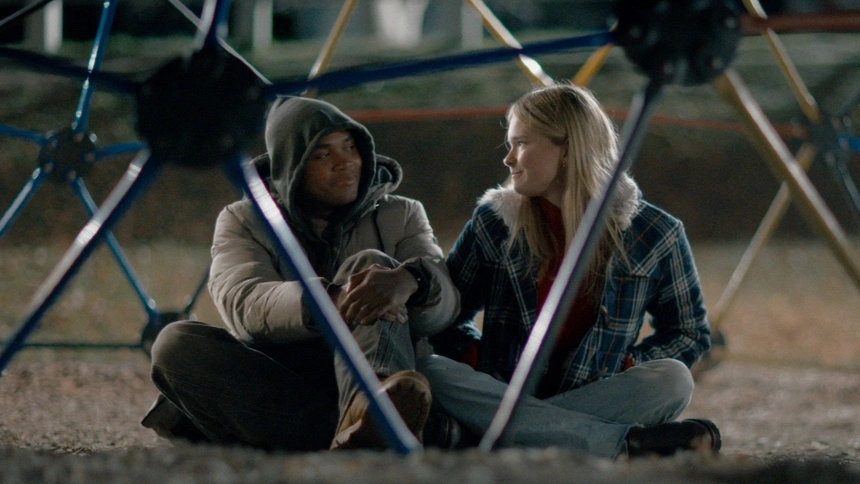
From there, Their Town settles into a loose rhythm of walking, talking, attempting to rehearse, and abandoning the lines when real life becomes harder to avoid. Bangor’s streets, Gloria’s taco truck, a fenced preschool, and a playground become temporary spaces outside parental expectation and school reputation. Sarah Whelden’s cinematography keeps the autumn air crisp and the interiors slightly shadowed, allowing the city to feel inhabited rather than packaged as quaint New England scenery.
At the taco truck, Abby speaks Spanish with Gloria while Matt watches, curious and uncertain about what may be said about him. Chosen Jacobs lets the moment play across his face before giving it language. His restraint works against Abby’s instinct to fill silence, and their chemistry grows through this imbalance. She performs ease. He studies it. Each gradually recognizes the effort in the other’s behavior.
Pain Beneath Performance
The swing-set conversation gives Aselton’s direction its finest sustained passage. The camera moves gently with Abby and Matt as their talk shifts between humor, attraction, family history, and emotional distress. The physical rise and fall of the swings keeps the scene from becoming static, while the pauses allow each disclosure to alter the space between them.
Matt’s history of depression, self-harm, and suicidal thinking introduces the film’s least assured material. The disclosure explains his family’s earlier departure from Bangor and his guarded return, but it arrives with a degree of narrative force the preceding scenes have carefully avoided. The screenplay has allowed Abby’s conflict with Janet to emerge through behavior, interruption, and embarrassment. Matt’s crisis is delivered with greater explicitness, leaving Jacobs to carry information that needed earlier dramatic preparation.
Anthony’s long absences also become harder to accept once the severity of Matt’s recent condition is clear. The affectionate video calls establish love, yet they cannot settle the practical question of why he has been left alone in such a large house. The film appears aware of the emotional contradiction without fully confronting the parental decision behind it.
Its stronger instinct returns through the school play. Abby and Matt use rehearsal as a protected form of confession, speaking borrowed lines while testing the possibility of being seen without the identities assigned to them. The stage does not cure their loneliness or repair their families. It asks each young actor to remain present while another person speaks, a modest discipline that many adults in their lives have failed to learn.
Their Town premiered at the South by Southwest Film Festival on March 14, 2026, and is available through independent festival circuits. The teen dramedy follows two high school students who spend a long night wandering their small town, examining their futures and unearthing surprises from their past after an unexpected casting change in the school play.
Where to Watch Their Town (2026) Online
Full Credits
Title: Their Town
Distributor: Duplass Brothers Productions
Release date: March 14, 2026
Running time: 80 minutes
Director: Katie Aselton
Writers: Mark Duplass
Producers and Executive Producers: Katie Aselton, Mary Budd, Jay Duplass, Mark Duplass, Mel Eslyn, Shuli Harel
Cast: Ora Duplass, Chosen Jacobs, William Atticus Parker, Kim Shaw, Jeffrey Self, Daveed Diggs, Leonardo Nam
The Review
Their Town
Their Town treats adolescence as a struggle against identities inherited from parents, partners, classmates, and social rank. Ora Duplass and Chosen Jacobs give its long conversations an alert, tender intimacy, while Katie Aselton lets Bangor’s homes, streets, and playgrounds carry the history between them. Matt’s mental health disclosure arrives with less care than the earlier family material, yet the film recovers through its stage scenes, where performance becomes permission to speak honestly. This is small-town cinema with clear eyes and an open hand.
PROS
- Natural chemistry between the leads
- Ora Duplass’s emotionally precise performance
- Patient, intimate direction
- Strong mother-daughter argument
- Expressive Bangor locations
CONS
- Matt’s depression storyline feels abrupt
- Questions around Anthony’s absence
- Mr. Elliot leans toward caricature
- Late dramatic escalation strains the tone