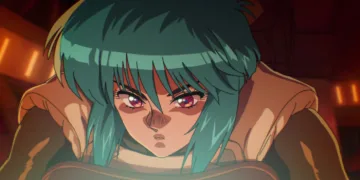








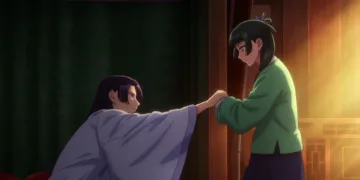




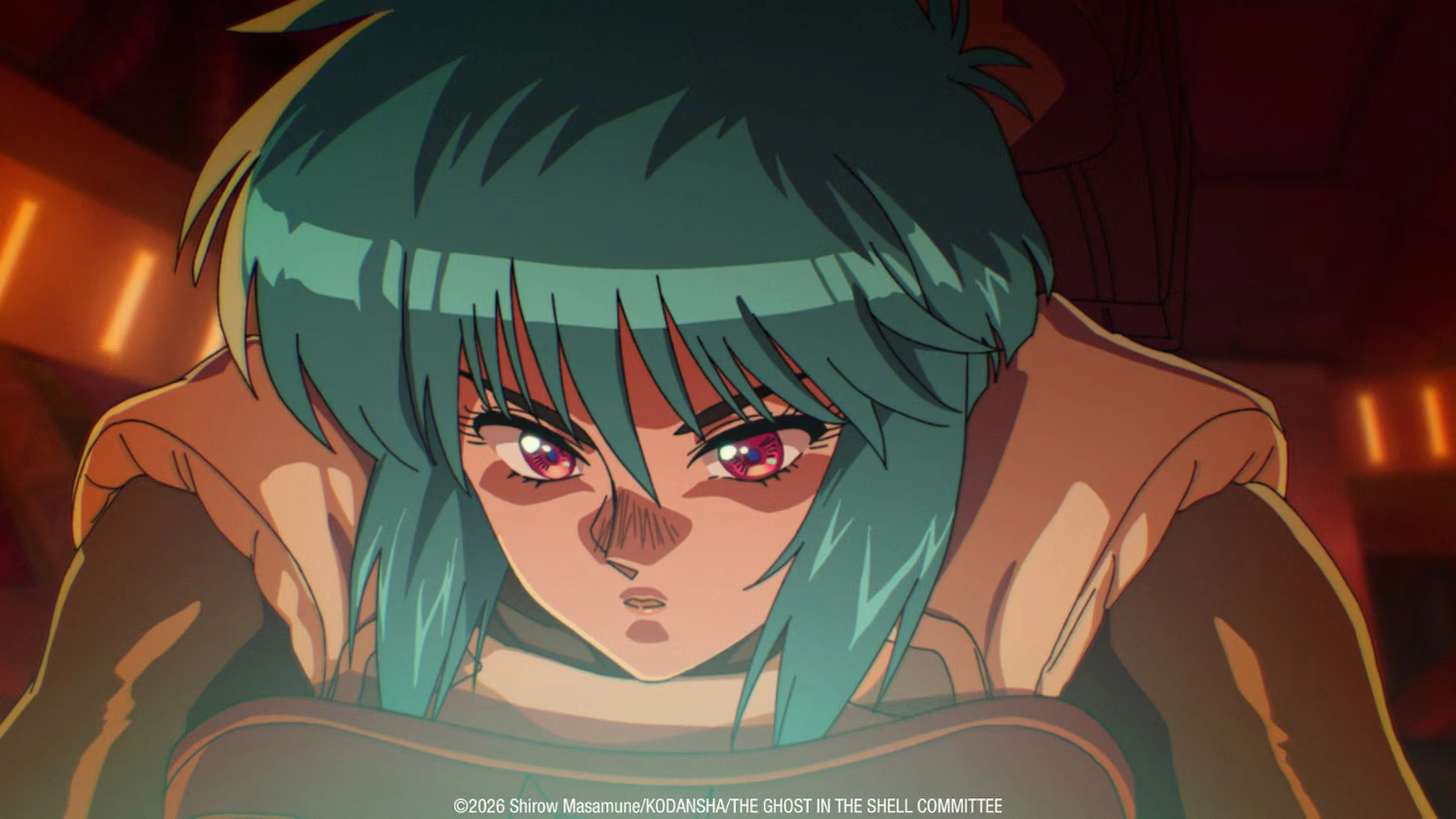

Motoko Kusanagi kills a bureaucrat before Science SARU pauses to explain what a ghost is. She slips through a police operation, watches a corrupt Far East Trade Representative hide behind jurisdiction, then executes him under an authorized order and leaves Aramaki with one brief glimpse of blue hair. It is fast, rude, and faintly funny. The sequence tells us exactly which version of Motoko has entered the room.
Mamoru Oshii’s 1995 film turned Masamune Shirow’s manga into austere cyberpunk scripture. Its silence, rain, and philosophical weight shaped decades of later adaptations. Science SARU goes back to Shirow’s pages and restores the grin that screen versions kept filing away.
This Motoko laughs, loses her temper, needles Batou, and treats official authority like a technical fault waiting to be exploited. Suzie Yeung voices her with quick shifts between command, irritation, and delight, which helps every exchange feel slightly dangerous before the guns arrive.
The clearest joke comes after the mission, when the Minister of Internal Affairs scolds Motoko for her team’s disorderly methods. She responds by hacking his cyberbrain and forcing him to punch himself. The gag is childish, invasive, and perfectly suited to a series about bodies that can be remotely controlled. Science SARU gets a laugh while planting the episode’s nastiest idea. Efficient television. Terrible workplace culture.
Section 9, Still Under Construction
The premiere wisely treats Public Security Section 9 as a crew being assembled rather than a legendary unit arriving fully formed. Motoko proposes the organization, Aramaki is told to manage it, and the team immediately behaves like a group that has skipped orientation. Batou can keep pace with Motoko’s sarcasm. Togusa looks capable until a Fuchikoma chase sends him crashing. Ishikawa becomes a warning sign when a Ghost Controller seizes his cyberbrain and turns an ally into a threat.
That loose chemistry gives the episode its comic rhythm. Conversations run a half-step ahead of procedure, and the characters keep bickering while the mission becomes increasingly ugly. The humor does not erase the danger. It makes the danger feel less ceremonial. When Ishikawa is hacked, the scene lands because the team’s casual familiarity has already made his body feel like part of a shared space. Watching that body get repurposed is violation in mechanical form.
The supporting cast remains thinly drawn after one episode, yet each member gets a functional introduction through action. Togusa’s failed escape establishes vulnerability. Ishikawa’s takeover demonstrates the enemy’s reach.
Batou’s exchanges with Motoko suggest intimacy built through long exposure to her worst impulses. Aramaki’s brief look at Motoko after the opening execution positions him as the adult who has realized the new department may need stronger insurance. A team can survive bullets. The paperwork might kill them.
Retro Color, Modern Velocity
Science SARU’s visual design refuses the cold gray palette many viewers associate with this franchise. Character faces stretch, eyes flare, limbs snap through poses, and saturated machinery sits comfortably beside sunlight and cherry blossoms. One early image places bright red robotic devices beneath falling petals, a composition that treats technology as part of the environment rather than an alien layer pasted over it. The future looks lived in, messy, and occasionally cheerful.
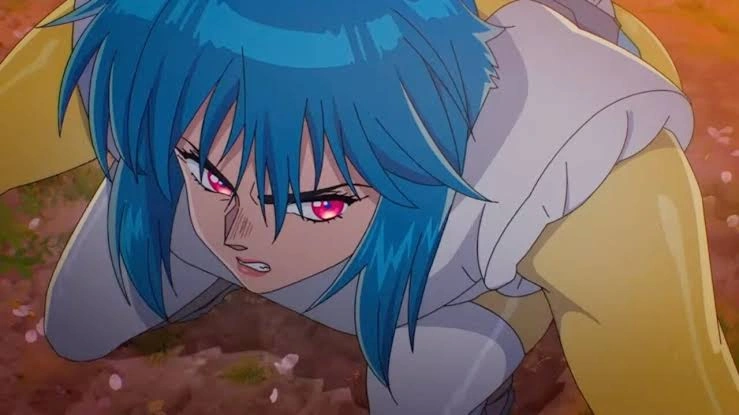
Cyberpunk has discovered daylight. The approach fits Motoko’s restored personality. Her irritation reads through her entire body, and her pleasure in outsmarting an opponent becomes visible before she says a word. The animation lets comedy and action share the same physical language. A broad reaction can pivot into gunfire without making either beat feel imported from another show.
That flexibility is tested during the Sacred Citizen Relief Center operation. Through hacked cameras, Section 9 sees children performing happiness for surveillance while hunger and punishment continue behind the performance. One boy has his food stolen, cannot keep working, and is tased before being removed. His escape triggers the mission’s chase, which sends Togusa after him in a Fuchikoma and exposes the Controller’s ability to invade cyberbrains.
The action tightens once Motoko is hacked and forced toward a cliff. She breaks free, ejects, and uses a dummy target to bait the Controller into revealing himself. By the time he understands the trap, an invisible Motoko has shot both his legs and is demanding the Ghost key. The sequence is cleanly staged, with each tactical decision following from the previous failure. Its operatic score lends scale, while the editing keeps the geography readable. The show has speed without visual panic, a skill many action series misplace somewhere between storyboard and final render. Then the blood pixels hit the bright palette, and the joke sharpens its teeth.
No Manual Included
The premiere’s weakest choice is its faith that every viewer will sprint alongside it. Ghosts, Ghost Controllers, Ghost keys, cyberbrains, Fuchikomas, ministries, and jurisdictional disputes arrive with little pause. Longtime fans can fill the gaps from earlier versions. Newcomers may spend half the episode wondering which noun can hack which other noun.
There is value in refusing a lecture. The world feels established because characters speak as if they live there, and the episode avoids turning Motoko into a tour guide for her own profession. The problem is accumulation. Terms arrive during gunfights, political negotiations, and rapid mission briefings, so confusion can interrupt tension at the exact moment tension should take control.
The episode also ends just as Section 9’s internal shape becomes interesting. After the Relief Center mission and the minister confrontation, Motoko rejects the idea of becoming a compliant Public Safety errand girl. Her rebellion gives the unit a purpose beyond assignment work, yet the credits arrive before that conflict can breathe. A two-episode premiere would have allowed the team’s comic energy and the wider cybercrime plot to settle into each other.
The escaped boy’s final exchange with Motoko reveals why the series deserves that space. He asks if Section 9 will save the other children. She refuses the comforting answer and tells him to make his own future. It is cruel, practical, and politically revealing. The state can dismantle a controller, seize a Ghost key, and call the operation successful while the institution harming those children remains larger than the mission. Motoko can hack a minister into punching himself. Saving everyone is apparently outside the budget.
The cyberpunk anime series premiered on Prime Video on July 7, 2026, offering global audiences a brand-new adaptation available for streaming directly on the platform. Set in a highly technological metropolis in 2029, the premise follows the elite cyber-security task force Section 9 as they investigate dangerous instances of cyberterrorism and political corruption.
Full Credits
Title: The Ghost in the Shell
Distributor: Prime Video
Release date: July 7, 2026
Rating: TV-MA
Running time: 23 minutes per episode
Director: Mokochan
Writers: Toh Enjoe, Masamune Shirow
Producers and Executive Producers: Kengo Abe, Kohei Sakita
Cast: Maaya Sakamoto, Kazuhiro Yamaji, Hiroki Yasumoto, Yuichi Nakamura, Kosuke Goto, Toru Nara, Marie Ooi, Tomoko Kaneda
Director of Photography (Cinematographer): Science SARU Photography Department
Editors: Science SARU Editing Department
Composer: Taisei Iwasaki, Yuki Kanasaki, Ryo Konishi
The Review
The Ghost in the Shell
Science SARU gives The Ghost in the Shell its grin back. Motoko’s temper, the team’s chaotic chemistry, and the manga-faithful retro design make the premiere feel loose, fast, and alive. The Sacred Citizen Relief Center mission proves the sillier tone can coexist with cyberbrain horror and institutional cruelty. Its one real obstacle is onboarding: the episode throws ghosts, keys, controllers, and Fuchikomas at newcomers with the confidence of someone skipping page one of the manual. Still, this is a thrilling reset with personality to spare.
PROS
- Expressive, mischievous Motoko
- Fluid and colorful animation
- Strong manga-faithful tone
- Sharp action-comedy balance
- Energetic team chemistry
CONS
- Dense opening exposition
- Limited supporting characterization
- Premiere ends too quickly
- Newcomer-unfriendly terminology