































Cleaning the second shelf of a refrigerator should feel like a minor household task. From the height of a sentient piece of sushi, it becomes an expedition across stained plastic, discarded food, and mold that keeps reclaiming neglected corners. Rubel Games builds Moldwasher around this shift in scale, turning ordinary kitchen fixtures into compact stages where cleanliness offers both the objective and the spectacle.
The premise draws from two recognizable design traditions. Its pressure-washing loop belongs to the Western cleaning simulator, where progress is measured through dirt disappearing from a surface. Its protagonist, food-shaped shopkeeper, decorative stickers, and pastel bedroom carry the playful character language associated with Japanese mascot culture. The combination works because neither side feels ornamental. The tiny nigiri changes how levels are built, while the cute presentation softens mechanics that might otherwise resemble digital housework.
The campaign lasts roughly four hours, with separate jobs set across refrigerator shelves, windows, drawers, counters, and the sink. Each one is short enough to complete without fatigue. Nearby parts of the kitchen remain visible beyond the current cleaning zone, so the stages still feel connected to a single contaminated home.
Mold That Refuses to Behave
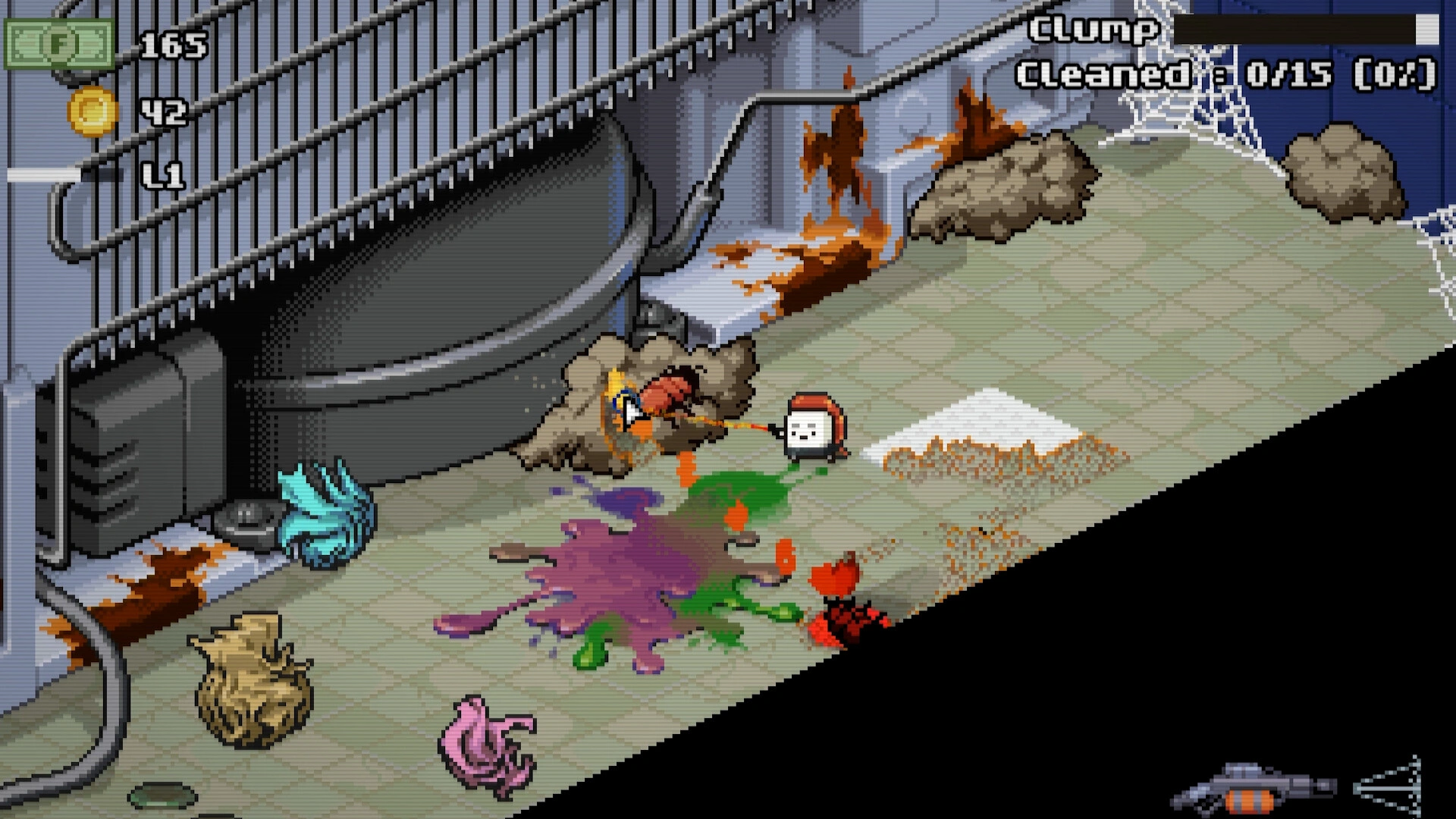
The pressure washer provides an immediate and readable pleasure. Directing its stream across a dark patch reveals the clean surface beneath, pixel by pixel. The contrast between contaminated and restored areas is clear, and the washer’s hiss gives each pass a physical texture that the simple graphics cannot supply alone.
Mold slowly grows back when it is ignored. This small rule gives the cleaning process a tactical rhythm. Spraying randomly across a wide surface creates fresh problems behind the player, especially before the washer’s pressure and cleaning radius have been upgraded. A methodical sweep works better. Players who want less resistance can activate Zen mode, which reduces the speed of regrowth without removing the satisfaction of clearing a level.
Pressing Tab highlights remaining grime in bright pink, an essential feature once a stage reaches its final few percentage points. Cleaning games often turn their last stain into an accidental hidden-object puzzle. Moldwasher recognizes the problem and lets the player expose it instantly.
Later tools keep the campaign from becoming a continuous exercise in holding down the spray button. The leaf blower moves loose debris that water cannot remove. A pickaxe or axe breaks hard obstructions. The flamethrower burns webs and dense piles of rubbish, replacing the washer’s gentle sweep with a short burst of destruction. Each tool occupies a specific cleaning role, and required equipment is identified before the player enters a mission.
Money earned from completed jobs pays for new tools and permanent improvements to pressure, range, radius, and efficiency. Replaying a stage grants the same reward, so a poor purchase never damages the save permanently. Buying every basic tool before chasing upgrades is still the sensible approach, since locked equipment can block access to later jobs.
Souvenirs From the Filth
Between assignments, the nigiri returns to a bedroom that serves as shop, gallery, and reward space. The Hot Dog Man sells equipment, extending the game’s food-character joke without burying the player in dialogue. Decorations collected during jobs can be placed around the room, allowing a plain hub to fill with stickers, soundtrack discs, VHS tapes, crystals, and other curiosities.
Several items reveal how freely the art direction moves between cultural references. A sticker resembles the exhausted expression of Gudetama, while bismuth and opal decorations bring bright mineral shapes into a room filled with retro electronics. These objects do not build a conventional story, yet they create a playful identity for the protagonist through accumulation.
Hidden dirty objects and 27 Steam achievements encourage careful exploration. Stronger tools also make revisiting early stages quicker. The reward systems become less reliable once completion replaces simple progress as the main goal.
Collectible tracking can be unclear, and the gachapon machine gives weak feedback about what remains missing. A late red-canister tool is introduced without the dedicated teaching mission provided for earlier equipment, leaving its purpose unusually obscure.
A reported problem in the beef-monster stage can halt a playthrough completely. The failure is especially disruptive in a game whose compact campaign depends on a smooth chain of small victories.
Lo-Fi Restoration
Pixel art proves well suited to cleaning because every removed cluster of grime creates a visible change. Mold appears in several patterns, including a galactic variation that turns contamination into something strangely decorative. Refrigerators, coffee machines, and sinks loom over the sushi protagonist, while insects and moving nuisances give certain levels a flicker of unpredictability.

The lo-fi soundtrack establishes a calm pace without dissolving into featureless ambience. New tracks can be collected and played in the bedroom, linking audio directly to exploration. Each tool has its own sound profile, from the washer’s steady hiss to the harsher ignition of the flamethrower, and those differences make switching equipment feel substantial.
Where larger cleaning simulators turn restoration into lengthy labor, Moldwasher treats it as a series of small rituals. Its brief length limits the value for players seeking dozens of hours, yet the narrow scale protects the game from exhausting its joke or its mechanics. A piece of sushi, a filthy refrigerator, and a pressure washer are enough to make one quiet afternoon feel unusually productive.
The Review
Moldwasher
Moldwasher borrows the familiar satisfaction of modern cleaning simulators, then filters it through pixel art, miniature spaces, and distinctly playful Japanese food imagery. The pressure washer, leaf blower, pickaxe, and flamethrower give its compact stages enough mechanical variety to sustain the short campaign, while the bedroom hub and collectibles create a gentle rhythm between jobs. Weak tracking, an unexplained late tool, and occasional technical trouble dull the final stretch, yet the game’s modest scale suits its easygoing character.
PROS
- Satisfying cleaning feedback
- Charming pixel-art presentation
- Useful tool variety
- Relaxed lo-fi soundtrack
- Compact, well-paced stages
CONS
- Short campaign
- Weak collectible tracking
- Poorly explained late tool
- Reported progression bugs